
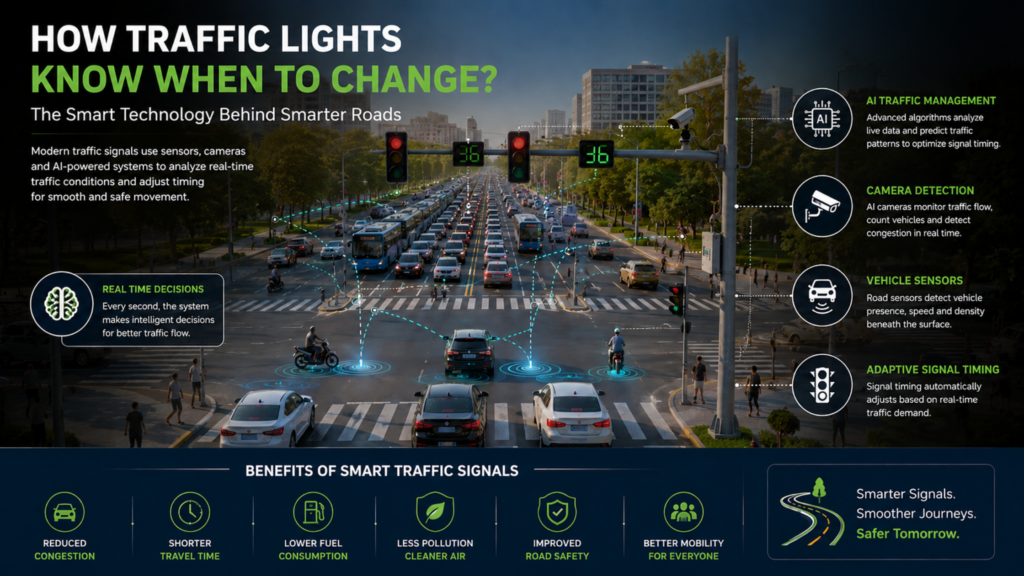
Understanding How Traffic Lights Know When to Change helps explain why modern cities are investing heavily in intelligent traffic infrastructure.
You’re sitting at a red light.
There are no cars around.
No pedestrians crossing.
No visible reason to wait.
Yet the signal refuses to change.
Ever wondered why?
Most people assume traffic lights simply run on timers. But that’s only part of the story.
In reality, understanding How Traffic Lights Know When to Change reveals a fascinating world of sensors, data, cameras, artificial intelligence, and intelligent transportation systems working behind the scenes every second.
Most drivers never notice this, but modern traffic signals are becoming increasingly intelligent. They don’t just control traffic—they observe it, analyze it, and respond to it.
And as India moves toward smarter cities and connected transportation networks, traffic signals are evolving faster than ever before.
How Traditional Traffic Lights Worked
For decades, traffic lights operated using fixed timers.
The concept was simple.
- Green for a set amount of time.
- Yellow for a few seconds.
- Red for another set duration.
Then repeat.
Think of it like a kitchen timer.
Regardless of whether there were two vehicles or two hundred vehicles, the signal followed the same schedule. This approach worked reasonably well when traffic volumes were lower and road networks were less complex. However, cities have changed dramatically.
Vehicle ownership has increased. Road usage patterns vary throughout the day. And fixed timing systems often struggle to keep up.
Why Fixed Timers Create Traffic Problems
Imagine a busy intersection during rush hour. One road has hundreds of vehicles waiting while the crossing road has almost no traffic, yet both roads receive the same signal time. It doesn’t seem very efficient, does it? This is one of the biggest limitations of traditional fixed-timer traffic signals.
These systems cannot react to real-world traffic conditions and treat every moment exactly the same. However, roads are constantly changing. Morning traffic patterns are different from afternoon traffic, weekends behave differently than weekdays, and special events can create sudden congestion in unexpected areas. But here’s the interesting part-modern traffic management systems can detect these changes automatically.
Instead of following a rigid schedule, they analyze live traffic conditions and adjust signal timings accordingly, making intersections far more efficient and responsive. This is where things start getting much smarter.
How Traffic Lights Know When to Change Using Sensors
When discussing How Traffic Lights Know When to Change, sensors are often the first piece of the puzzle.
Hidden beneath roads or installed near intersections, sensors continuously monitor vehicle movement.
These sensors can detect:
- Vehicle presence
- Vehicle count
- Traffic density
- Queue length
- Waiting times
When enough vehicles accumulate at a signal, the system recognizes demand and adjusts signal timing accordingly. Think of it as a receptionist managing appointments. The more people waiting, the faster adjustments are made to improve flow.
What happens next is surprisingly smart.
The signal controller processes incoming data and determines the most efficient timing sequence for that specific moment.
Cameras and Vehicle Detection Systems
Sensors are not the only technology involved. Many modern intersections now use advanced Vehicle Detection Systems and intelligent cameras. These systems provide a broader view of traffic conditions.
Instead of monitoring a single lane, cameras can analyze:
- Multiple traffic lanes
- Turning movements
- Pedestrian crossings
- Traffic congestion levels
- Emergency vehicle priority
Using computer vision technology, cameras help signals understand what is happening across an entire intersection. Cameras also play a significant role in determining How Traffic Lights Know When to Change, especially at high-volume intersections where traffic patterns change rapidly.
This improves traffic flow and enhances road safety.
In many smart city deployments, camera-based monitoring works alongside other intelligent traffic systems to create a comprehensive traffic management solution.
How Traffic Lights Know When to Change Through AI-Based Smart Traffic Signals
As artificial intelligence evolves, How Traffic Lights Know When to Change is becoming increasingly predictive rather than reactive.
- This is where things get fascinating.
- Traditional traffic signals react.
- AI-powered signals predict.
Modern Smart Traffic Signals use artificial intelligence and machine learning to analyze traffic patterns continuously. Rather than relying solely on current traffic conditions, AI systems can learn from historical data.
They recognize patterns such as:
- Morning rush hours
- School traffic
- Weekend congestion
- Festival-related traffic spikes
- Event-based road usage
This allows signals to make smarter decisions. Instead of waiting for congestion to occur, they can proactively optimize traffic flow. AI Traffic Management is rapidly becoming a cornerstone of modern transportation infrastructure worldwide.
How Smart Cities Use Intelligent Traffic Systems
In smart city projects, How Traffic Lights Know When to Change is integrated with larger Intelligent Traffic Systems to improve mobility and reduce congestion.
India’s Smart City initiatives are accelerating the adoption of Intelligent Traffic Systems. Traffic signals are no longer isolated devices. They are becoming connected components within a larger transportation ecosystem.
These systems often integrate with:
- Smart Traffic Signals
- Variable Message Signs (VMS)
- Traffic Monitoring Cameras
- Highway Automation Solutions
- LED Display Systems
Together, they create a connected environment where traffic information can be collected, analyzed, and communicated in real time. This helps cities improve mobility while reducing congestion and improving safety.
Organizations such as the Smart Cities Mission are actively promoting technology-driven urban infrastructure development.
Benefits of Adaptive Traffic Signals
One of the biggest advantages of adaptive traffic systems is their ability to improve How Traffic Lights Know When to Change based on real-time traffic conditions. Instead of relying on fixed schedules, these systems continuously analyze vehicle movement, traffic density, and waiting times to optimize signal timing. This not only reduces congestion and travel delays but also demonstrates how How Traffic Lights Know When to Change has evolved from simple timers to intelligent, data-driven decision-making systems that support safer and more efficient roads.
Benefits include:
- Reduced congestion
- Shorter waiting times
- Improved fuel efficiency
- Reduced emissions
- Better road safety
- Enhanced travel experience
For drivers, the difference is noticeable.
- Less waiting.
- Smoother traffic flow.
- Fewer unnecessary stops.
And ultimately, a more efficient transportation network.
Future of Traffic Management in India
The future of How Traffic Lights Know When to Change will likely involve connected vehicles, predictive analytics, and AI-driven traffic optimization.
India is undergoing one of the world’s largest infrastructure transformations.
Projects led by organizations such as Ministry of Road Transport & Highways (MoRTH) and National Highways Authority of India (NHAI) are increasingly incorporating intelligent technologies into transportation infrastructure.
The future will likely include:
- Connected intersections
- AI Traffic Management
- Predictive traffic systems
- Vehicle-to-infrastructure communication
- Real-time data sharing
- Autonomous mobility integration
Traffic signals will continue evolving from simple controllers into intelligent decision-making systems.
How Intelligent Infrastructure Is Changing Roads
At Vulcan Advance Intelligence Computing Pvt. Ltd., we see this transformation happening every day. Road infrastructure is no longer limited to physical roads, signs, and signals. It now includes intelligent communication systems capable of collecting data, providing real-time information, and supporting safer mobility.
Technologies such as Smart Traffic Signals, Variable Message Signs (VMS), intelligent displays, and connected transportation systems are helping cities become more responsive and efficient.
The objective is simple:
- Safer roads.
- Smarter mobility.
- Better communication.
Because modern transportation isn’t just about moving vehicles. It’s about moving information.
Conclusion
The future of How Traffic Lights Know When to Change will likely involve connected vehicles, predictive analytics, and AI-driven traffic optimization. The next time you’re waiting at a traffic signal, remember that much more is happening than a simple timer counting down.
- Sensors may be tracking traffic flow.
- Cameras may be analyzing congestion.
- AI systems may be predicting traffic patterns.
And intelligent transportation networks may be coordinating multiple intersections simultaneously. Understanding How Traffic Lights Know When to Change reveals just how sophisticated modern traffic management has become. One day, traffic lights may not just react to traffic—they may predict it before it happens.

