
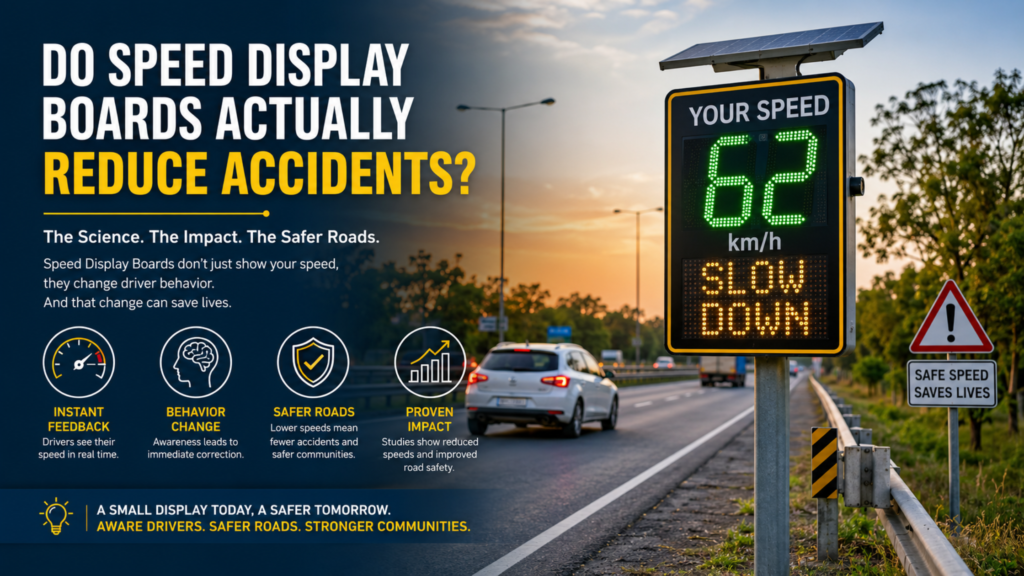
Do Speed Display Boards Actually Reduce Accidents? It’s a question many traffic planners, highway authorities, and drivers ask as roads become increasingly dependent on intelligent transportation systems.
You’re driving down a familiar road. The traffic is light. The weather is clear. There’s no visible danger ahead. Without realizing it, your speed slowly increases. Then suddenly, a bright digital display flashes your current speed.
“78 km/h”
Almost instantly, you ease off the accelerator.
- No police officer.
- No fine.
- No warning.
- Just a number on a screen.
Strange, right?
Yet this simple interaction is exactly why Speed Display Boards are becoming increasingly common on highways, urban roads, school zones, construction areas, and smart city projects around the world.
But here’s the big question:
Do Speed Display Boards Actually Reduce Accidents?
The answer might surprise you.
Why Drivers Often Ignore Speed Limits
Most people believe accidents happen because drivers intentionally break the rules.
In reality, that’s not always true. Many drivers exceed speed limits without realizing it.
Why?
Because humans naturally adapt to their environment.
- A wide road feels safer.
- Less traffic feels safer.
- Familiar routes feel safer.
As a result, drivers often drive faster than intended.
This is known as “speed adaptation.”
The brain becomes comfortable and stops actively monitoring speed. Most people don’t know this, but simply seeing your speed displayed in real time can interrupt this behavior almost immediately. That’s where Speed Display Boards become effective.
How Speed Display Boards Work
A Speed Display Board is an intelligent traffic device that detects approaching vehicle speeds and instantly displays them to drivers.
Most systems use:
- Radar sensors
- Speed detection technology
- LED display systems
- Real-time processing
When a vehicle approaches, the system measures its speed and displays it on a bright digital screen.
Some systems also show:
- Warning messages
- Flashing alerts
- Speed limit reminders
- Color-changing notifications
The process happens within seconds.
- No intervention required.
- No enforcement required.
- Just instant driver awareness.
The Psychology Behind Speed Display Boards
Here’s where things get interesting.
Speed Display Boards don’t physically force anyone to slow down. They simply make drivers aware of their actions. And awareness changes behavior.
Think about fitness trackers.
People often walk more steps simply because they can see their step count. The same principle applies here. When drivers see their actual speed displayed in front of them, they immediately compare it with what they believe their speed should be. That moment of awareness often leads to voluntary speed correction. In many cases, drivers slow down without even consciously thinking about it.
That’s the power of behavioral feedback.
Do Speed Display Boards Actually Reduce Accidents on Highways?
Research and traffic studies from different countries consistently show that Speed Display Boards help reduce average vehicle speeds.
Lower speeds generally mean:
- Better reaction times
- Shorter stopping distances
- Reduced collision severity
- Improved pedestrian safety
Even small speed reductions can significantly impact accident outcomes.
For example:
A vehicle traveling slightly slower has more time to react to:
- Sudden braking
- Pedestrians
- Road hazards
- Unexpected traffic conditions
This doesn’t mean Speed Display Boards eliminate accidents completely. However, they help create safer driving environments by influencing behavior before incidents occur. And prevention is always better than response.
Why Modern Roads Need More Than Signboards
Traditional speed limit signs provide static information. Drivers see them once and often forget about them.
Speed Display Boards are different. They create interaction.
Instead of simply saying: “Speed Limit 60”
They say: “You are currently driving at 74.”
That’s personal. That’s immediate. And that’s why they tend to be more effective. Modern transportation infrastructure increasingly depends on intelligent communication systems rather than static information.
- Roads are becoming smarter.
- Communication is becoming real-time.
- And drivers are responding better because of it.
How Intelligent Traffic Systems Improve Safety
Speed Display Boards are only one part of a much larger transformation happening in transportation infrastructure.
Today’s intelligent traffic systems include:
- Variable Message Signs (VMS)
- Vehicle Actuated Speed Displays (VASD)
- Smart Traffic Signals
- AI-Based Traffic Monitoring
- Real-Time Communication Systems
Together, these technologies help road networks become more responsive and adaptive. Instead of reacting after incidents occur, infrastructure can now influence driver behavior proactively.
At Vulcan Advance Intelligence Computing Pvt. Ltd., intelligent display technologies are designed to support this shift toward smarter, safer, and more connected mobility infrastructure.
The goal is simple:
- Improve communication.
- Improve awareness.
- Improve safety.
The Future of Road Safety Is Intelligent
A few years ago, road safety mainly relied on enforcement.
- More signs.
- More monitoring.
- More penalties.
Today, the focus is shifting toward communication. Infrastructure is becoming intelligent enough to interact with drivers in real time.
Imagine roads that can:
- Detect speeding vehicles
- Display dynamic warnings
- Adjust messaging based on conditions
- Communicate instantly with drivers
The future of transportation isn’t just about building roads. It’s about building roads that think. And Speed Display Boards are one of the simplest examples of that future already in action.
So, Do Speed Display Boards Actually Reduce Accidents?
The evidence suggests they help.
Not because they punish drivers.
Not because they enforce laws.
But because they increase awareness. And awareness changes behavior. Sometimes the most effective safety solution isn’t a barrier, a camera, or a fine. Sometimes it’s simply showing people information at exactly the right moment. That small digital display on the side of the road may look simple. But its impact on driver behavior can be surprisingly powerful.
Frequently Asked Questions
Do Speed Display Boards Actually Reduce Accidents?
Yes. Studies and real-world deployments indicate that Speed Display Boards help reduce vehicle speeds, improve driver awareness, and contribute to safer road environments.
How do Speed Display Boards work?
They use radar-based sensors to detect vehicle speed and instantly display it on an LED screen visible to approaching drivers.
Where are Speed Display Boards commonly used?
They are commonly installed on highways, school zones, urban roads, construction sites, residential areas, and smart city infrastructure projects.
What is the difference between a Speed Display Board and a speed camera?
A Speed Display Board provides real-time feedback to drivers, while a speed camera is primarily used for monitoring and enforcement purposes.

