
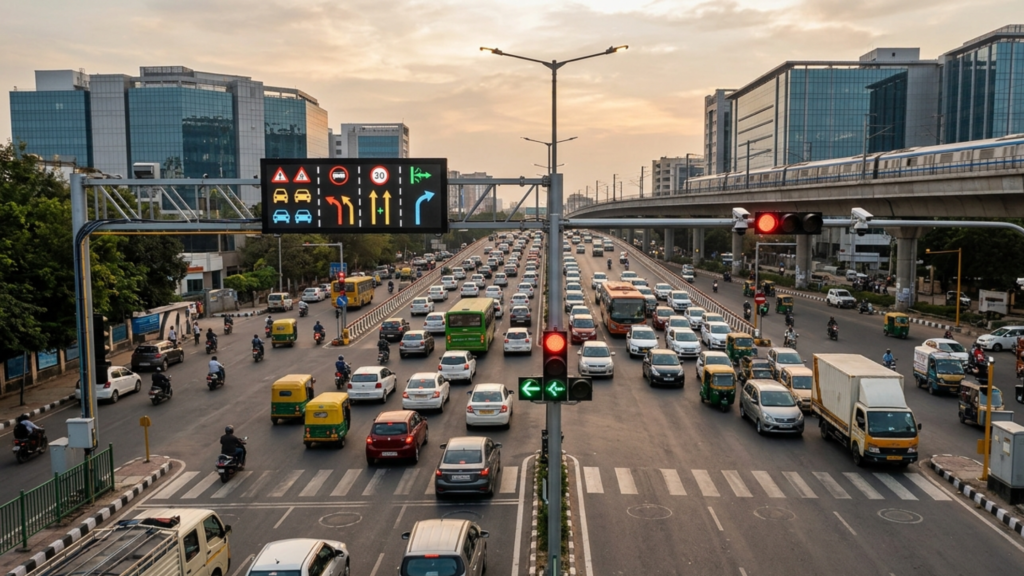
You’re already late. You reach a signal. It turns red. No cars on the other side. No movement. Just you… waiting.
10 seconds. 20 seconds. 60 seconds.
At this point, it’s not just a traffic light. It feels personal. If you’ve ever thought, “Why is this signal not changing?” – you’re not alone. Almost every driver in India has felt this frustration.
But the reality is more interesting than it seems.
Why Traffic Signals Feel So Random
In many Indian cities, traffic lights don’t always “see” what’s happening on the road. A large number of signals still work on fixed timers.
That means:
- The signal doesn’t care if the road is empty
- It doesn’t adjust for real-time traffic
- It simply follows a preset cycle
So even if you’re the only car waiting, the system won’t react. And that’s exactly why it feels so irritating.
But That’s Not the Full Story
Things are changing.
Modern traffic systems in India are slowly becoming smarter, especially in metro cities and highways.
Here’s how signals are starting to “understand” traffic:
1.Sensors That Detect Vehicles
Some roads now have sensors installed beneath the surface.
These sensors can:
- Detect if vehicles are waiting
- Measure traffic load
- Trigger faster signal changes when needed
So instead of blindly following a timer, the signal responds to real conditions.
2.Cameras That Watch Traffic Flow
Those cameras you see at intersections are not just for challans.
They help monitor:
- How long the queue is
- How fast vehicles are moving
- Whether congestion is building
Based on this, the system can adjust signal timing.
3.Smart Traffic Systems (The Game Changer)
In advanced setups, signals are connected to a central system.
This system:
- Collects data from multiple roads
- Analyzes patterns
- Adjusts signals across the city
So instead of one signal working alone, everything becomes connected.
Companies like Vulcan Advance Intelligence Computing Pvt. Ltd. are working on such intelligent systems in India, helping roads move from fixed timing to real-time decision-making.
Then Why Do You Still Get Stuck?
Even with better technology, traffic in India has its own challenges.
Mixed Traffic Reality
Cars, bikes, autos, buses, pedestrians—everything moves together.
This makes it harder for systems to predict flow accurately.
Signal Jumping & Lane Cutting
Let’s be honest.
When people:
- Cross before green
- Block intersections
- Ignore lanes
It disrupts the entire system.
Even the smartest signal can’t fix human behavior instantly.
Overloaded Roads
Many roads are carrying more vehicles than they were designed for.
So even if signals are optimized, congestion still builds up.
The Role of Smart Displays You See on Highways
Have you noticed digital boards on highways showing messages like:
- “Accident Ahead”
- “Slow Down”
- “Diversion”
These are part of a smarter ecosystem. Known as Variable Message Signs (VMS), they help drivers react early instead of suddenly braking.
Solutions developed by companies such as Vulcan Advance Intelligence Computing Pvt. Ltd. are designed to provide real-time updates, reducing confusion and improving traffic flow before you even reach a signal.
The Future of Traffic in India
The goal is simple: fewer unnecessary stops.
In the coming years, traffic systems in India will:
- Predict jams before they happen
- Adjust signals automatically
- Communicate with vehicles
This means less waiting, less frustration, and smoother journeys.
Final Thought
That moment when you sit at a red light with no traffic – it feels pointless. But it’s not always broken. Sometimes it’s just outdated. And slowly, that’s changing. India’s roads are moving from fixed signals to intelligent systems. It won’t happen overnight, but the shift has already begun. So the next time you’re stuck at a signal, remember:
It’s not just a delay.
It’s a system in transition.

