
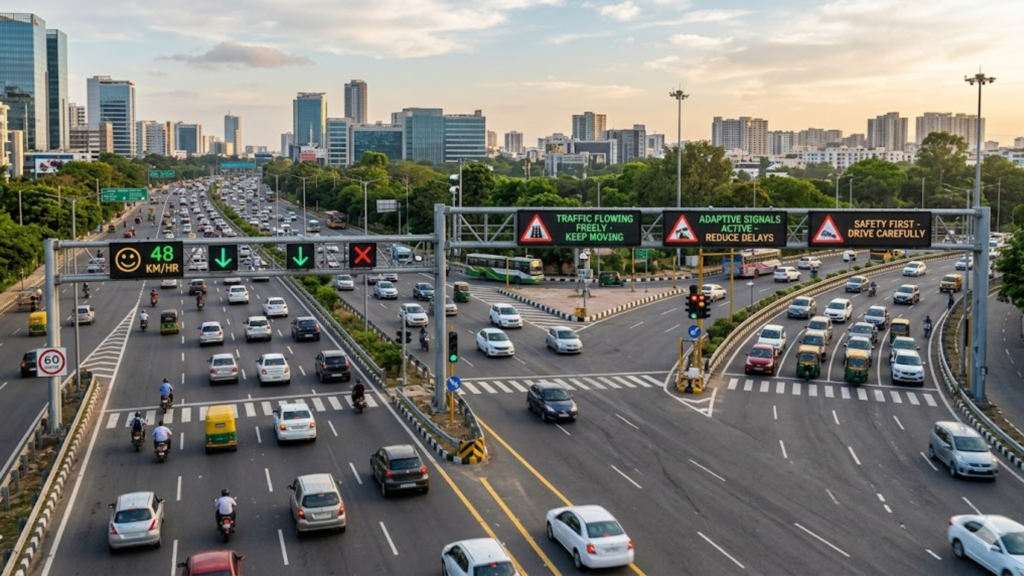
Every day, the things you see on roads daily guide your journey without you even realizing it.
Traffic signals change, digital boards display messages, and lane markings keep vehicles in order. Everything feels routine. But behind this everyday experience lies a system designed to manage movement, improve safety, and reduce confusion.
Let’s take a closer look at the things you see on roads daily-and how they are evolving into smarter systems.
1.Things You See on Roads Daily: Traffic Signals That Feel Random-but Aren’t
Almost everyone has experienced this.
You’re waiting at a red light. There’s no traffic on the other side. Yet, the signal doesn’t change.
It feels inefficient. Sometimes even frustrating.
Traditionally, many traffic signals in India operate on fixed timers. These systems follow a preset cycle, regardless of actual traffic conditions.
This is why:
- You wait even when roads are empty
- Traffic builds up during peak hours
- Flow feels inconsistent
However, this is gradually changing.
Modern traffic systems are becoming adaptive. They use sensors, cameras, and intelligent algorithms to understand real-time traffic conditions and adjust signal timing accordingly.
At Vulcan Advance Intelligence Computing Pvt. Ltd., intelligent traffic solutions are designed to move beyond fixed systems—introducing responsive signal control that improves flow, reduces waiting time, and enhances overall efficiency.
What seems random today is slowly becoming smarter and more predictable.
2.Things You See on Roads Daily: Digital Boards That Speak Before the Road Does
Have you ever noticed those digital boards on highways displaying messages like:
- “Accident Ahead”
- “Slow Down”
- “Diversion”
Most drivers read them and move on without a second thought. But these boards are doing something critical – they are preparing you before you encounter a situation. Earlier, roads depended on static signboards. These signs were fixed, meaning they couldn’t adapt to changing conditions.
Today, Variable Message Signs (VMS) have transformed this completely.
They:
- Provide real-time updates
- Warn drivers in advance
- Help prevent sudden braking or confusion
Vulcan AIC’s smart VMS solutions are built to ensure high visibility and instant communication, even in challenging conditions like highways, fog, or high-speed zones.
These boards may seem simple, but they play a powerful role in reducing risk and improving driver awareness.
3.Things You See on Roads Daily: Lane Markings You Follow Without Realizing
White lines, yellow dividers, arrows – you follow them instinctively every day. But imagine driving on a road without them.
Lane markings:
- Guide vehicle movement
- Maintain order in traffic
- Reduce chances of collision
They are one of the simplest yet most effective tools in traffic management. Because they are always there, we stop noticing them. However, in modern infrastructure, lane guidance is evolving.
Static markings are now being supported by dynamic systems such as:
- LED lane indicators
- Overhead lane signals
- Real-time directional guidance
At Vulcan AIC, solutions like Overhead Lane Signals (OHLS) are designed to bring flexibility into lane management—especially in complex environments like tunnels, highways, and toll plazas.
So what once was static is now becoming adaptable.
4. Things You See on Roads Daily: Speed Display Boards That Change Your Behavior Instantly
You’re driving at a steady speed. Suddenly, a board ahead flashes your speed.
Without thinking, you slow down.
No one stopped you. No penalty was issued.
Yet, your behavior changed instantly.
That’s the power of awareness.
Earlier, speed control relied heavily on:
- Signboards showing limits
- Manual enforcement
But these methods depended on whether drivers chose to comply.
Today, Vehicle Actuated Speed Displays (VASD) make speed visible in real time.
They:
- Detect your speed
- Display it instantly
- Encourage self-correction
Vulcan’s intelligent speed display systems are designed to influence driver behavior without disruption—making roads safer through awareness rather than enforcement.
It’s a small interaction, but with a big impact.
5. Things You See on Roads Daily: Cameras That Quietly Make Roads Smarter
When most people see traffic cameras, they think of fines. But their role is far more significant. Modern traffic cameras are part of a larger system that helps:
- Monitor traffic density
- Identify congestion patterns
- Improve signal efficiency
They continuously collect data that helps authorities understand how roads are being used. This data is then used to make improvements over time.
At Vulcan Advance Intelligence Computing Pvt. Ltd., integrated systems combine cameras, intelligent displays, and real-time analytics to create a connected traffic ecosystem.
Instead of reacting to problems, these systems help prevent them.
The Bigger Picture: Roads Are Becoming Intelligent Systems
What appears to be a normal road is actually a combination of multiple systems working together:
- Signals managing movement
- Displays communicating information
- Sensors detecting activity
- Systems analyzing and adapting
The shift is clear:
From fixed → adaptive
From reactive → predictive
From isolated → connected
This transformation is redefining how roads function.
Conclusion
Most of us don’t notice these elements because they are designed to blend into our daily lives. But every signal, every marking, every display has a purpose. They guide decisions, prevent risks, and keep traffic moving – even when we’re not aware of it.
The next time you’re on the road, take a closer look. You might realize that what feels ordinary is actually the result of intelligent design, continuous innovation, and systems working quietly in the background to make every journey safer and more efficient.
As technology evolves, the things you see on roads daily are becoming smarter, more connected, and more efficient—quietly transforming how roads function.

