
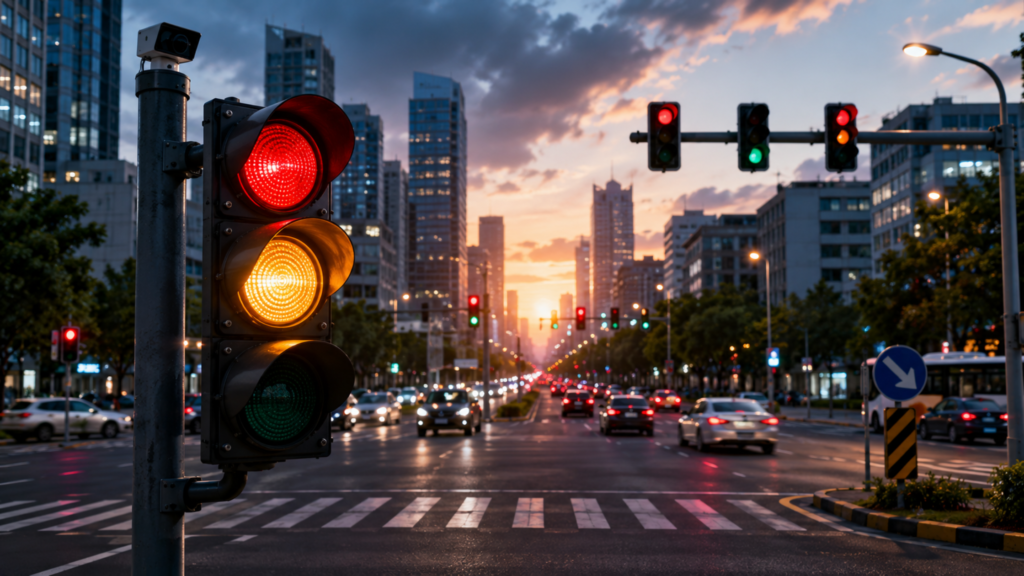
Understanding Why Do Traffic Lights Turn Yellow Before Red helps us appreciate the science and engineering behind everyday road safety. While most drivers see the yellow signal as a routine part of their commute, traffic engineers view it as one of the most important safety features at any intersection.
You’re driving through an intersection. The signal ahead is green. Traffic is moving smoothly, Then suddenly, the light turns yellow. For a split second, your brain starts calculating.
Should you continue?
Should you slow down?
Do you have enough distance to stop safely?
It happens countless times every day, yet most people never stop to ask an interesting question:
Why Do Traffic Lights Turn Yellow Before Red?
- Red means stop.
- Green means go.
- But why introduce a third color in between?
The answer goes far beyond simple traffic control. In reality, the yellow signal is one of the most important road safety features ever introduced. It helps prevent accidents, improves traffic flow, and gives drivers the critical time needed to react safely.
As cities become smarter and transportation systems more advanced, understanding Why Do Traffic Lights Turn Yellow Before Red reveals how even the simplest pieces of infrastructure are carefully engineered to protect lives.
The Purpose of the Yellow Traffic Signal
Think of the yellow light as a warning message.
It tells drivers:
“Prepare to stop.”
Without this transition phase, traffic lights would change directly from green to red.
Imagine driving at speed and suddenly seeing a red signal appear without warning. The result would be panic braking, confusion, and a much greater risk of collisions. The yellow signal creates a predictable transition between movement and stopping. It gives drivers time to assess their position, speed, and distance from the intersection before making a safe decision.
Although it typically lasts only a few seconds, its impact on road safety is enormous.
Why Do Traffic Lights Turn Yellow Before Red on Busy Roads?
Imagine driving on a major city road during peak traffic hours. Vehicles are moving continuously. Drivers are focused on maintaining safe distances and traffic flow.
If a signal suddenly switched from green to red without warning, drivers would be forced into sudden braking situations. This is exactly why Why Do Traffic Lights Turn Yellow Before Red is such an important question in traffic engineering.
The yellow phase acts as a safety buffer.
It reduces uncertainty. It helps drivers respond calmly rather than react suddenly. And perhaps most importantly, it significantly reduces the likelihood of rear-end collisions at intersections.
Traffic engineers carefully calculate yellow signal timing based on factors such as:
- Road speed
- Traffic volume
- Vehicle stopping distance
- Driver reaction time
- Intersection design
What appears simple is actually backed by years of research and safety analysis.
The Science Behind Driver Reaction Time
But here’s the interesting part. Traffic lights are not designed randomly. Every second matters.
When a signal changes, drivers need time to:
- Notice the change
- Process the information
- Decide what action to take
- Move their foot to the brake pedal
- Begin slowing down
This process takes time.
Even experienced drivers cannot react instantly. Studies have shown that human reaction time plays a critical role in road safety.
This is one of the key reasons Why Do Traffic Lights Turn Yellow Before Red remains an important aspect of modern traffic management. The yellow light bridges the gap between awareness and action.
Without it, intersections would become significantly more dangerous.
How Yellow Signals Improve Road Safety
The yellow signal provides several important safety benefits.
1. Reduces Sudden Braking
Drivers receive advance warning before the signal turns red.
This allows for smoother and safer stopping.
2. Prevents Rear-End Collisions
Abrupt braking is one of the leading causes of rear-end accidents.
The yellow phase helps reduce this risk.
3. Improves Intersection Safety
Drivers already committed to crossing can safely clear the intersection.
4. Creates Predictable Traffic Flow
Consistency helps drivers anticipate signal changes and react appropriately.
5. Supports Better Driver Decision-Making
The yellow light provides a brief but essential decision-making window.
These benefits demonstrate why yellow signals remain a critical component of traffic management systems worldwide.
Why Do Traffic Lights Turn Yellow Before Red in Smart Traffic Systems?
Modern cities are increasingly adopting intelligent traffic management solutions. But here’s something many people don’t realize. Even the most advanced Smart Traffic Signals still rely on the yellow phase.
The difference is that intelligent systems can optimize signal timing based on:
- Traffic density
- Vehicle speed
- Congestion levels
- Time of day
- Emergency vehicle movement
This demonstrates how Why Do Traffic Lights Turn Yellow Before Red remains relevant even as transportation technology evolves. Rather than eliminating yellow lights, modern systems make them smarter.
Adaptive traffic systems can adjust signal timing to improve safety while maintaining efficient traffic flow.
The Role of Intelligent Traffic Systems
Today’s traffic infrastructure extends far beyond traditional signals.
Modern cities are increasingly deploying:
- Smart Traffic Signals
- Vehicle Detection Systems
- Traffic Monitoring Cameras
- Variable Message Signs (VMS)
- Intelligent Transportation Systems
- Highway Automation Solutions
These technologies work together to create a connected transportation network. Instead of operating independently, traffic systems now communicate and share information in real time. For example, Smart Traffic Signals may work alongside Variable Message Signs (VMS) to provide drivers with traffic alerts, congestion warnings, and route information.
The goal is simple:
- Safer roads.
- Better traffic flow.
- Improved travel experiences.
How Smart Cities Are Improving Traffic Flow
Across India, transportation infrastructure is becoming more intelligent. Smart city initiatives are integrating technology into roads, intersections, tunnels, highways, and urban mobility networks. Most drivers never notice this transformation happening around them. But here’s the fascinating part.
Traffic signals are no longer isolated devices. They are becoming part of larger Intelligent Transportation Systems that monitor traffic conditions continuously. These systems collect real-time data and help authorities make faster, more informed decisions.
As traffic volumes continue to increase, intelligent infrastructure will play an increasingly important role in reducing congestion and improving road safety.
How Intelligent Infrastructure Is Shaping Safer Roads
At Vulcan Advance Intelligence Computing Pvt. Ltd., we understand that modern transportation infrastructure is no longer just about physical roads and signals.
- It is about communication.
- Information.
- And intelligent decision-making.
Technologies such as Smart Traffic Signals, Variable Message Signs (VMS), Traffic Monitoring Systems, and Intelligent Transportation Systems are helping roads become more responsive and efficient.
The objective is not simply to move vehicles. It is to create safer journeys for everyone using the road network. As transportation systems continue to evolve, intelligent infrastructure will become one of the defining elements of future mobility.
The Future of Traffic Signals
Traffic signals have come a long way from simple timers.
The future may include:
- AI-powered traffic management
- Predictive traffic control
- Connected intersections
- Vehicle-to-infrastructure communication
- Real-time adaptive signal systems
In the coming years, traffic signals may not just respond to traffic. They may predict it. Yet even as technology advances, one thing is likely to remain unchanged. The yellow signal will continue serving its essential purpose as a critical safety transition between movement and stopping.
Conclusion
The next time you’re approaching an intersection and the signal turns yellow, remember that you’re witnessing one of the simplest yet most effective road safety innovations ever created.
A few seconds of warning may not seem important. But every day, those few seconds help prevent accidents, improve traffic flow, and support safer journeys for millions of people. As cities become smarter and transportation systems become more connected, the technology behind traffic signals will continue to evolve.
But one thing is unlikely to change: The yellow light will remain the critical bridge between movement and stopping. Because sometimes, the smartest infrastructure is the infrastructure that gives people just enough time to make the right decision.
Frequently Asked Questions
Why Do Traffic Lights Turn Yellow Before Red?
Why Do Traffic Lights Turn Yellow Before Red instead of changing directly to red? The yellow phase provides drivers with enough time to react safely, reducing the likelihood of accidents and sudden braking.
How Long Does a Yellow Traffic Signal Last?
The duration depends on road speed, traffic conditions, and intersection design. Higher-speed roads typically have longer yellow phases.
Do Yellow Lights Reduce Accidents?
Yes. Yellow lights help reduce sudden braking, improve driver awareness, and lower the risk of rear-end collisions.
Why Do Traffic Lights Turn Yellow Before Red in Smart Cities?
Smart cities use intelligent traffic management systems that optimize signal timing while still relying on yellow lights to maintain safety.
How Do Smart Traffic Signals Work?
Smart Traffic Signals use sensors, cameras, and data analytics to monitor traffic conditions and adjust signal timing dynamically.

