
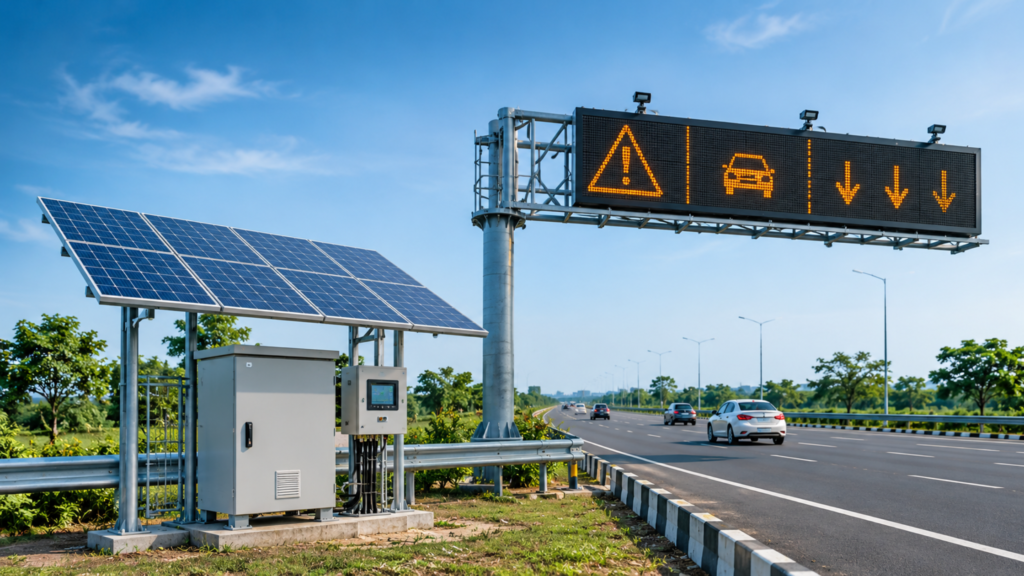
Understanding solar VMS battery backup is essential for highway authorities planning reliable and energy-efficient Variable Message Sign installations.
A Variable Message Sign (VMS) plays an important role in modern highway infrastructure. It helps authorities communicate real-time traffic updates, road closures, accident alerts, weather warnings, speed restrictions and other important information to motorists.
But what happens when a solar-powered VMS receives insufficient sunlight for several days?
This is where solar VMS battery backup becomes an important part of the system design.
For highway authorities and infrastructure developers, installing a solar-powered VMS is not simply about choosing a display and connecting solar panels. The system must be designed to store enough energy to keep the display, controller and communication equipment operational when solar generation is low.
So, how many days of battery backup does a solar VMS actually need?
The answer depends on the project requirements, energy consumption, geographical location, solar availability and expected operating conditions. Let’s understand the factors that matter when planning a reliable solar-powered VMS installation.
Table of Contents
- What is a solar-powered VMS?
- How many days of solar VMS battery backup are required?
- Five factors that determine battery backup
- How to calculate VMS battery capacity
- Why solar panel capacity matters as much as battery storage
- Important specifications for highway authorities and EPC contractors
- How Vulcan AIC approaches intelligent highway infrastructure
- Frequently asked questions
1. What Is a Solar-Powered VMS?
A solar-powered Variable Message Sign (VMS) is an electronic road display system that uses energy generated by solar panels to operate its display and supporting electronic components.
Unlike conventional signage, a VMS can communicate changing road and traffic information in real time. It can display:
- Accident and incident alerts
- Traffic congestion information
- Speed restrictions and road safety messages
- Lane closures and diversion information
- Weather-related warnings
- Travel information and emergency notifications
A typical solar VMS power system consists of:
- Solar panels: Convert sunlight into electrical energy.
- Battery bank: Stores energy for operation when sunlight is unavailable.
- Solar charge controller: Regulates charging and protects the battery.
- Power management system: Distributes and manages electrical power.
- LED display: Shows messages and traffic information.
- Controller and communication equipment: Manage display content and connectivity.
The performance of the complete installation depends on how effectively these components work together.
2. How Many Days of Solar VMS Battery Backup Are Required?
There is no universal number of backup days that applies to every solar VMS installation. The required battery autonomy should be decided according to the project’s technical specifications and the expected period of low solar generation.
For example, a project may consider:
- 1 day: Suitable only where the project design and power availability support a short autonomy requirement.
- 2–3 days: A possible design consideration for locations where moderate backup autonomy is required.
- 5–7 days: May be considered for more demanding installations, subject to battery sizing, solar generation and project requirements.
These are illustrative design ranges, not mandatory Indian highway standards. The actual requirement must be confirmed through the tender, applicable specifications and site-specific engineering calculations.
For context, Queensland’s Transport and Main Roads specification for transportable VMS requires a minimum seven-day battery backup. This is an example of an international project specification, not a general requirement for Indian VMS projects.
In India, the Indian Roads Congress publication IRC:SP:85-2023 addresses VMS design, power management, installation, operation and maintenance. It also recommends using solar power wherever feasible and appropriate.
The key takeaway: A reliable solar VMS should be designed around the required autonomy and actual energy demand, rather than selecting a battery based only on its Ah rating.
3. Five Factors That Determine Solar VMS Battery Backup
Before finalising battery capacity, project engineers should evaluate the following five factors.
1. Daily Power Consumption
The first step is to understand how much energy the complete VMS system consumes in a day.
Power consumption depends on:
- Display dimensions and LED technology
- Brightness settings
- Number of active pixels
- Display operating hours
- Controller and communication equipment
- Additional sensors and connected devices
A larger display may require more energy than a smaller one. Similarly, a display operating at higher brightness can consume more power. This is why the actual operating load should be measured or established from the manufacturer’s technical data before calculating battery requirements.
2. Location and Solar Availability
A solar VMS installed in Rajasthan may receive different levels of solar radiation compared with one installed in a region that experiences prolonged monsoon conditions.
Factors to consider include:
- Average daily solar irradiation
- Seasonal weather variations
- Cloudy and rainy periods
- Dust accumulation on solar panels
- Shading from trees, structures or nearby buildings
- Panel orientation and installation angle
A solar system designed only around average sunny-day conditions may struggle during extended periods of poor sunlight.
Site-specific solar assessment is therefore essential.
3. Required Battery Autonomy
Battery autonomy refers to the number of days a system can operate using stored energy without relying on fresh solar generation. For example, if a highway project requires three days of operation without meaningful solar charging, the battery bank must be sized to support the complete system’s energy requirement for that period.
The battery design should also account for the permitted depth of discharge, conversion losses and an appropriate engineering margin.
4. Battery Technology and Usable Capacity
Battery capacity is commonly expressed in ampere-hours (Ah) or kilowatt-hours (kWh). However, the total rated capacity is not necessarily the same as the energy available for actual operation.
The usable capacity depends on:
- Battery chemistry
- Permitted depth of discharge
- Operating temperature
- Charging and discharging efficiency
- Battery ageing
- Manufacturer recommendations
The battery management system also plays an important role in monitoring battery health, temperature, charging conditions and protection limits.
5. Maintenance and Monitoring
A solar VMS installed along a highway may be located far from a regular maintenance facility. Without proper monitoring, problems such as battery degradation, charging failure or reduced solar generation may remain unnoticed.
A well-designed system should support:
- Battery health monitoring
- Solar charging status
- Low-voltage protection
- Temperature monitoring
- Fault alerts
- Preventive maintenance planning
Remote monitoring can help maintenance teams identify potential problems before they affect system availability.
4. How to Calculate Solar VMS Battery Capacity
Battery sizing should begin with the actual daily energy consumption of the complete installation.
A basic calculation is:
Required nominal battery capacity (kWh) = Daily energy consumption × Required backup days ÷ (Usable depth of discharge × System efficiency)
Let’s understand this with an illustrative example.
Suppose a solar VMS installation has the following requirements:
| Parameter | Example value |
|---|---|
| Daily energy consumption | 4.8 kWh |
| Required autonomy | 3 days |
| Usable depth of discharge | 80% |
| Overall system efficiency | 90% |
The calculation becomes:
4.8 × 3 ÷ (0.80 × 0.90) = 20 kWh
Therefore, the indicative nominal battery capacity required would be approximately 20 kWh.
This is only an example to explain the calculation. Actual battery sizing must consider the battery manufacturer’s specifications, temperature conditions, ageing allowance, load profile and applicable project requirements.
For an accurate design, engineers should also evaluate the battery’s discharge limits and whether the battery can deliver the required power continuously.
5. Why Solar Panel Capacity Matters as Much as Battery Storage
A larger battery does not automatically make a solar VMS reliable. Think of the battery as an energy storage unit and the solar panels as the source that replenishes that energy. If the solar panels cannot generate enough electricity to operate the VMS and recharge the battery, the system may gradually lose its backup capacity.
Solar panel sizing should consider:
- Daily energy consumption of the complete VMS.
- Available peak sun hours at the installation site.
- Solar panel temperature and performance losses.
- Dust, shading and seasonal variations.
- Battery charging requirements.
- Energy required to recover after cloudy weather.
A properly designed system should be able to support the operational load while restoring the battery charge within the expected solar generation window.
This balance between solar generation, energy consumption and battery storage is essential for long-term reliability.
6. Important Solar VMS Specifications for NHAI and Government Projects
For NHAI, state highway authorities, government departments and EPC contractors, battery backup is only one part of the overall VMS specification.
A complete technical evaluation should also consider:
| Evaluation parameter | Why it matters |
|---|---|
| Display performance | Ensures clear and readable road information |
| Power consumption | Determines solar and battery sizing |
| Battery autonomy | Supports operation during low-solar periods |
| Solar panel capacity | Maintains energy generation and battery charging |
| Power management | Regulates and distributes electrical energy |
| Weather protection | Supports operation in outdoor conditions |
| Remote monitoring | Helps identify faults and performance issues |
| Communication system | Enables remote message updates |
| Maintenance access | Supports inspection and component replacement |
| Standards and certification | Helps establish compliance with project specifications |
In India, the NHAI ATMS technical specifications provide functional and technical requirements for highway VMS installations. The Indian Roads Congress IRC:SP:85-2023 also provides guidance covering VMS design, power management, installation, testing, operation and maintenance.
Project teams should review the latest applicable tender documents and contractual requirements before finalising the system design.
7. How Vulcan AIC Supports Intelligent Highway Infrastructure
At Vulcan AIC, we believe that highway infrastructure needs more than display technology. It needs reliable engineering, intelligent communication and systems designed around real-world operating conditions.
Vulcan AIC is an Indian OEM specializing in intelligent LED displays, AI-based traffic systems, highway automation and solar power storage solutions.
Our product portfolio includes:
- Smart VMS: Intelligent Variable Message Signs for real-time highway communication.
- VMS: Electronic display systems for traffic information, warnings and road guidance.
- PVMS: Portable Variable Message Signs for temporary traffic management.
- VASD: Vehicle Actuated Speed Displays for real-time vehicle speed feedback.
- Energy & Infra Solutions: Technologies supporting solar power storage and infrastructure requirements.
With experience across government and private infrastructure projects, Vulcan AIC focuses on developing solutions that support smarter roads and connected transportation systems.
For a solar-powered VMS project, selecting the right combination of display technology, power management, solar generation and battery storage is an important part of the engineering process.
Our approach is to understand the project application and technical requirements before recommending a suitable solution.
Planning a solar-powered VMS installation? Connect with Vulcan AIC to discuss your highway display and infrastructure requirements.
8. Frequently Asked Questions
Q1. How many days of battery backup does a solar VMS need?
There is no fixed backup duration for every solar VMS. The requirement depends on project specifications, daily energy consumption, site conditions and expected periods of low solar generation. Two to three days may be considered in some designs, while more demanding projects may specify longer autonomy.
Q2. What factors affect solar VMS battery capacity?
The main factors include display power consumption, operating hours, battery chemistry, depth of discharge, system efficiency, weather conditions and required backup duration.
Q3. Can a solar VMS operate during continuous cloudy weather?
Yes, provided the battery bank has sufficient stored energy to support the system’s load. The required battery capacity should be calculated according to the expected duration of low solar generation.
Q4. Which battery is suitable for a solar-powered VMS?
The battery should be selected according to the system load, required autonomy, operating temperature, charging characteristics, lifecycle expectations and maintenance requirements. Lithium-based and other battery technologies should be evaluated against the project specifications.
Q5. Is solar power suitable for highway VMS installations?
Solar power can be suitable where grid connectivity is difficult, expensive or impractical. However, solar panel capacity, battery storage and site conditions must be evaluated before installation.
Q6. Does a larger VMS require more battery backup?
Not necessarily more backup days, but a larger display may consume more energy. Higher daily energy consumption generally requires greater battery storage to achieve the same number of autonomy days.
Q7. What should government authorities check before approving a solar VMS?
Authorities should review the display specifications, daily power consumption, battery autonomy calculations, solar panel capacity, power management system, outdoor protection, communication features, testing documents and compliance with the applicable tender requirements.
Conclusion: Design for Reliability, Not Just Backup Days
A solar-powered VMS is an important part of intelligent highway infrastructure. Its performance depends not only on the display but also on the complete energy system supporting it.
The right solar VMS battery backup is determined by engineering calculations, site-specific solar conditions, actual energy consumption and project requirements.
For NHAI, government authorities and EPC contractors, the objective should be to select a system that delivers dependable operation, efficient energy management and manageable long-term maintenance.
At Vulcan AIC, we are committed to engineering intelligent display and infrastructure solutions that contribute to safer, smarter and more connected roads.
Looking for a reliable VMS solution for your next highway project?
Visit Vulcan AIC for your project requirements.
Vulcan AIC | Intelligent Infrastructure. Engineered for Progress.

