
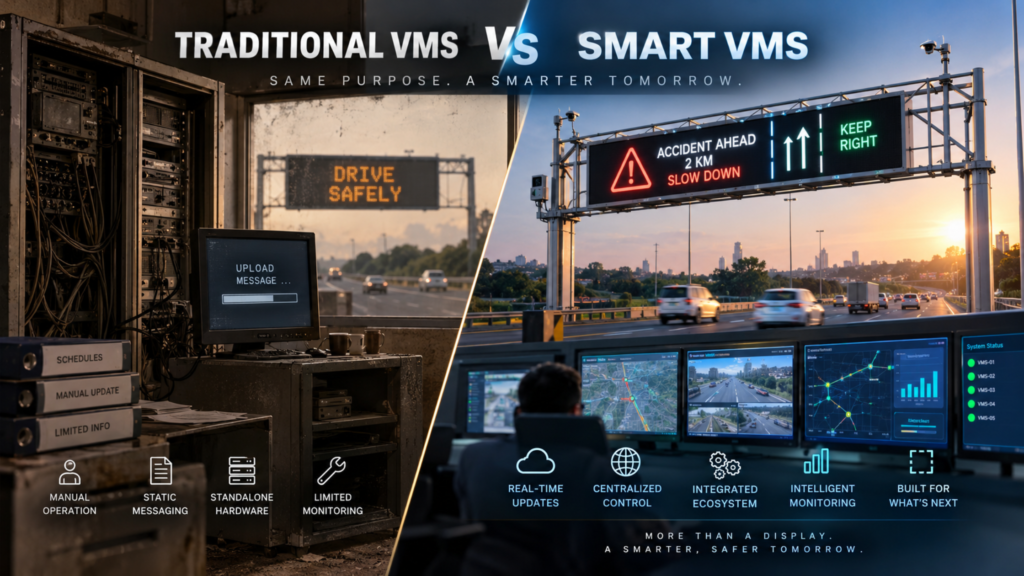
A Variable Message Sign may look simple from the highway.
A large LED display. A short message. A driver reads it and continues.
But behind that message is an entire technical system.
The real question today is not simply whether a VMS can display text.
It is how intelligently that display can communicate, how quickly it can respond, how easily it can be managed, and how well it can become part of a larger traffic management ecosystem.
That is where the difference between a Smart VMS and a traditional VMS becomes important.
VULCAN AIC defines its Smart VMS as an intelligent full-colour LED display system designed for real-time traffic communication, while its VMS is positioned as a standard LED display board for messages, warnings and road information.
For modern highways, that distinction matters.
A conventional VMS can serve an important communication function. But when the requirement moves toward connected infrastructure, centralized management, dynamic information and integration with intelligent transportation systems, the architecture behind the display becomes just as important as the display itself.
This article breaks down the difference technically and practically.
What Is a Traditional VMS?
A Variable Message Sign (VMS) is an electronic road display used to communicate information to drivers.
It can display messages related to:
- Traffic conditions
- Road works
- Lane restrictions
- Warnings
- Diversions
- Weather conditions
- Travel information
- Safety instructions
- Other road-related information
VULCAN AIC’s product portfolio describes its standard VMS as an LED display board designed to display messages, warnings and road information.
The important point is that a traditional VMS is fundamentally a display system.
It receives a message and presents that message to road users.
That function remains valuable.
In fact, NHAI’s ATMS specification identifies VMS as an important subsystem for providing road users with advance information about road conditions and managing traffic during incidents, special events, construction and maintenance activities.
The difference comes when we ask what exists around the display.
What Is a Smart VMS?
A Smart VMS takes the concept further by combining the display with intelligence, connectivity and system-level communication.
we manufacture Smart VMS as an intelligent full-colour LED display system designed for real-time traffic communication. In a smart highway environment, the VMS is not expected to operate as an isolated LED board.
It can become one component within a wider intelligent transportation architecture.
That architecture may involve:
- Traffic monitoring
- Communication networks
- Central control systems
- Sensors
- Cameras
- Incident information
- Lane management
- Traffic data
- Automated workflows
- Operator-controlled messaging
NHAI’s ATMS specifications similarly position VMS as a subsystem controlled from an ATMS control centre, with requirements around message accuracy, continual monitoring and updating according to incidents.
So, in simple terms:
Traditional VMS focuses primarily on displaying information. Smart VMS focuses on making that information part of a connected traffic communication system.
Smart VMS vs Traditional VMS: Quick Comparison
| Parameter | Traditional VMS | Smart VMS |
|---|---|---|
| Primary role | LED message display | Intelligent traffic communication |
| Display | LED-based | Intelligent full-colour LED system |
| Communication | Primarily message delivery | Real-time connected communication |
| Control | Can be configured/operator controlled | Designed for connected, centralized environments |
| Integration | More standalone | Designed for broader system integration |
| Monitoring | Basic/installation dependent | Greater emphasis on system intelligence and connectivity |
| Traffic response | Message-focused | Dynamic information-focused |
| Scalability | Depends on architecture | Better suited to connected infrastructure |
| ATMS role | VMS subsystem | Intelligent component within connected ATMS |
| Future expansion | Hardware/application dependent | Better aligned with evolving smart-road ecosystems |
The exact capabilities of any deployment depend on the selected system architecture, communication network, software and project requirements.
That distinction is important.
A Smart VMS is not simply a traditional VMS with a more modern screen.
The difference is in the system surrounding the screen.
7 Key Differences Between Smart VMS and Traditional VMS
1. Display vs Intelligent Communication
The first difference is conceptual.
A traditional VMS primarily answers: “What message should appear on this board?”
A Smart VMS operates around a broader question: “What information should reach the driver, when should it appear, and how does the display fit into the traffic management system?”
That shift sounds small, but technically it is significant.
A highway display exists to communicate information quickly and clearly.
NHAI specifications emphasize that VMS messages should serve a purpose, command attention for a short but definite period, remain simple and unambiguous, and give drivers enough time to respond.
A smart architecture therefore considers more than LED brightness or pixel configuration.
It considers:
- Information source
- Communication path
- Control architecture
- Message logic
- Display hardware
- Operator interface
- System integration
- Monitoring
- Updating
This is why intelligent highway displays increasingly need to be considered as communication infrastructure, not merely electronic signage.
2. Manual Operation vs Connected Control
The second major difference is control.
A basic VMS installation may depend heavily on an operator or predefined configuration to update messages. A Smart VMS can be designed as part of a connected architecture where information originates from a central traffic management environment. This becomes particularly useful when a highway network contains multiple displays.
Imagine a road incident occurs several kilometres ahead.
One display may need to warn approaching traffic.
Another may need to advise drivers to use an alternate route.
A third location may need to communicate a lane restriction.
Managing these displays individually can become increasingly complex as the network grows.
A centralized architecture changes that model.
NHAI’s ATMS specification states that VMS should be controlled from the local ATMS control centre. It also emphasizes continually monitoring incidents and updating displayed information to maintain relevance.
That is an important principle behind intelligent VMS infrastructure. The display is no longer treated as an isolated endpoint.
It becomes part of a networked control environment.
3. Static Messaging vs Real-Time Updates
Traffic conditions do not remain constant.
A road can move from normal traffic to congestion within minutes.
An accident can close a lane.
Road maintenance can create a temporary diversion.
Weather can suddenly reduce visibility.
A useful VMS therefore needs information that remains relevant. NHAI’s ATMS specifications specifically state that message relevance should be maintained by continually monitoring incidents and updating the display.
This is where Smart VMS architecture becomes particularly useful. Instead of treating the message as a fixed piece of content, the system can be designed around dynamic information flow.
For example:
Traffic detected → information processed → operator/system decision → message generated → VMS updated → driver receives information.
That is fundamentally different from simply changing text on an LED board.
The technical objective is not to make the screen “busy.”
It is to make the information timely, relevant and actionable.
4. Standalone Equipment vs System Integration
Modern highway infrastructure rarely consists of one technology.
A traffic management environment can contain:
- VMS
- Cameras
- Lane control systems
- Speed displays
- Traffic signals
- Communication networks
- Control centres
- Sensors
- Incident detection systems
- Data platforms
VULCAN AIC’s own intelligent infrastructure portfolio spans Smart VMS, VMS, VASD, LASB, VSLS, LCS, OHLS, traffic lights, toll displays and other highway display systems.
That ecosystem matters. A Smart VMS should be considered with integration in mind.
For example, a speed detection system identifies an abnormal traffic condition.
A camera confirms an incident.
The control centre receives the information.
The appropriate VMS communicates the warning to approaching drivers.
The display is therefore not working alone.
It is participating in a chain of information. VULCAN AIC also describes its broader technology direction around AI, IoT, highway automation and connected intelligent infrastructure.
5. Basic Display Monitoring vs Intelligent Monitoring
There is another difference that is often invisible to road users. A driver sees whether a VMS is displaying a message. The infrastructure operator needs to know much more.
For example:
- Is the display connected?
- Is the communication link available?
- Is the system responding?
- Is the correct message being displayed?
- Is the information still relevant?
- Is the display available for the next event?
This is where monitoring becomes important.
In large highway networks, a problem with one display can become difficult to identify if there is no structured monitoring architecture. A connected Smart VMS environment can be designed to support centralized visibility of deployed equipment, depending on the system architecture and project requirements.
This aligns with the wider direction of modern ATMS, where VMS forms part of an integrated traffic management environment rather than operating independently.
For infrastructure operators, visibility is part of reliability. You cannot manage what you cannot see.
6. Present Requirements vs Future Scalability
Highway infrastructure is built for long operational lifecycles. A display installed today may need to remain useful as traffic patterns, communication technologies and traffic management requirements change. That makes scalability an engineering consideration from the beginning.
A traditional VMS can perform its intended display function effectively.
But if the wider infrastructure later needs:
- Additional displays
- Centralized management
- New data sources
- Additional traffic systems
- More sophisticated software
- Expanded communication networks
then the original architecture becomes important.
A Smart VMS approach considers these possibilities earlier. This does not mean that every highway requires the same level of intelligence.
Instead, the right question is: What does the infrastructure need today, and what might it need tomorrow?
That is especially relevant as highways increasingly become connected digital infrastructure.
The Indian Roads Congress has highlighted the broader shift toward smart roads, digital-age highways and intelligent transportation systems in its recent editorial material.
7. Information Display vs Traffic Management
This is perhaps the biggest difference.
A traditional VMS can be thought of primarily as:
Display → Message → Driver
A Smart VMS can become part of:
Road → Data → Control System → Decision → Message → Driver
That is a much larger ecosystem.
The display remains important.
But it becomes the communication endpoint of a larger intelligence layer.
This distinction becomes especially relevant in incident management.
Consider a lane closure.
A conventional approach may involve displaying:
LANE CLOSED
A connected traffic management environment may involve:
Incident detected → location identified → affected traffic assessed → instruction generated → VMS updated → driver receives guidance.
The exact workflow depends on the project’s ATMS architecture, software and connected systems.
But the principle remains the same: The value of a Smart VMS is not only in what it displays. It is in how intelligently it participates in the system around it.
Where Does a Smart VMS Fit in ATMS?
A Smart VMS should not be viewed independently from Advanced Traffic Management Systems (ATMS).
ATMS brings different highway technologies into a coordinated operational environment.
NHAI’s technical specification identifies VMS as a subsystem of ATMS and describes its role in providing advance information about road conditions, incidents, construction, maintenance and traffic management requirements.
The communication chain can be visualized as:
Traffic Environment
↓
Sensors / Cameras / Data Sources
↓
Traffic Management System
↓
Decision & Message Management
↓
Smart VMS
↓
Driver
The VMS is therefore one of the most visible parts of a much larger system.
Drivers may see only a few words.
Behind those words can be an entire technical architecture.
Why Message Engineering Matters
Making a VMS intelligent does not mean filling it with more information.
In fact, highway communication has a strict limitation:
Drivers have very little time to read.
NHAI specifications require messages to be concise and clear, with simple wording because drivers need to understand them quickly while operating a vehicle.
The specification also describes a useful message structure built around:
Location + Event + Instruction/Regulation
For example:
5 KM AHEAD — ACCIDENT — SLOW DOWN
or
EXIT 12 — ROAD WORK — USE LEFT LANE
Not every message requires all three elements, but the framework demonstrates an important engineering principle:
Smart communication is not about displaying more. It is about communicating better.
Why Highway VMS Engineering Is Different From Commercial LED Displays
A highway VMS is not simply a commercial LED screen placed outdoors.
Its communication purpose is different.
Its environment is different.
And its operational requirements are different.
Highway users may be moving at high speed. The display may need to communicate information in seconds.
The equipment may be exposed to:
- Heat
- Rain
- Dust
- Humidity
- Vibration
- Pollution
- Continuous outdoor operation
The message must also be readable and relevant.
NHAI’s specifications emphasize visibility, concise communication, message accuracy and timely updates. This is why selecting highway display technology should involve much more than comparing LED resolution or screen size.
The system architecture, communication, control and operational environment matter just as much.
How VULCAN AIC Approaches Intelligent Display Infrastructure
VULCAN AIC is a Noida-headquartered Indian OEM working across intelligent LED displays, AI-based traffic systems, highway automation and solar power storage. Its published portfolio includes Smart VMS alongside VMS, VASD, LASB, VSLS, LCS, OHLS, traffic lights and other intelligent display systems.
The company’s positioning is broader than manufacturing LED boards. Its stated vision is to combine AI, IoT and sustainable energy technologies to create connected ecosystems for safer roads and smarter cities.
That philosophy is relevant to the Smart VMS conversation. A highway display is one physical component. The real engineering challenge is making that component work reliably within the infrastructure around it.
VULCAN AIC states that its solutions are conceptualized, engineered and manufactured in India and that its portfolio is supported by certifications including BIS, EN 12966, CE and FCC. Its published client information also documents work with organizations including NHAI, Indian Air Force and RailTel, along with private infrastructure partners. The company states that its collaboration with NHAI included development of an 8-metre True Colour VMS.
These projects illustrate an important point:
Intelligent display infrastructure is an engineering discipline, not simply a display category.
Smart VMS: More Than an LED Display
When someone looks at a VMS from the highway, they see pixels. An infrastructure engineer sees something different.
They see:
- LED modules
- Power architecture
- Control electronics
- Communication
- Structural design
- Software
- Environmental requirements
- Message management
- System integration
- Maintenance
- Operational reliability
And when the display becomes part of a Smart VMS environment, another layer is added:
intelligence.
That intelligence is what allows the display to become part of a connected infrastructure ecosystem. The evolution can therefore be understood simply:
Traditional VMS
Display information.
Smart VMS
Connect information, intelligence and communication.
Neither concept eliminates the importance of the physical display.
The LED hardware still has to perform.
The message still has to be readable.
The system still has to operate reliably.
But the smarter architecture expands what the display can do within the wider traffic management environment.
Smart VMS vs Traditional VMS: Which One Fits Your Project?
There is no universal answer.
The right technology depends on the project’s:
- Road category
- Traffic volume
- Number of displays
- ATMS architecture
- Communication infrastructure
- Control-centre requirements
- Data sources
- Environmental conditions
- Future expansion plans
- Operational model
- Budget and lifecycle requirements
A simple deployment with limited requirements may need a conventional VMS. A connected highway network with centralized traffic management, multiple information sources and evolving operational requirements may benefit from a Smart VMS architecture.
The decision should therefore begin with the system requirement, not simply the screen specification.
Frequently Asked Questions
What is a Smart VMS?
A Smart VMS is an intelligent Variable Message Sign designed for real-time traffic communication. VULCAN AIC describes its Smart VMS as an intelligent full-colour LED display system, distinguishing it from its standard VMS offering.
What is the difference between Smart VMS and traditional VMS?
A traditional VMS primarily functions as an electronic LED message display. A Smart VMS extends the concept toward connected, real-time traffic communication and integration with broader intelligent transportation infrastructure.
Is Smart VMS part of ATMS?
Yes. VMS is a recognized subsystem within ATMS. NHAI’s ATMS specification describes VMS as a component controlled from the ATMS control centre and used for traffic information, incident response and road-user guidance.
Can a Smart VMS display more than text?
The capabilities depend on the system design and project requirements. VULCAN AIC describes its Smart VMS as a full-colour LED display system, while VMS messaging can include text and, where supported, graphical information. NHAI specifications also provide for graphic symbols alongside VMS text messages.
Why is centralized control important?
Centralized control becomes increasingly useful when multiple displays are deployed across a highway network. It allows information to be managed as part of a broader traffic management operation rather than treating every display as an isolated device.
Does a Smart VMS automatically make a highway smart?
No. A Smart VMS is one component of intelligent infrastructure. A genuinely connected highway environment may involve VMS, cameras, sensors, lane control, communication networks, traffic management software and other systems working together.
What should be considered when selecting a highway VMS?
Look beyond screen size and LED specifications. Consider communication, control architecture, message management, environmental conditions, integration, monitoring, maintenance, scalability and the requirements of the overall ATMS.
Final Takeaway
The difference between a traditional VMS and a Smart VMS is not simply the difference between an old screen and a new screen. It is a shift from displaying information to intelligently communicating information.
A traditional VMS can perform an important role on the road.
A Smart VMS takes that role into a connected infrastructure environment where information can be managed, updated and integrated as part of a wider traffic management system.
For modern highways, that distinction is becoming increasingly important. Because the future of road infrastructure is not only about building roads that move vehicles. It is about building roads that can sense, communicate, respond and adapt.
And sometimes, that intelligence begins with the screen drivers see for only a few seconds.

