
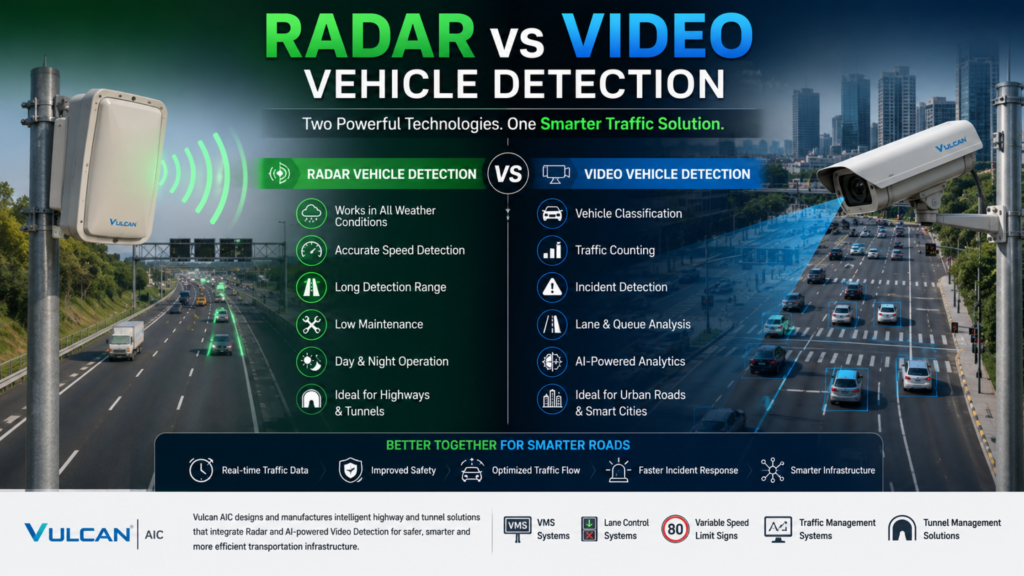
As cities become smarter and transportation networks grow more complex, selecting the right vehicle detection technology is essential for improving road safety, reducing congestion, and enabling intelligent traffic management. Radar vs Video Vehicle Detection is one of the most common comparisons made by traffic engineers, highway authorities, and smart city planners when designing Intelligent Transportation Systems (ITS).
Both technologies detect vehicles, monitor traffic flow, and collect real-time data, but they operate using different principles and perform differently under varying environmental conditions. Understanding the strengths and limitations of Radar vs Video Vehicle Detection helps organizations choose the most effective solution for highways, intersections, tunnels, urban roads, and smart mobility projects.
This guide explores the working principles, key differences, advantages, applications, and future trends of Radar vs Video Vehicle Detection.
What is Radar Vehicle Detection?
Radar Vehicle Detection uses radio waves to detect moving and stationary vehicles. A radar sensor emits electromagnetic waves that reflect off vehicles and return to the sensor. The system then calculates speed, distance, direction, and vehicle presence based on the reflected signals.
Radar technology performs reliably in harsh environmental conditions, making it ideal for highways, tunnels, and outdoor traffic monitoring.
Features of Radar Vehicle Detection
- Accurate speed measurement
- Long detection range
- Operates in rain, fog, and dust
- Low maintenance
- Day and night operation
- High reliability
What is Video Vehicle Detection?
Video Vehicle Detection uses high-resolution cameras and computer vision algorithms to identify, classify, and track vehicles.
Unlike radar, video systems capture visual information, enabling traffic authorities to analyze vehicle types, lane occupancy, incidents, queue lengths, and pedestrian movement.
Modern AI-powered video analytics provide highly detailed traffic intelligence.
Features of Video Vehicle Detection
- Vehicle classification
- Lane monitoring
- Incident detection
- Traffic counting
- Queue analysis
- AI-based analytics
Radar vs Video Vehicle Detection: Key Differences
| Feature | Radar Detection | Video Detection |
|---|---|---|
| Technology | Radio Waves | Camera + AI |
| Speed Detection | Excellent | Very Good |
| Vehicle Classification | Limited | Excellent |
| Weather Performance | Excellent | Moderate |
| Night Performance | Excellent | Good (with IR support) |
| Maintenance | Low | Moderate |
| Data Collection | Basic | Advanced |
| Installation | Easy | Moderate |
| Privacy Concerns | Minimal | Higher |
| Cost | Moderate | Moderate to High |
Why Radar vs Video Vehicle Detection Matters
Modern traffic management relies on accurate, real-time vehicle detection.
Choosing the right solution helps authorities:
- Reduce congestion
- Improve road safety
- Optimize signal timing
- Detect incidents faster
- Support smart city initiatives
- Improve traffic flow
- Enhance infrastructure efficiency
For Intelligent Transportation Systems (ITS), understanding Radar vs Video Vehicle Detection ensures better planning and long-term operational performance.
Advantages of Radar Vehicle Detection
Reliable in All Weather Conditions
Radar sensors perform consistently in:
- Heavy rain
- Dense fog
- Dust storms
- Snow
- Low visibility
This makes radar an excellent choice for highways and critical transportation corridors.
Accurate Speed Measurement
Radar provides highly accurate speed detection, making it suitable for:
- Speed enforcement
- Variable Speed Limit Systems
- Highway monitoring
- Safety applications
Low Maintenance
Since radar sensors have no optical lenses, they require less cleaning and maintenance compared to camera-based systems.
High Reliability
Radar delivers stable performance regardless of lighting conditions, making it suitable for 24/7 traffic monitoring.
Advantages of Video Vehicle Detection
Advanced Traffic Analytics
Video detection systems can provide:
- Vehicle counting
- Vehicle classification
- Queue length analysis
- Wrong-way detection
- Pedestrian detection
- Incident detection
Rich Visual Information
Unlike radar, video systems capture images that help traffic operators verify incidents in real time.
AI Integration
Modern AI-powered video analytics continuously improve detection accuracy through machine learning.
Multi-Purpose Infrastructure
A single camera can perform multiple functions, reducing the need for additional roadside equipment.
Radar vs Video Vehicle Detection in Highway and Tunnel Infrastructure
Highways and tunnels demand highly reliable vehicle detection systems that can operate continuously under challenging environmental conditions. From high-speed expressways to enclosed tunnel environments, accurate traffic detection is essential for maintaining safety, reducing congestion, and supporting efficient traffic operations.
At Vulcan AIC, we design and manufacture intelligent highway and tunnel solutions that integrate advanced vehicle detection technologies with Intelligent Transportation Systems (ITS). Our solutions support applications such as Variable Message Signs (VMS), Lane Control Signals (LCS), Variable Speed Limit Signs (VSLS), Automatic Incident Detection (AID), and centralized Traffic Management Systems (TMS).
By combining Radar Vehicle Detection and AI-powered Video Vehicle Detection, Vulcan AIC enables road operators to monitor traffic in real time, improve incident response, optimize lane management, and enhance road safety across highways, tunnels, and smart mobility corridors.
Applications of Radar vs Video Vehicle Detection
Both technologies play an important role in intelligent transportation infrastructure.
Radar Vehicle Detection
- Highways
- Expressways
- Tunnels
- Speed enforcement
- Variable Speed Limit Systems
- Lane Control Systems
- Adverse weather monitoring
Video Vehicle Detection
- Urban intersections
- Smart cities
- Toll plazas
- Parking management
- Traffic surveillance
- Incident management
- Public safety monitoring
Radar vs Video Vehicle Detection for Smart Infrastructure
Infrastructure developers increasingly deploy both technologies together to maximize efficiency.
For example:
- Radar measures vehicle speed and presence.
- Video analytics classify vehicles and detect incidents.
- Integrated systems provide comprehensive traffic intelligence.
Companies like Vulcan AIC deploy intelligent traffic technologies that combine advanced sensing, AI-driven analytics, and real-time communication to support highways, smart cities, tunnels, and command centres.
How to Choose Between Radar vs Video Vehicle Detection
Selecting the right technology depends on several factors.
Choose Radar When You Need:
- Reliable operation in harsh weather
- High-speed vehicle detection
- Low maintenance
- Highway applications
- Speed monitoring
Choose Video When You Need:
- Vehicle classification
- Incident verification
- AI-powered analytics
- Urban traffic monitoring
- Smart city applications
For many modern ITS projects, a hybrid solution combining radar and video detection offers the best performance.
Future Trends in Radar vs Video Vehicle Detection
The future of vehicle detection is driven by intelligent automation and connected infrastructure.
Emerging trends include:
- AI-enhanced traffic analytics
- Edge computing
- 5G-enabled ITS
- Cloud-based traffic management
- Sensor fusion (Radar + Camera + LiDAR)
- Digital twins for traffic simulation
- Predictive congestion management
These innovations will enable safer, more efficient, and more sustainable transportation systems.
Frequently Asked Questions
Which is more accurate: Radar or Video Vehicle Detection?
Radar provides superior speed measurement and performs reliably in poor weather. Video detection offers richer traffic data and advanced analytics. The best choice depends on the application.
Can Radar and Video Detection work together?
Yes. Many modern Intelligent Transportation Systems combine radar and video detection to improve accuracy, incident detection, and traffic management.
Which technology is better for highways?
Radar is generally preferred for highways due to its excellent performance in adverse weather and long-range vehicle detection. Video systems complement radar by providing visual verification and vehicle classification.
Is Video Vehicle Detection suitable for smart cities?
Yes. Video detection is widely used in smart city projects because it supports AI-powered analytics, traffic monitoring, and public safety applications.
Conclusion
The comparison between Radar vs Video Vehicle Detection highlights that both technologies are essential components of modern Intelligent Transportation Systems. Radar excels in speed measurement, reliability, and performance under challenging weather conditions, while video detection provides detailed visual analytics, vehicle classification, and AI-powered insights.
Rather than viewing them as competing technologies, many transportation authorities now deploy them together to create comprehensive traffic management solutions. By combining the strengths of radar and video, organizations can improve road safety, optimize traffic flow, reduce congestion, and build smarter, more resilient infrastructure.
As cities continue to embrace digital transformation, the integration of advanced sensing technologies will play a critical role in shaping the future of connected mobility.

