
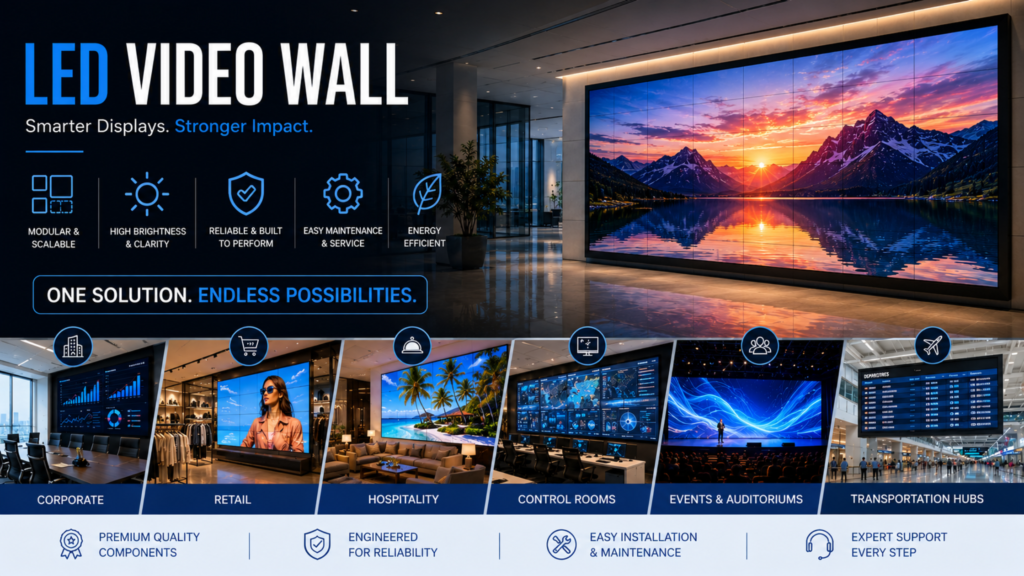
An LED Video Wall has evolved from being a premium visual display into an important communication and experience-building tool for modern businesses.
Corporate offices, retail stores, shopping malls, hotels, airports, auditoriums, control rooms, educational institutions and experience centers are increasingly using large-format LED displays to communicate information, showcase content and create visually engaging environments. Unlike conventional televisions or LCD-based video walls, an LED Video Wall is built using modular LED panels or cabinets that can be combined to create large, seamless display surfaces.
This modular architecture gives businesses greater flexibility in terms of screen size, resolution, installation format and application.
At Vulcan AIC, we design and manufacture display solutions for commercial and infrastructure applications, combining display hardware, electronics, cabinet engineering and intelligent control systems to create reliable visual communication platforms.
In this guide, we’ll explore 10 major reasons businesses are switching to LED Video Walls and why this technology is becoming increasingly relevant for modern commercial environments.
What Is an LED Video Wall?
An LED Video Wall is a large-format digital display created by combining multiple LED modules or cabinets into a single visual surface.
Each LED module contains numerous light-emitting diodes that work together to produce images, video, graphics and text.
Unlike conventional displays, an LED Video Wall can be manufactured in a wide range of sizes and configurations.
For example, a business may require:
- A compact corporate presentation wall
- A large retail advertising screen
- A fine-pitch boardroom display
- A large auditorium screen
- A control-room visualization wall
- A custom-shaped architectural display
The modular nature of LED technology makes these configurations possible.
Why Businesses Are Moving Beyond Traditional Displays
Traditional LCD screens remain useful for many applications. However, large commercial environments often require something more scalable and visually impactful. A conventional display has a fixed physical size. An LED Video Wall, on the other hand, can be configured according to the available space and viewing requirements.
This flexibility becomes particularly valuable when businesses want to create:
- Large immersive experiences
- High-impact brand environments
- Corporate communication centers
- Digital storefronts
- Large presentation surfaces
- Real-time information displays
The decision is therefore not simply about choosing a larger screen. It is about choosing a display architecture that can support the organization’s long-term communication requirements.
10 Reasons Businesses Are Switching to LED Video Walls
1. Exceptional Large-Format Visual Impact
The first major reason businesses choose an LED Video Wall is visual impact. Large displays naturally attract attention. A high-quality LED installation can turn an otherwise ordinary wall into a major visual focal point.
This is particularly useful for:
- Retail brands
- Corporate headquarters
- Hotels
- Shopping malls
- Experience centers
- Airports
- Entertainment venues
For brands, the display itself becomes part of the physical environment. A carefully designed LED Video Wall can communicate brand identity through high-resolution imagery, videos, animations and real-time content.
2. Seamless Large-Scale Viewing
One of the key advantages of LED technology is its ability to create large display surfaces without the prominent bezels associated with multiple conventional screens. Traditional LCD video walls consist of several individual panels. Even with narrow bezels, visible lines can remain between screens. An LED Video Wall is designed as a modular surface, allowing multiple cabinets or modules to work together as one display.
This creates a more continuous visual experience.
For applications where content extends across the entire screen, seamless presentation can significantly improve the overall appearance.
3. Flexible Screen Sizes and Configurations
Every commercial environment has different architectural requirements.
A corporate boardroom may require a relatively compact display.
A shopping mall may need a much larger installation.
An airport or public venue may require a custom-format screen covering an extensive area.
This is where the modular architecture of an LED Video Wall becomes valuable.
Businesses can configure displays according to:
- Available wall space
- Viewing distance
- Content requirements
- Aspect ratio
- Installation structure
- Audience size
LED cabinets can also support different installation approaches depending on the application. This flexibility makes LED technology suitable for both standardized and customized projects.
4. High Brightness for Commercial Environments
Commercial displays often operate in environments where ambient lighting changes throughout the day.
Retail stores may have strong interior lighting.
Airport terminals can have large glass windows and high levels of natural light.
Outdoor-facing commercial installations may experience direct sunlight.
An LED Video Wall can be engineered with brightness levels appropriate for its environment.
This allows content to remain visible and impactful under different lighting conditions.
However, maximum brightness is not always the objective.
The correct brightness level should be determined by factors such as:
- Installation environment
- Viewing distance
- Ambient illumination
- Indoor or outdoor application
- Content type
Intelligent brightness management can also help reduce unnecessary power consumption and improve viewing comfort.
5. Fine Pixel Pitch for Closer Viewing
As LED technology has evolved, smaller pixel pitches have made LED Video Walls increasingly suitable for close-viewing applications. Pixel pitch refers to the distance between the centers of adjacent LED pixels. A smaller pixel pitch generally provides higher pixel density and improved image detail at shorter viewing distances.
Fine-pitch LED solutions are particularly relevant for:
- Boardrooms
- Executive offices
- Broadcast environments
- Control rooms
- Experience centers
- Premium retail environments
For businesses, choosing the right pixel pitch is more important than simply choosing the smallest available pitch. The correct specification depends on the expected viewing distance and application.
6. Better Branding and Customer Engagement
Modern businesses compete for attention. A static wall or conventional display may communicate information, but an immersive LED installation can transform the entire environment.
Retailers can use LED displays for:
- Product campaigns
- Brand storytelling
- Seasonal promotions
- New product launches
- Visual merchandising
Corporate organizations can use them for:
- Company presentations
- Brand communication
- Leadership events
- Employee engagement
- Visitor experiences
Hotels and hospitality businesses can use them to create memorable lobby and event environments. The result is a communication platform that can support both information and brand experience.
7. Suitable for Diverse Commercial Applications
Another important advantage of an LED Video Wall is its versatility. The same underlying technology can be adapted to different commercial requirements.
Corporate Offices
LED video walls can be installed in:
- Reception areas
- Boardrooms
- Conference rooms
- Town halls
- Collaboration spaces
Retail
Retailers can use large LED displays to attract customers and deliver dynamic campaigns.
Hospitality
Hotels and event venues can use LED displays for:
- Events
- Conferences
- Weddings
- Brand experiences
- Guest communication
Education
Universities and institutions can use large displays in:
- Auditoriums
- Lecture halls
- Digital campuses
- Event spaces
Control Rooms
Control-room environments require high-quality visualization for monitoring large amounts of information. LED technology can provide large, continuous visualization surfaces for these applications.
8. Modular Design Simplifies Scalability
A major advantage of an LED Video Wall is modularity. Instead of treating the entire display as one fixed unit, manufacturers construct the system using multiple cabinets and modules.
This architecture can simplify:
- Installation
- Transportation
- Maintenance
- Replacement
- Expansion
If a project grows in the future, a modular display architecture can provide greater flexibility than a fixed-size display. This is particularly valuable for organizations planning long-term digital infrastructure investments.
9. Designed for Continuous Commercial Operation
Commercial displays may need to operate for long periods every day.
A retail display could operate throughout business hours.
A hotel or transportation facility may need communication screens for extended periods.
A control room may require displays to operate continuously.
Therefore, businesses should evaluate an LED Video Wall based on more than image quality.
Important considerations include:
- Thermal management
- Power architecture
- Component quality
- Cabinet engineering
- Controller reliability
- Serviceability
- Preventive maintenance
At Vulcan AIC, these engineering considerations form an important part of developing commercial display solutions designed for reliable operation.
10. Long-Term Value and Total Cost of Ownership
The initial purchase price is only one part of a commercial display investment. Businesses should also consider the total cost of ownership (TCO).
This includes:
- Energy consumption
- Maintenance
- Replacement components
- Downtime
- Service requirements
- Expected operational life
A properly engineered LED Video Wall can provide long-term value when the display is correctly specified, installed and maintained. This is why businesses should evaluate the manufacturer, components, engineering standards and service capability—not simply compare prices.
LED Video Wall vs Traditional Display Solutions
| Feature | LED Video Wall | Traditional Large Display |
|---|---|---|
| Screen Size | Highly scalable | Usually fixed |
| Modular Design | Yes | Limited |
| Large-Format Applications | Excellent | Limited |
| Custom Configurations | High flexibility | Lower flexibility |
| Fine Pixel Pitch Options | Available | Technology dependent |
| Seamless Large Surface | Yes | Limited by bezels |
| Commercial Applications | Very broad | Broad |
| Maintenance Architecture | Modular | Unit-based |
The right choice ultimately depends on the application, viewing distance, installation environment and budget. How to Choose the Right LED Video Wall Choosing an LED Video Wall should not begin with screen size or price alone. A commercial display is a long-term investment, so businesses should evaluate the complete system.
Important considerations include:
- Viewing distance
- Pixel pitch
- Screen size
- Brightness
- Refresh rate
- Indoor or outdoor environment
- Cabinet design
- LED technology
- Power consumption
- Maintenance access
- Controller and software
- Installation structure
- Manufacturer capability
The right combination of these specifications determines whether a display performs effectively in its intended environment.
Pixel Pitch and Viewing Distance
Pixel pitch is one of the most important specifications when selecting an LED Video Wall. It represents the distance between two adjacent LED pixels. A smaller pixel pitch provides higher pixel density, which can produce sharper images when viewers are positioned close to the display.
For example:
Fine Pixel Pitch
Best suited for:
- Boardrooms
- Corporate offices
- Control rooms
- Broadcast environments
- Experience centers
Medium Pixel Pitch
Suitable for:
- Retail stores
- Hotels
- Conference venues
- Large indoor spaces
Larger Pixel Pitch
Often appropriate for:
- Large halls
- Outdoor installations
- Stadium environments
- Long-distance viewing
The objective should not simply be to select the smallest pixel pitch. Instead, businesses should select a pixel pitch appropriate to the viewing distance and application. This can help balance image quality, project cost, and overall performance.
7. Indoor vs Outdoor LED Video Walls
Not every LED Video Wall is designed for the same environment. Indoor and outdoor installations have significantly different requirements.
Indoor LED Video Walls
Indoor displays typically operate in controlled environments.
They are commonly installed in:
- Corporate offices
- Shopping malls
- Retail stores
- Hotels
- Airports
- Auditoriums
- Conference rooms
Indoor installations generally require lower brightness because ambient lighting is controlled.
Fine pixel pitch is also commonly preferred when viewers are positioned relatively close to the screen.
Outdoor LED Video Walls
Outdoor environments introduce additional challenges.
Displays may experience:
- Direct sunlight
- Rain
- Dust
- Humidity
- Temperature fluctuations
- Wind
- Pollution
Outdoor LED systems therefore require appropriate protection, cabinet engineering, thermal management, and environmental resistance. Brightness also becomes particularly important because the display must remain visible under strong ambient light.
8. SMD, COB and GOB LED Technologies
The underlying LED technology also influences the performance and application of an LED Video Wall.
SMD LED
SMD, or Surface-Mounted Device, is one of the most widely used LED packaging technologies.
SMD displays can provide:
- High image quality
- Good brightness
- Wide viewing angles
- Flexible pixel pitch options
They are widely used across indoor and outdoor commercial applications.
COB LED
COB stands for Chip-on-Board. Instead of packaging individual LED components separately, multiple LED chips are mounted directly onto a substrate.
Potential advantages include:
- High pixel density
- Improved protection
- Better durability
- Enhanced contrast
- Suitable for fine-pitch applications
COB technology is increasingly relevant for premium indoor installations where close viewing and high image quality are important.
GOB LED
GOB stands for Glue-on-Board. A protective layer is applied over the LED surface to provide additional protection against environmental and physical factors.
GOB technology can be useful in applications where displays may experience:
- Frequent handling
- Dust
- Moisture
- Accidental contact
The appropriate technology depends on the specific application rather than one technology being universally better than another.
Brightness and Visibility
Brightness is another critical consideration when selecting an LED Video Wall.
The display must produce enough light to remain clearly visible in its installation environment.
For indoor applications, excessive brightness can create unnecessary glare.
For outdoor installations, insufficient brightness can make content difficult to see during daylight.
Therefore, brightness should be selected according to:
- Ambient lighting
- Installation location
- Viewing distance
- Content requirements
- Indoor or outdoor conditions
Modern LED systems can also incorporate brightness adjustment to adapt to changing environmental conditions. This can improve viewing comfort while potentially reducing unnecessary energy consumption.
Refresh Rate and Smooth Visual Performance
Refresh rate determines how frequently the display updates its image.
A higher refresh rate can produce smoother visual performance, particularly when displaying:
- Fast-moving video
- Sports
- Presentations
- Camera footage
- Broadcast content
It can also be important when an LED Video Wall is being captured by professional cameras. A suitable refresh rate helps minimize visible flickering and improves the quality of recorded footage. For corporate, broadcast, event, and professional applications, refresh rate should therefore be considered alongside resolution and pixel pitch.
Energy Efficiency
Large commercial displays can operate for thousands of hours. Consequently, power consumption is an important consideration when evaluating an LED Video Wall.
Energy efficiency can be influenced by:
- LED chip efficiency
- Brightness settings
- Power supply efficiency
- Display content
- Thermal management
- Cabinet design
Intelligent brightness control can help reduce unnecessary power consumption when maximum brightness is not required. For businesses operating large installations across multiple locations, even modest efficiency improvements can contribute to lower operating costs over time.
Thermal Management
Heat management is critical to the long-term reliability of an LED Video Wall. LED modules, power supplies, controllers, and other electronic components generate heat during operation.
If heat is not properly managed, it can affect:
- Component reliability
- Brightness consistency
- Power supply performance
- Display lifespan
- Maintenance requirements
Effective cabinet engineering can improve airflow and heat dissipation. Depending on the design, systems may use optimized ventilation, cooling fans, heat-dissipation structures, or other thermal management approaches.
At Vulcan AIC, thermal performance is considered during display engineering to support reliable operation across commercial environments.
Installation Matters as Much as the Display
A high-quality LED Video Wall still requires professional installation. Installation involves much more than mounting cabinets onto a wall.
Engineers must consider:
- Structural support
- Cabinet alignment
- Electrical connections
- Signal distribution
- Cable management
- Ventilation
- Service access
- Viewing angle
- Weight distribution
Poor installation can result in alignment issues, overheating, difficult maintenance, or unstable operation. Professional installation ensures that the display performs according to its intended design.
Maintenance and Serviceability
Commercial LED displays should be designed with maintenance in mind. Because an LED Video Wall consists of multiple modules and electronic components, serviceability can significantly affect long-term operational costs. A well-designed system should allow technicians to access components efficiently.
Important service considerations include:
- Module replacement
- Power supply access
- Receiving card replacement
- Cable inspection
- Cabinet access
- Controller diagnostics
- Remote monitoring
Modular construction makes it possible to replace individual components instead of replacing the entire display. This can reduce downtime and simplify long-term maintenance.
Choosing a Manufacturer, Not Just a Screen
One of the most important purchasing decisions is selecting the right manufacturer.
Businesses should look beyond product specifications and evaluate the manufacturer’s:
- Engineering capabilities
- Manufacturing infrastructure
- Quality-control processes
- Component sourcing
- Testing procedures
- Customization capabilities
- Installation expertise
- Technical support
- After-sales service
A display may look impressive in a product brochure, but long-term performance depends heavily on the engineering and manufacturing behind it.
How Vulcan AIC Approaches LED Video Wall Manufacturing
At Vulcan AIC, commercial LED displays are approached as engineered systems rather than standalone screens.
Our capabilities combine: Hardware Engineering + Electronics + Cabinet Manufacturing + Display Technology + Intelligent Control
This integrated approach allows us to develop display solutions according to specific project requirements.
Our commercial display applications include:
- Corporate environments
- Retail spaces
- Shopping malls
- Hotels
- Auditoriums
- Experience centers
- Control rooms
- Transportation environments
- Public infrastructure
From component selection to cabinet engineering and testing, reliability and serviceability remain important parts of the development process.
What Businesses Should Ask Before Buying
Before selecting an LED Video Wall, decision-makers should ask:
1. What is the viewing distance?
This helps determine the appropriate pixel pitch.
2. Is the display indoor or outdoor?
The environment determines brightness, protection and cabinet requirements.
3. How many hours will it operate?
Continuous applications require appropriate thermal and electronic engineering.
4. What type of content will be displayed?
Video, presentations, text, live feeds and camera content can have different technical requirements.
5. How will maintenance be handled?
Easy component access can reduce downtime.
6. Can the display be monitored remotely?
Remote diagnostics can make multi-location deployments easier to manage.
7. Who manufactures the display?
Manufacturer expertise can have a major impact on long-term performance.
LED Video Wall: A Long-Term Digital Investment
The shift toward LED Video Wall technology is not simply about having a larger screen.
Businesses are looking for displays that combine:
- High visual quality
- Scalability
- Reliability
- Flexibility
- Energy efficiency
- Intelligent management
- Long-term serviceability
As commercial spaces become increasingly digital, LED Video Walls are becoming an important part of how organizations communicate with customers, employees, visitors, and stakeholders.
At Vulcan AIC, our focus is on engineering display solutions that can integrate into these evolving commercial environments while providing dependable performance and scalable architecture.
LED Video Walls Transform Corporate Communication
Corporate environments are becoming increasingly digital. Modern offices are no longer designed only around desks and meeting rooms. Businesses are creating experience-driven spaces where technology plays an important role in communication.
An LED Video Wall can become a central visual communication platform within a corporate environment.
Common applications include:
- Reception areas
- Boardrooms
- Conference rooms
- Town halls
- Training rooms
- Experience centers
- Collaboration spaces
A reception display can showcase company achievements, projects, brand stories, and corporate messaging.
In boardrooms, an LED Video Wall can provide a large, high-quality surface for presentations, dashboards, video conferences, and strategic meetings.
Retail Stores Use LED Video Walls to Capture Attention
Retail is one of the industries where visual communication has a direct influence on customer experience. Customers encounter hundreds of messages every day. Static signage can struggle to compete for attention.
An LED Video Wall allows retailers to create dynamic visual environments using:
- Product videos
- Promotional campaigns
- Brand stories
- Seasonal content
- Product launches
- Lifestyle imagery
Large displays can also be integrated into storefronts and interior environments. Instead of simply placing advertising on a wall, retailers can turn the entire space into a branded digital experience.
Shopping Malls Are Creating Immersive Digital Spaces
Shopping malls have increasingly become entertainment and experience destinations.
Large LED installations can be used in:
- Atriums
- Entrance areas
- Food courts
- Event zones
- Brand activation spaces
- Digital advertising networks
An LED Video Wall can display multiple content formats throughout the day.
For example, a mall could use the display for:
Morning:
General announcements and wayfinding.
Afternoon:
Retail promotions and brand campaigns.
Evening:
Entertainment content and event promotions.
This makes the display useful beyond traditional advertising.
Hotels & Hospitality Use LED Displays for Premium Experiences
First impressions matter significantly in hospitality. Hotels, resorts, convention centers, and event venues can use LED displays to create visually impressive environments.
Applications include:
- Hotel lobbies
- Ballrooms
- Conference rooms
- Wedding venues
- Event stages
- Reception areas
An LED Video Wall can also support changing event requirements.
A conference venue could use the same display for:
- Corporate presentations
- Product launches
- Award ceremonies
- Conferences
- Live events
This flexibility can increase the value of the venue while reducing dependence on temporary visual equipment.
Auditoriums & Event Venues Need Large Visual Surfaces
Large audiences need clear visuals. In auditoriums and event spaces, traditional screens may not always provide the visual scale required for large audiences.
An LED Video Wall can provide:
- Large viewing areas
- High brightness
- High contrast
- Dynamic video playback
- Live camera feeds
- Presentations
- Event graphics
The modular nature of LED technology also allows the display to be designed according to the venue’s architecture.
Control Rooms Depend on Reliable Visualization
Control rooms represent another important application. Operators often need to monitor large amounts of information simultaneously.
This may include:
- Maps
- Dashboards
- Camera feeds
- System alerts
- Operational data
- Performance indicators
An LED Video Wall can create a large visualization surface that allows multiple information sources to be displayed together. This can support decision-making by giving operators a broader view of operational information.
For mission-critical environments, businesses should pay particular attention to:
- Reliability
- Redundancy
- Continuous operation
- Pixel consistency
- Controller performance
- Maintenance access
Airports & Transportation Hubs
Airports, metro stations, railway terminals, and other transportation facilities process large volumes of information.
Digital displays can communicate:
- Passenger information
- Directions
- Announcements
- Advertising
- Emergency messages
- Operational updates
An LED Video Wall can be particularly effective in large public areas where information needs to remain highly visible.
For these environments, display reliability and content management are critical because communication may need to continue throughout extended operating hours.
Education & Institutional Applications
Educational institutions are also adopting large-format digital displays.
Universities and training facilities can use LED displays in:
- Auditoriums
- Lecture halls
- Conference rooms
- Digital campuses
- Reception areas
- Innovation centers
An LED Video Wall can support both educational and institutional communication.
For example, a university auditorium could use one display for lectures, another day for an academic event, and later for a graduation ceremony.
Experience Centers & Brand Spaces
Experience centers are designed to immerse visitors in a brand, product, or technology. An LED Video Wall can become a central part of this environment.
Businesses can combine LED displays with:
- Interactive technology
- Sensors
- Lighting
- Audio
- Touch interfaces
- Product demonstrations
This creates a multi-sensory environment rather than a conventional presentation space.
For technology companies, automobile brands, infrastructure companies, financial institutions, and manufacturers, experience centers can use LED walls to simplify complex information through visual storytelling.
Measuring the ROI of an LED Video Wall
Businesses should not evaluate an LED Video Wall solely based on its purchase price. A better approach is to consider Total Cost of Ownership (TCO).
TCO can include:
- Initial investment
- Installation
- Energy consumption
- Maintenance
- Replacement components
- Software
- Downtime
- Service requirements
A high-quality display may have a higher initial investment but provide better long-term value through reliability and lower maintenance requirements.
How Can Businesses Measure ROI?
Depending on the application, businesses can evaluate:
Advertising Revenue
Retailers and shopping malls may generate advertising revenue by selling screen time to brands.
Customer Engagement
Businesses can measure:
- Visitor interactions
- Campaign engagement
- Dwell time
- Content performance
Operational Efficiency
Control rooms and corporate environments can measure improvements in communication and information accessibility.
Brand Impact
Experience centers can evaluate visitor engagement and brand recall.
The appropriate ROI metric depends on the purpose of the installation.
LED Video Wall vs Projector
Projectors remain useful in many environments, but an LED Video Wall offers several advantages for applications requiring high brightness and continuous operation.
| Feature | LED Video Wall | Projector |
|---|---|---|
| Brightness | High | Environment dependent |
| Ambient Light Performance | Excellent | Can be affected |
| Large Format | Highly scalable | Scalable |
| Maintenance | Modular | Lamp/laser & optical maintenance |
| Content Visibility | Strong | Environment dependent |
| Installation Flexibility | High | High |
| Continuous Operation | Suitable with correct engineering | Model dependent |
The best solution depends on the environment, application, viewing distance, budget, and content requirements.
The Future of LED Video Wall Technology
The next generation of LED Video Wall systems will increasingly combine display hardware with intelligent software.
Several developments are likely to influence the industry.
AI-Powered Content
Artificial Intelligence can help organizations optimize content according to:
- Audience behavior
- Time
- Location
- Campaign performance
- Business objectives
Cloud-Based Management
Cloud platforms can allow businesses to manage displays across multiple locations from a centralized interface. This is particularly valuable for retail chains, hospitality groups, educational networks, and large corporate organizations.
Remote Monitoring
Modern systems can monitor:
- Temperature
- Power
- Controller status
- Communication
- Module performance
Remote diagnostics can help maintenance teams identify problems before they cause major downtime.
Fine Pixel Pitch Evolution
As LED technology continues to improve, smaller pixel pitches will make large LED displays increasingly suitable for close-viewing applications.
This will continue expanding LED technology into premium corporate and commercial environments.
Why Businesses Should Choose an Experienced LED Manufacturer
An LED Video Wall is a combination of multiple technologies.
It requires expertise in:
- LED modules
- Electronics
- Power systems
- Cabinet engineering
- Thermal management
- Controllers
- Software
- Structural integration
For this reason, choosing the right manufacturer is critical. Businesses should evaluate whether the manufacturer can provide more than the display itself.
Important questions include:
- Does the manufacturer have in-house engineering?
- Are displays tested before deployment?
- Can the display be customized?
- Is technical support available?
- Are replacement components accessible?
- Can the system be remotely monitored?
- Does the manufacturer understand the application?
Why Choose Vulcan AIC for LED Video Wall Solutions?
At Vulcan AIC, we approach commercial display projects from an engineering and manufacturing perspective. Our capabilities combine product engineering, electronics, display technology, cabinet manufacturing, testing, and system integration. This allows us to develop solutions according to the specific requirements of a project rather than treating every installation as a standard product.
Our commercial LED display applications include:
- Corporate offices
- Retail environments
- Shopping malls
- Hotels
- Auditoriums
- Experience centers
- Control rooms
- Transportation environments
- Public infrastructure
The objective is simple: create display systems that deliver strong visual performance while remaining reliable, serviceable, and scalable.
What to Look for in a Commercial LED Video Wall
Before making a purchase decision, create a checklist around the following:
Display Performance
- Pixel pitch
- Brightness
- Refresh rate
- Contrast
- Color consistency
Engineering
- Cabinet design
- Thermal management
- Power architecture
- Structural integration
Operations
- Content management
- Remote monitoring
- Maintenance access
- Replacement components
Manufacturer
- Manufacturing capability
- Quality testing
- Engineering expertise
- Technical support
- Project experience
This approach helps businesses compare solutions based on long-term value rather than only upfront cost.
Conclusion
The rise of the LED Video Wall reflects a larger transformation in how businesses communicate.
Organizations are moving beyond traditional displays because they need visual systems that are larger, more flexible, more immersive, and better suited to modern commercial environments.
From corporate offices and retail stores to hotels, shopping malls, control rooms, airports, auditoriums, and experience centers, LED technology is becoming an important part of digital infrastructure.
The biggest advantages include:
- High visual impact
- Scalable screen sizes
- Seamless large-format viewing
- Fine pixel pitch options
- High brightness
- Flexible installation
- Modular architecture
- Long-term commercial usability
- Intelligent management
- Broad application potential
However, choosing the right LED Video Wall requires more than comparing screen sizes and prices.
Pixel pitch, viewing distance, brightness, thermal management, cabinet engineering, power architecture, maintenance, and manufacturer expertise all influence the final result.
At Vulcan AIC, we believe commercial displays should be engineered as complete systems.
Our focus is on combining display technology, electronics, manufacturing, engineering, and intelligent control to create reliable commercial display solutions for today’s businesses and tomorrow’s digital environments.
The future of commercial communication is not just bigger screens. It’s smarter, more immersive, and more intelligently engineered visual infrastructure.
FAQs
How long does an LED Video Wall last?
The operational life depends on LED quality, brightness, thermal management, usage, environment, and maintenance. High-quality commercial LED systems can provide many years of service when properly engineered and maintained.
Is an LED Video Wall better than an LCD video wall?
Neither technology is universally better. LED is particularly attractive when businesses need large, seamless, highly scalable displays, while LCD can be suitable for smaller installations and certain budget-sensitive applications.
What pixel pitch should I choose?
Pixel pitch should primarily be selected according to viewing distance. A smaller pitch is generally more suitable when viewers are closer to the display.
Can LED Video Walls be used indoors?
Yes. Indoor LED Video Walls are widely used in corporate offices, retail stores, hotels, auditoriums, control rooms, experience centers, and other commercial spaces.
Can an LED Video Wall be customized?
Yes. Modular LED architecture allows manufacturers to create different screen sizes, aspect ratios, cabinet configurations, and installation formats according to project requirements.
What makes Vulcan AIC different?
Vulcan AIC combines engineering, electronics, manufacturing, display technology, and system integration, allowing commercial LED display solutions to be developed around specific project requirements rather than relying only on standardized configurations.

