
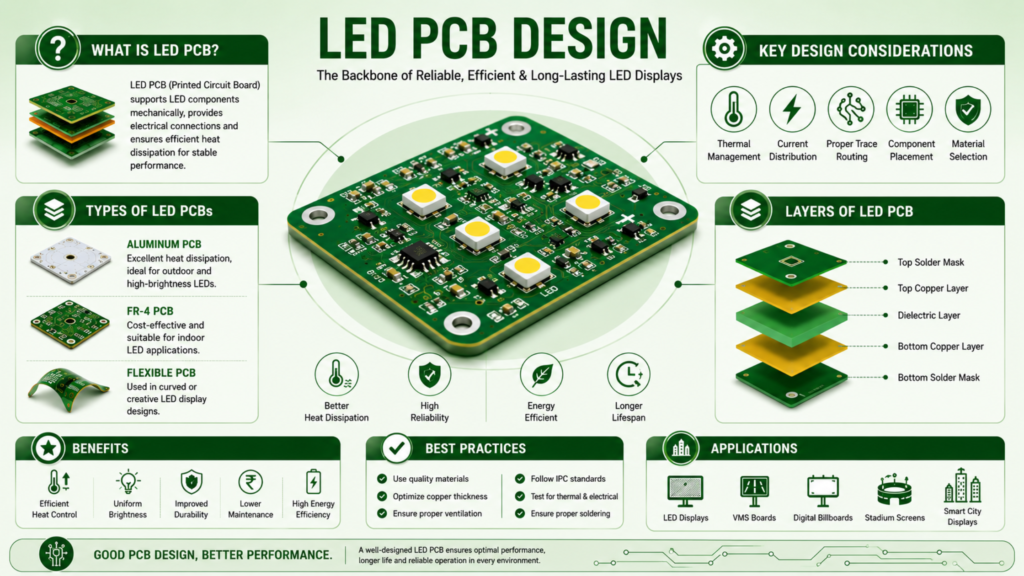
When you see a bright outdoor LED display, a Variable Message Sign (VMS), or a digital billboard working flawlessly in extreme weather, one important component is working behind the scenes-the LED PCB Design. While LEDs get most of the attention, the printed circuit board (PCB) is what powers, connects, and protects every LED module.
A well-planned LED PCB Design improves brightness, extends the display’s lifespan, reduces heat, and ensures reliable performance in demanding environments. Whether it’s for highway information systems, smart city displays, industrial signboards, or commercial LED screens, PCB design directly impacts the overall quality of the display.
In this guide, we’ll explain how LED PCBs work, the materials used, design considerations, and best practices for achieving long-lasting performance.
What Is LED PCB Design?
LED PCB Design refers to the process of designing a printed circuit board that mechanically supports LEDs while providing electrical connections and effective heat dissipation.
Unlike standard PCBs, LED boards are designed to handle higher temperatures and ensure consistent current distribution. Poor PCB design can lead to uneven brightness, overheating, reduced lifespan, and premature LED failure.
Why Is LED PCB Design Important?
A high-quality LED PCB Design offers several benefits:
- Efficient heat management
- Longer LED lifespan
- Stable brightness
- Lower maintenance costs
- Improved energy efficiency
- Reliable operation in outdoor environments
- Better electrical performance
For industries like transportation, smart cities, and digital signage, reliable PCB design is critical for uninterrupted operation.
Main Components of an LED PCB
A typical LED PCB consists of several essential components:
LED Chips
The primary light source mounted on the PCB.
Copper Traces
Carry electrical current between components.
Driver IC
Regulates current supplied to LEDs.
Resistors and Capacitors
Control voltage, filter noise, and stabilize the circuit.
Thermal Pads
Transfer heat away from LEDs to prevent overheating.
Connectors
Provide power and communication between modules.
Types of LED PCB Design
1. Aluminum PCB
The most common choice for outdoor LED displays because of excellent heat dissipation.
Advantages
- Lightweight
- High thermal conductivity
- Longer LED life
- Suitable for high-brightness displays
2. FR-4 PCB
Widely used in indoor LED applications where heat generation is relatively low.
Advantages
- Cost-effective
- Easy to manufacture
- Suitable for low-power displays
3. Flexible PCB
Used in curved LED displays and creative digital signage.
Advantages
- Lightweight
- Bendable
- Compact design
Materials Used in LED PCB Design
Material selection significantly affects performance.
| Material | Best For | Benefits |
|---|---|---|
| Aluminum | Outdoor LED Displays | Excellent heat dissipation |
| FR-4 | Indoor Displays | Affordable and reliable |
| Copper | High-power LED Modules | Superior electrical conductivity |
| Ceramic | Industrial Applications | High thermal resistance |
Key Considerations in LED PCB Design
Thermal Management
Heat is one of the biggest enemies of LED performance. Proper thermal design ensures stable brightness and longer operating life.
Current Distribution
Balanced current prevents brightness variation across the display.
Copper Thickness
Thicker copper layers improve current carrying capacity and reduce voltage drops.
Component Placement
Proper spacing between LEDs and driver ICs improves airflow and reduces heat concentration.
Signal Integrity
Clean PCB routing minimizes electrical interference and improves display stability.
Common Challenges in LED PCB Design
Engineers often face challenges such as:
- Excessive heat generation
- Voltage drop across long PCB traces
- Uneven brightness
- Poor solder joints
- Moisture exposure in outdoor installations
- Thermal expansion during temperature changes
Addressing these issues early in the design stage helps improve long-term reliability.
10 Best Practices for LED PCB Design
- Choose the right PCB material for the application.
- Optimize thermal management with aluminum or copper-core PCBs.
- Use wider copper traces for high-current circuits.
- Place driver ICs strategically to reduce heat buildup.
- Ensure uniform current distribution across LED modules.
- Minimize signal interference through proper routing.
- Follow IPC PCB design standards.
- Design for easy maintenance and module replacement.
- Test thermal performance before production.
- Use high-quality components for improved durability.
Applications of LED PCB Design
Modern LED PCB Design is widely used across industries, including:
- Variable Message Signs (VMS)
- Highway Information Systems
- Smart Traffic Displays
- Digital Billboards
- Outdoor Advertising Screens
- Stadium LED Displays
- Airport Information Displays
- Railway Passenger Information Systems
- Industrial Control Panels
- Smart City Display Solutions
Frequently Asked Questions
What is LED PCB Design?
LED PCB Design is the process of designing printed circuit boards specifically for LED lighting and display applications, focusing on electrical performance and heat management.
Why are aluminum PCBs preferred?
Aluminum PCBs offer excellent thermal conductivity, making them ideal for high-brightness outdoor LED displays.
How does PCB design affect LED lifespan?
Efficient thermal management and proper current distribution reduce overheating, helping LEDs operate reliably for longer periods.
Which PCB material is best for outdoor LED displays?
Aluminum-core PCBs are widely preferred because they efficiently dissipate heat and withstand harsh environmental conditions.
What standards should LED PCBs follow?
Many manufacturers follow IPC standards for PCB quality, along with industry-specific requirements depending on the application.
Conclusion
A reliable LED PCB Design is the backbone of every high-performance LED display. From selecting the right material to optimizing thermal management and current distribution, every design decision influences brightness, efficiency, and durability.
For demanding applications such as highway infrastructure, smart city projects, and industrial display systems, investing in a well-engineered PCB ensures long-term reliability and reduced maintenance costs.
As LED technology continues to evolve, advanced PCB designs will play an even greater role in delivering brighter, smarter, and more energy-efficient display solutions.

