
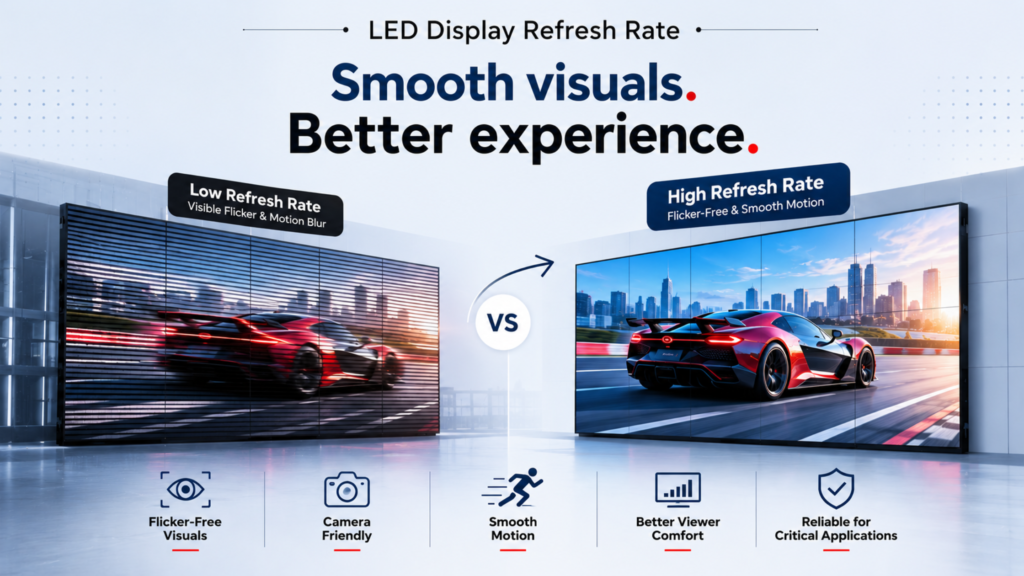
When people evaluate an LED display, they often focus on brightness, pixel pitch, or screen size. While these factors are important, one specification that significantly influences visual quality is the LED Display Refresh Rate.
Whether you’re watching a large outdoor billboard, a stadium display, a Variable Message Sign (VMS), or a digital screen inside an airport, the refresh rate determines how smooth, stable, and flicker-free the content appears.
A high LED Display Refresh Rate not only improves the viewing experience for people but also ensures the display performs well when captured by cameras during live broadcasts, video recording, or photography.
At Vulcan Advance Intelligence Computing Pvt. Ltd. (Vulcan AIC), refresh rate is one of the many engineering parameters carefully considered while designing intelligent LED display solutions for highways, transportation systems, smart cities, command centers, and commercial applications.
In this guide, we’ll explain what LED Display Refresh Rate is, how it works, why it matters, and how choosing the right refresh rate improves overall display performance.
What is LED Display Refresh Rate?
LED Display Refresh Rate refers to the number of times an LED display updates the image every second.
It is measured in Hertz (Hz).
For example:
- 1,920 Hz means the display refreshes the image 1,920 times every second.
- 3,840 Hz means the display refreshes 3,840 times every second.
- 7,680 Hz refreshes the display 7,680 times per second.
The higher the LED Display Refresh Rate, the smoother and more stable the displayed content appears.
Unlike frame rate, which depends on the video source, refresh rate is determined by the LED display hardware and its control system.
Why LED Display Refresh Rate Matters
A high LED Display Refresh Rate directly affects how content is viewed by both the human eye and digital cameras.
The benefits include:
- Smoother video playback
- Reduced flickering
- Better camera recording
- Improved visual stability
- Enhanced viewing experience
- Professional-quality broadcasting
For applications where displays operate continuously, refresh rate becomes a critical performance factor.
How LED Display Refresh Rate Works
Every LED display consists of thousands-or even millions-of LEDs arranged in a grid. The display controller continuously updates these LEDs by turning them on and off at extremely high speeds. This process happens so quickly that the human eye perceives a stable, continuous image.
A higher LED Display Refresh Rate means these updates occur more frequently, resulting in smoother visuals and reduced flicker.
LED Display Refresh Rate vs Frame Rate
Many people confuse LED Display Refresh Rate with frame rate, but they are different concepts.
| LED Display Refresh Rate | Frame Rate |
|---|---|
| Controlled by display hardware | Controlled by video source |
| Measured in Hertz (Hz) | Measured in Frames Per Second (FPS) |
| Determines display update speed | Determines video recording speed |
| Affects screen stability | Affects motion captured in content |
Both work together to create a smooth visual experience.
Common LED Display Refresh Rates
Modern LED displays are available with different refresh rates depending on their intended application.
960 Hz
Suitable for basic indoor displays where camera recording is not a priority.
1,920 Hz
Common in commercial LED displays and standard advertising applications.
3,840 Hz
Widely considered the industry standard for professional LED displays.
It offers:
- Excellent image stability
- Smooth motion
- Reduced flickering
- Better camera performance
7,680 Hz
Used in premium broadcast studios, television production, virtual production environments, and high-end commercial displays. These displays provide exceptional visual quality even under high-speed cameras.
Factors That Affect LED Display Refresh Rate
Several hardware components influence LED Display Refresh Rate.
LED Driver IC
High-quality LED Driver ICs improve grayscale performance and support higher refresh rates.
Receiving Card
The receiving card processes display data and synchronizes image updates across the LED screen.
Sending Card
The sending card transmits image information from the control system to the display.
Its performance directly impacts refresh stability.
Control System
Modern LED display controllers optimize image processing while maintaining consistent refresh performance.
Scan Rate
Scan rate and LED Display Refresh Rate are related but different specifications.
Lower scan ratios generally allow higher brightness, while refresh rate determines how frequently the image updates.
Benefits of High LED Display Refresh Rate
Smooth Motion
Fast-moving videos appear significantly smoother.
Better Camera Performance
Displays with higher refresh rates eliminate rolling lines, flickering, and image banding during video recording.
Improved Viewer Comfort
Stable images reduce eye strain during prolonged viewing.
Professional Broadcasting
Television studios, sports arenas, and live event production require high LED Display Refresh Rate to maintain broadcast-quality visuals.
Higher Display Quality
Whether displaying advertisements, traffic information, or public announcements, higher refresh rates improve the overall visual experience.
Applications That Require High LED Display Refresh Rate
High refresh rates are particularly important in:
- Outdoor LED Displays
- Variable Message Signs (VMS)
- Digital Billboards
- Airports
- Railway Stations
- Stadium Displays
- Broadcast Studios
- Command & Control Centers
- Smart City Infrastructure
- Corporate Display Solutions
At Vulcan AIC, selecting the appropriate LED Display Refresh Rate is part of delivering reliable display solutions that perform effectively in demanding environments, from highways and tunnels to transportation hubs and commercial spaces.
Low Refresh Rate vs High LED Display Refresh Rate
Understanding the difference between a low and high LED Display Refresh Rate helps buyers choose the right display for their application.
| Feature | Low Refresh Rate | High LED Display Refresh Rate |
|---|---|---|
| Visual Smoothness | Basic | Excellent |
| Camera Recording | Visible Flicker | Flicker-Free |
| Motion Handling | Average | Smooth |
| Live Broadcasting | Not Recommended | Highly Recommended |
| Viewer Comfort | Moderate | Excellent |
| Professional Applications | Limited | Ideal |
For critical applications such as transportation, broadcasting, command centers, and outdoor advertising, a higher LED Display Refresh Rate delivers a noticeably better viewing experience.
How to Choose the Right LED Display Refresh Rate
Choosing the correct LED Display Refresh Rate depends on how and where the display will be used.
Indoor Commercial Displays
A refresh rate of around 1,920 Hz is suitable for many retail stores, meeting rooms, and indoor advertising screens.
Outdoor LED Displays
Outdoor installations typically benefit from 3,840 Hz or higher to maintain image stability under varying lighting conditions.
Broadcast Studios
Television production and virtual studios generally require 3,840 Hz to 7,680 Hz to eliminate flickering when captured by professional cameras.
Variable Message Signs (VMS)
Highway Variable Message Signs (VMS) display critical traffic information in real time. A stable LED Display Refresh Rate, combined with proper brightness and control systems, ensures messages remain clear and readable for drivers under different lighting conditions.
At Vulcan Advance Intelligence Computing Pvt. Ltd. (Vulcan AIC), intelligent LED display solutions are engineered by balancing refresh rate, brightness, driver IC performance, and display control technologies to deliver reliable performance across highways, tunnels, smart cities, and transportation infrastructure.
Common Myths About LED Display Refresh Rate
Myth 1: Higher Brightness Means Better Quality
Brightness improves visibility, but it does not replace the need for a high LED Display Refresh Rate. Both work together to produce a better visual experience.
Myth 2: Pixel Pitch Determines Refresh Rate
Pixel pitch affects image resolution and viewing distance, while LED Display Refresh Rate determines how frequently the display updates its content.
Myth 3: Refresh Rate Only Matters for Cameras
Although high refresh rates are essential for broadcasting, they also improve image stability, reduce flicker, and enhance the viewing experience for the human eye.
Myth 4: All LED Displays Have the Same Refresh Rate
Different LED displays use different driver ICs, receiving cards, control systems, and scan rates, resulting in varying LED Display Refresh Rate performance.
Future of LED Display Refresh Rate
As LED display technology continues to evolve, refresh rates are becoming even higher to support increasingly demanding applications.
Future developments include:
- AI-powered display optimization
- Higher grayscale performance
- Advanced LED driver ICs
- Improved HDR compatibility
- Virtual production studios
- XR and mixed reality applications
- High-speed sports broadcasting
- Smart transportation infrastructure
These advancements will further improve image quality, energy efficiency, and display reliability.
Frequently Asked Questions
What is a good LED Display Refresh Rate?
For professional LED displays, 3,840 Hz is widely considered an excellent refresh rate because it delivers smooth visuals and performs well during camera recording.
Does LED Display Refresh Rate affect image quality?
Yes. A higher LED Display Refresh Rate reduces flickering, improves motion clarity, and creates a more stable viewing experience.
Is refresh rate important for outdoor LED displays?
Absolutely. Outdoor displays often operate under changing lighting conditions and are frequently recorded by cameras. A high refresh rate helps maintain clear and stable visuals.
Is LED Display Refresh Rate the same as frame rate?
No. LED Display Refresh Rate is the speed at which the display updates the image, while frame rate refers to the number of video frames generated by the content source.
Which industries require high LED Display Refresh Rate?
Industries such as broadcasting, transportation, advertising, sports venues, airports, railway stations, command centers, and smart cities benefit from high-refresh-rate LED displays.
Conclusion
The Display Refresh Rate is one of the most important technical specifications influencing the performance of an LED display. While brightness and pixel pitch often receive more attention, refresh rate plays a crucial role in delivering smooth visuals, reducing flicker, enhancing camera compatibility, and ensuring a comfortable viewing experience.
Whether it’s an outdoor billboard, a Variable Message Sign (VMS), a broadcast studio display, or a command-and-control center, selecting the appropriate refresh rate helps achieve reliable, high-quality visual communication.
At Vulcan Advance Intelligence Computing Pvt. Ltd. (Vulcan AIC), every LED display solution is engineered with careful attention to refresh rate, driver electronics, display control systems, and overall performance. This integrated approach ensures reliable operation across highways, tunnels, smart city projects, transportation hubs, corporate environments, and other mission-critical applications.
As display technology continues to advance, understanding the importance of LED Display Refresh Rate will help businesses and infrastructure developers make informed decisions that deliver long-term performance and exceptional visual quality.

