
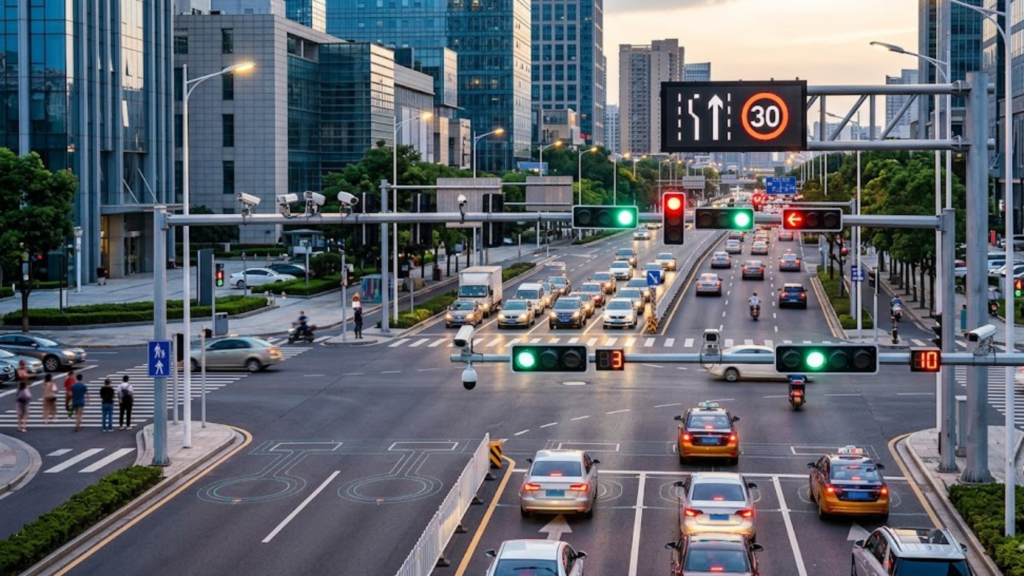
How traffic lights know when to change is something most of us have wondered at least once.
You’re waiting at a red signal. There’s no traffic on the other side. No pedestrians. Yet, the light doesn’t change. It feels random. Sometimes even frustrating. But traffic lights don’t actually work randomly. Behind every signal change, there is a system designed to manage traffic flow, improve safety, and reduce congestion.
Let’s understand how it really works.
1.Fixed-Time Signals (The Basic System)
In many areas, traffic lights still operate on fixed timers.
This means:
- Each signal follows a preset cycle
- Green, yellow, and red lights run for fixed durations
- The system does not react to real-time traffic
This is why you may wait even when the road is empty.
While simple and reliable, fixed systems are not efficient for modern traffic conditions.
2. Sensor-Based Traffic Signals
To improve efficiency, modern systems use sensors installed on or under the road.
These sensors help traffic lights know when to change by:
- Detecting vehicles waiting at intersections
- Measuring traffic density
- Triggering signal changes based on demand
For example, if one lane has more vehicles, it may get a longer green signal. This reduces waiting time and improves flow.
3.Camera-Based Monitoring Systems
You may have seen cameras installed at traffic signals.
These cameras are not just for surveillance.
They help:
- Monitor traffic movement
- Analyze congestion levels
- Support dynamic signal control
This allows signals to adjust based on actual road conditions rather than fixed timing.
4.AI-Based Traffic Control Systems
The most advanced systems today use artificial intelligence.
AI helps traffic lights know when to change more accurately by:
- Collecting real-time data
- Analyzing traffic patterns
- Predicting congestion
- Adjusting signals automatically
Instead of working independently, signals can coordinate across multiple intersections. This creates smoother and more efficient traffic movement.
5.Why Signals Don’t Change Instantly
Even with smart systems, traffic lights don’t always switch immediately.
There are important reasons:
Safety Timing
Signals include buffer time to allow vehicles to clear intersections safely.
Signal Coordination
Traffic lights are often synchronized to maintain flow across multiple roads.
Traffic Priority
Busy roads may be given longer green signals compared to less crowded ones.
6.Role of Smart Display Systems
Traffic lights are only one part of modern traffic management.
Today’s systems also include:
- Variable Message Signs (VMS)
- Speed display systems
- Lane control signals
These systems provide real-time information to drivers, helping them make better decisions.
At Vulcan Advance Intelligence Computing Pvt. Ltd., intelligent display and traffic solutions are designed to work together—creating a connected system that improves both safety and efficiency.
7.How Traffic Systems Are Evolving
Traffic management is shifting from static to intelligent systems.
Earlier:
- Fixed signals
- Manual monitoring
- No real-time response
Now:
- Adaptive signals
- AI-based decision-making
- Real-time traffic control
This evolution is helping cities manage increasing traffic more effectively.
8.The Future of Traffic Signals
The future of traffic systems is predictive.
Soon, traffic lights will:
- Anticipate congestion before it happens
- Communicate with vehicles
- Adjust instantly in real time
This will reduce delays and make travel smoother.
Conclusion
So, how do traffic lights know when to change? They use a combination of timers, sensors, cameras, and AI-based systems to manage traffic efficiently. What may seem like a simple signal is actually part of a larger, intelligent system working behind the scenes.
The next time you’re waiting at a signal, remember – it’s not random. It’s designed to keep roads safe and traffic moving.
Want Smarter Traffic Solutions for Your Project?
Modern traffic systems are no longer just about signals-they are about real-time intelligence and connected infrastructure.
At Vulcan Advance Intelligence Computing Pvt. Ltd., we design intelligent traffic and display systems that improve road safety, reduce congestion, and support smarter cities.
Looking to upgrade your traffic systems?
Need intelligent display or smart signaling solutions?
Connect with Vulcan AIC to explore solutions built for modern infrastructure.
FAQ
How do traffic lights know when to change?
Traffic lights use timers, sensors, cameras, and AI systems to detect traffic and adjust signal timing.
Do traffic lights detect vehicles?
Yes, modern systems use sensors and cameras to detect vehicles and optimize signals.
Why do traffic lights stay red when no cars are coming?
This happens in fixed-timer systems that do not respond to real-time traffic.
Are traffic lights controlled by AI?
Yes, advanced systems use AI to analyze traffic and manage signals efficiently.

