
When motorists see a Variable Message Sign (VMS) on an expressway displaying messages such as “Accident Ahead,” “Reduce Speed,” or “Lane Closed,” they usually notice only the LED display mounted above the road.
What remains hidden is the engineering that powers every message.
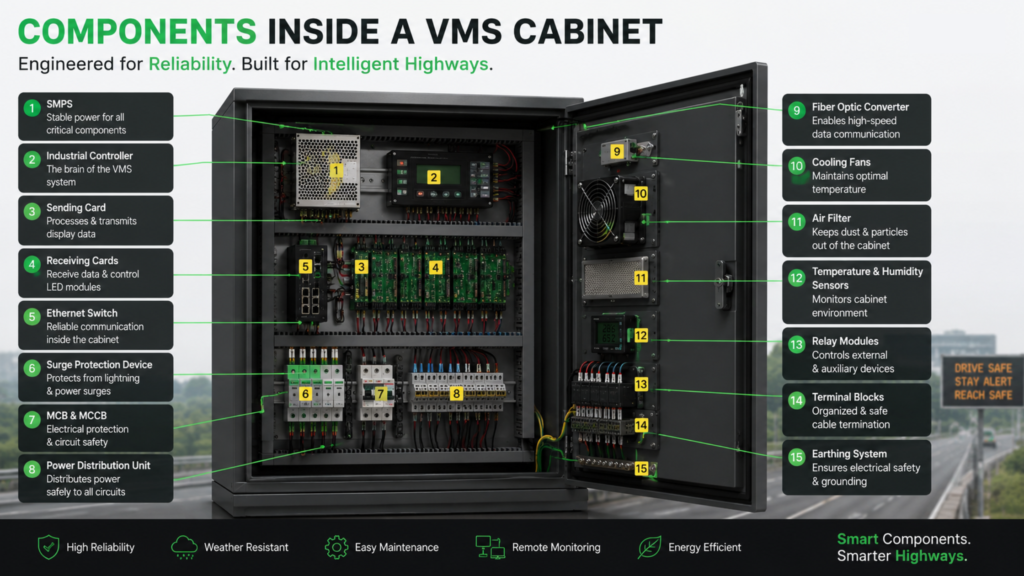
Behind every reliable highway display is a carefully designed enclosure containing dozens of electrical, electronic, communication, and protection devices working together. These Components Inside a VMS Cabinet ensure the display operates continuously despite heat, rain, dust, power fluctuations, vibration, and around-the-clock operation.
A modern VMS cabinet is much more than a metal box. It is the control center of the entire Variable Message Sign system, housing intelligent electronics responsible for power distribution, communication, display control, diagnostics, and equipment protection.
At Vulcan AIC, our engineering teams design and manufacture intelligent transportation solutions for highways, tunnels, expressways, and smart infrastructure. Every VMS cabinet is engineered to provide dependable performance in demanding outdoor environments while supporting real-time traffic communication.
In this guide, we’ll explore the Components Inside a VMS Cabinet, understand the function of each device, and see how they work together to keep intelligent transportation systems operating safely and efficiently.
What Is a VMS Cabinet?
A Variable Message Sign (VMS) Cabinet is an outdoor electrical enclosure that houses all the equipment required to operate an LED traffic display. It acts as the central hub where power enters the system, communication signals are processed, control electronics operate, and protection devices safeguard the equipment.
While the LED display panel is the visible part installed on highways, nearly all the intelligence that enables the display to function resides inside the cabinet.
A typical VMS cabinet supports:
- LED display modules
- Traffic management communication
- Power distribution
- Remote monitoring
- Environmental protection
- Electrical safety
- Fault diagnostics
- Maintenance access
Without these integrated systems, a highway VMS would not be able to deliver reliable real-time information to road users.
Why Are Components Inside a VMS Cabinet Important?
Unlike indoor electronic equipment, highway infrastructure operates under some of the harshest environmental conditions.
A VMS system may face:
- Extreme summer temperatures
- Heavy rainfall
- Dust storms
- High humidity
- Continuous vibration
- Lightning-induced surges
- Unstable power supply
- 24×7 continuous operation
Every one of these conditions places stress on the electronics.
The Components Inside a VMS Cabinet are selected and arranged to ensure the system remains operational even under demanding field conditions. Each component has a dedicated responsibility, whether it is distributing power, processing data, protecting against electrical faults, regulating temperature, or enabling remote communication.
When these components work together seamlessly, highway authorities can rely on the VMS system to deliver timely information that supports traffic management and road safety.
Understanding the Architecture of a VMS Cabinet
Before examining individual components, it is helpful to understand how a modern VMS cabinet is organized.
Although configurations vary depending on project requirements, most systems follow a structured architecture that separates electrical, communication, and control functions.
A typical cabinet consists of five major sections:
1. Power Distribution Section
This section receives incoming electrical power and safely distributes it throughout the cabinet.
It includes equipment such as:
- Main isolator
- MCBs
- MCCBs
- Surge Protection Devices (SPD)
- Power distribution terminals
- Earthing system
This section protects the entire VMS installation against electrical faults and ensures stable power reaches every subsystem.
2. Display Control Section
This is the brain of the Variable Message Sign. It processes commands received from the traffic management center and converts them into signals that drive the LED display.
The control section typically houses:
- Industrial controller
- Sending card
- Receiving cards
- Display processor
- Communication interfaces
Together, these devices determine what message appears on the display and ensure it is shown accurately.
3. Communication Section
Modern highways rely on real-time communication. The communication section enables the VMS cabinet to exchange information with centralized traffic control systems.
Depending on the project, this area may include:
- Ethernet switches
- Fiber optic converters
- Network routers
- Cellular communication devices
- Industrial communication modules
Reliable communication ensures operators can update messages instantly in response to changing traffic conditions.
4. Environmental Control Section
Electronic components generate heat.
Excessive temperature can reduce equipment performance and lifespan.
To maintain suitable operating conditions, VMS cabinets often include:
- Cooling fans
- Air filters
- Ventilation systems
- Thermostats
- Temperature sensors
- Humidity monitoring devices
These components help maintain stable internal conditions despite changing weather.
5. Safety & Protection Section
Safety is one of the most important considerations inside any outdoor electrical cabinet.
Protective devices reduce the risk of damage caused by:
- Overcurrent
- Short circuits
- Lightning surges
- Voltage fluctuations
- Ground faults
- Environmental exposure
These systems help ensure continuous operation while protecting valuable electronic equipment.
Categories of Components Inside a VMS Cabinet
Although every manufacturer may use different layouts, the Components Inside a VMS Cabinet generally fall into five primary categories.
Structural Components
These provide the mechanical foundation of the cabinet.
They include:
- Cabinet enclosure
- Mounting plates
- DIN rails
- Cable trays
- Cable glands
- Locks
- Hinges
- Sealing gaskets
- Maintenance doors
A well-designed enclosure protects sensitive electronics from water, dust, and unauthorized access while simplifying maintenance.
Electrical Components
Electrical equipment distributes and regulates power throughout the system.
Examples include:
- MCB
- MCCB
- SMPS
- Terminal blocks
- Power distribution units
- Earthing bars
- Surge Protection Devices
Reliable power management is essential for uninterrupted highway operation.
Communication Components
These devices connect the VMS cabinet to traffic management systems.
Typical communication hardware includes:
- Ethernet switches
- Fiber optic equipment
- Industrial routers
- Communication controllers
- Network cables
- RJ45 connectors
These components allow traffic operators to remotely monitor and control the display in real time.
Environmental Components
Outdoor cabinets must maintain suitable internal operating conditions.
Environmental equipment commonly includes:
- Cooling fans
- Filters
- Exhaust units
- Temperature sensors
- Thermostats
- Humidity sensors
These systems protect electronics from overheating and moisture buildup.
Protection Components
Protection devices help safeguard expensive electronic equipment.
Common examples include:
- Surge Protection Devices (SPD)
- Circuit breakers
- Earthing systems
- Lightning protection interfaces
- Fuse holders
- Isolation switches
These components reduce the risk of equipment damage caused by electrical disturbances.
Engineering Considerations for Components Inside a VMS Cabinet
Designing a VMS cabinet is not simply about installing components inside a metal enclosure. It requires careful engineering to ensure every device operates reliably throughout years of outdoor service.
At Vulcan AIC, cabinet design begins with understanding the operating environment. Factors such as ambient temperature, rainfall, dust levels, highway location, communication requirements, and maintenance accessibility all influence the final cabinet configuration.
Some of the key engineering considerations include:
- Proper heat dissipation
- Organized cable routing
- Easy maintenance access
- Protection against water and dust ingress
- Reliable grounding and bonding
- Modular component placement
- Efficient airflow management
- Future scalability for system upgrades
A well-engineered cabinet not only improves system reliability but also reduces maintenance time and extends the operational life of critical infrastructure.
Components Inside a VMS Cabinet: Complete Guide to Every Critical Component
Now let’s look inside the cabinet and examine each major component in detail. Every device has a specific purpose, and together they create a robust, intelligent, and reliable Variable Message Sign (VMS) system.
At Vulcan AIC, every VMS cabinet is engineered with carefully selected industrial-grade components to ensure dependable performance across highways, expressways, tunnels, and other Intelligent Transportation System (ITS) applications.
1. Switched Mode Power Supply (SMPS)
One of the most critical Components Inside a VMS Cabinet is the Switched Mode Power Supply (SMPS). The SMPS converts the incoming AC supply into stable DC voltages required by the LED modules, receiving cards, communication equipment, industrial controllers, and other electronic devices.
Unlike conventional transformers, SMPS units offer:
- High efficiency
- Compact size
- Lower heat generation
- Stable voltage output
- Better energy efficiency
A VMS display may contain several SMPS units working together depending on the display size and power requirements.
At Vulcan AIC, SMPS selection is based on load calculations, redundancy requirements, thermal performance, and long-term reliability.
2. Main Circuit Breaker (MCB)
Every electrical cabinet begins with protection.
The Miniature Circuit Breaker (MCB) protects the electrical circuits from:
- Short circuits
- Overcurrent
- Equipment faults
If excessive current flows through the system, the MCB disconnects the supply automatically. This prevents damage to expensive electronics inside the cabinet.
MCBs are installed for different circuits, including:
- LED power
- Controller supply
- Cooling system
- Communication equipment
- Auxiliary circuits
3. Molded Case Circuit Breaker (MCCB)
Larger VMS installations typically include an MCCB as the primary incoming protection device.
Compared to MCBs, MCCBs provide:
- Higher current ratings
- Adjustable protection settings
- Greater fault interruption capability
They protect the complete VMS cabinet against major electrical faults before power reaches downstream components.
4. Surge Protection Device (SPD)
Outdoor highway installations are exposed to lightning and switching surges.
A Surge Protection Device (SPD) protects sensitive electronics by diverting transient overvoltages safely to earth.
Without an SPD, voltage spikes can damage:
- LED modules
- Controllers
- Communication equipment
- Power supplies
- Industrial PCs
Highway infrastructure cannot afford unexpected downtime, making surge protection one of the most important Components Inside a VMS Cabinet.
5. Industrial Controller
The industrial controller acts as the brain of the entire system.
It receives commands from the Traffic Management Center (TMC), processes them, and sends instructions to the LED display.
Its responsibilities include:
- Message processing
- Scheduling
- Diagnostics
- Display management
- Fault monitoring
- Remote communication
Modern controllers also support multiple communication protocols for integration with ITS platforms.
At Vulcan AIC, industrial controllers are selected for continuous operation under demanding environmental conditions.
6. Sending Card
The Sending Card converts digital information into display signals.
Its functions include:
- Receiving messages
- Processing graphics
- Synchronizing display data
- Managing screen refresh
Think of it as the bridge between the control software and the physical LED display.
Without it, images and text cannot be displayed correctly.
7. Receiving Cards
Each LED cabinet contains one or more Receiving Cards.
These cards receive data from the Sending Card and distribute it to the LED modules.
They manage:
- Pixel mapping
- Brightness control
- Color calibration
- Signal synchronization
Large Variable Message Signs may contain multiple receiving cards working together to maintain seamless display performance.
8. LED Driver Circuits
The driver circuits regulate electrical current supplied to every LED.
Proper current regulation ensures:
- Uniform brightness
- Accurate colors
- Longer LED lifespan
- Stable performance
Poor driver design can cause:
- Flickering
- Uneven brightness
- Dead pixels
- Reduced display life
For highway infrastructure, reliability is more important than maximum brightness alone.
9. Ethernet Switch
Modern ITS relies heavily on networking.
The Industrial Ethernet Switch connects various devices inside the VMS cabinet.
These may include:
- Controller
- Receiving cards
- Monitoring systems
- CCTV integration
- Remote diagnostics
- Fiber communication devices
Industrial switches are specifically designed to operate reliably under vibration, heat, and electrical noise.
10. Fiber Optic Converter
Many highway VMS systems communicate using optical fiber.
Fiber communication offers:
- High-speed data transmission
- Long-distance connectivity
- Low signal loss
- Excellent immunity to electromagnetic interference
The Fiber Optic Converter translates electrical Ethernet signals into optical signals and vice versa.
This enables reliable communication between the VMS cabinet and centralized traffic management centers.
11. Industrial Router
Some VMS installations communicate through:
- 4G
- LTE
- 5G
- VPN networks
Industrial routers provide secure remote connectivity between the cabinet and control center.
Operators can:
- Update messages
- Monitor equipment
- Diagnose faults
- Perform remote maintenance
without physically visiting the site.
12. Terminal Blocks
Although often overlooked, Terminal Blocks play a vital role in cabinet organization.
They provide:
- Safe cable termination
- Organized wiring
- Easy maintenance
- Faster troubleshooting
Proper terminal labeling also simplifies future upgrades and repairs.
13. Relay Modules
Relay modules act as electrically controlled switches.
They are commonly used to operate:
- Cooling fans
- Warning lights
- Alarm systems
- External sensors
- Auxiliary devices
Relays isolate control circuits from power circuits, improving both safety and reliability.
14. Cooling Fans
LED displays and power electronics generate significant heat.
Without proper airflow, internal temperatures may rise beyond safe operating limits.
Cooling fans circulate air throughout the cabinet to remove excess heat.
Benefits include:
- Improved equipment lifespan
- Stable performance
- Lower operating temperatures
- Reduced thermal stress
At Vulcan AIC, airflow paths are carefully engineered to ensure efficient cooling across all critical components.
15. Air Filters
Outdoor environments contain:
- Dust
- Sand
- Pollen
- Industrial particles
- Insects
Air filters prevent these contaminants from entering the cabinet while allowing sufficient airflow for cooling.
Regular filter maintenance helps preserve system efficiency and reduces component failures.
16. Thermostat
A thermostat automatically controls the operation of cooling fans or heaters based on internal cabinet temperature.
Instead of running continuously, environmental control equipment operates only when required.
This approach:
- Saves energy
- Reduces fan wear
- Maintains optimal operating temperature
- Improves equipment reliability
17. Temperature Sensor
Continuous temperature monitoring is essential for outdoor electronics.
Temperature sensors:
- Measure internal cabinet temperature
- Trigger alarms
- Activate cooling systems
- Send status updates to remote monitoring platforms
Operators can quickly detect overheating before it causes equipment failure.
18. Humidity Sensor
Moisture inside electrical cabinets can cause:
- Corrosion
- Short circuits
- Condensation
- Reduced insulation performance
Humidity sensors continuously monitor internal moisture levels.
If humidity exceeds safe limits, maintenance personnel can investigate before damage occurs.
19. Power Distribution Unit (PDU)
A Power Distribution Unit safely distributes electrical power from the incoming supply to multiple circuits inside the cabinet.
It ensures every subsystem receives the appropriate voltage and current while maintaining organized power routing.
20. Earthing System
A reliable grounding system is fundamental for electrical safety.
The earthing system protects:
- Personnel
- Equipment
- Communication devices
- Power electronics
It also provides a safe path for lightning energy and electrical faults.
Proper grounding significantly improves the reliability of all Components Inside a VMS Cabinet.
21. Cable Glands and Cable Management
Professional cable management is far more than aesthetics.
Organized cable routing:
- Prevents mechanical damage
- Improves airflow
- Simplifies maintenance
- Reduces electrical interference
- Enhances safety
Weatherproof cable glands also maintain the cabinet’s environmental protection rating by preventing water and dust ingress.
22. Maintenance Lighting
Many premium VMS cabinets include internal LED maintenance lights.
These lights allow technicians to inspect and service equipment safely during nighttime or low-light conditions without requiring external lighting.
Why Component Integration Matters
Each device discussed above performs a specialized function, but the real strength of a VMS cabinet lies in how these components work together as a unified system.
Power flows from the incoming supply through protection devices and distribution units. The SMPS converts it into stable DC power for electronic equipment. The industrial controller receives commands from the Traffic Management Center, processes the information, and passes it through the sending and receiving cards to the LED modules. At the same time, communication devices maintain network connectivity, while cooling systems regulate internal temperature and monitoring devices continuously check the cabinet’s health.
At Vulcan AIC, every VMS cabinet undergoes detailed engineering to ensure that these components operate seamlessly, delivering dependable performance in demanding highway and tunnel environments.
Components Inside a VMS Cabinet: How Everything Works Together
Now it’s time to understand how all these components function together as one intelligent system.
At Vulcan AIC, a Variable Message Sign (VMS) cabinet is not simply an enclosure filled with electronic equipment. It is an integrated engineering solution designed to deliver reliable communication, high uptime, simplified maintenance, and long service life in demanding highway environments.
How All Components Inside a VMS Cabinet Work Together
A modern Variable Message Sign (VMS) is essentially a complete computer-controlled display system. Every component depends on the others for proper operation.
The complete operational sequence follows this workflow:
Step 1 – Incoming Power
Electrical power enters the cabinet through the main power supply.
Before reaching any sensitive equipment, it passes through:
- MCCB
- MCB
- Surge Protection Device (SPD)
- Terminal blocks
These components ensure the incoming electrical supply is protected and safely distributed.
Step 2 – Power Conversion
The incoming AC voltage is converted into stable DC voltage by the SMPS (Switched Mode Power Supply).
Different voltages are supplied to:
- LED modules
- Industrial Controller
- Receiving Cards
- Ethernet Switch
- Fiber Converter
- Communication Devices
Stable power is critical because even minor voltage fluctuations can affect LED performance and communication reliability.
Step 3 – Receiving Commands
The Traffic Management Center (TMC) sends instructions to the VMS cabinet through:
- Optical Fiber
- Ethernet
- Cellular Network
- VPN
- Industrial Router
These commands may include:
- Speed limits
- Accident warnings
- Lane closures
- Weather alerts
- Diversion messages
- Emergency notifications
Step 4 – Processing Information
The Industrial Controller receives the incoming command.
Its software:
- Validates the message
- Processes graphics
- Schedules display timing
- Performs diagnostics
- Sends data to the Sending Card
The controller ensures only valid information reaches the display.
Step 5 – Sending Data to the Display
The Sending Card converts processed information into LED display signals.
These signals travel to multiple Receiving Cards.
Each receiving card controls a dedicated section of the LED display.
Together they synchronize thousands of LEDs to display a seamless message.
Step 6 – Display Operation
The Receiving Cards communicate with the LED Driver ICs.
Driver ICs regulate current supplied to individual LEDs.
This produces:
- Uniform brightness
- Clear characters
- Accurate symbols
- Smooth scrolling
- Reliable animations
The driver circuitry continuously adjusts the LEDs to maintain consistent display quality.
Step 7 – Continuous Monitoring
Throughout operation, monitoring devices continuously observe:
- Temperature
- Humidity
- Fan operation
- Power status
- Network connectivity
- Voltage levels
- Controller health
If abnormal conditions occur, alerts are generated for maintenance personnel.
Internal Wiring Architecture
Inside a professionally engineered VMS cabinet, cable organization is just as important as component selection.
Poor cable management can cause:
- Signal interference
- Difficult maintenance
- Reduced airflow
- Increased fault risk
At Vulcan AIC, cable routing follows disciplined engineering practices that prioritize reliability and serviceability.
Typical wiring sections include:
Power Wiring
Carries electrical power between:
- MCCB
- MCB
- SMPS
- Distribution units
- LED modules
Power cables are sized according to load requirements.
Signal Wiring
Signal cables connect:
- Sending Card
- Receiving Cards
- Controller
- LED Drivers
Signal integrity is essential for stable display performance.
Communication Wiring
Industrial Ethernet and Fiber Optic cables connect:
- Traffic Management Center
- Ethernet Switch
- Communication Devices
- Remote Monitoring Systems
Communication wiring is separated from power wiring to minimize electromagnetic interference.
Earthing Conductors
Dedicated grounding conductors connect:
- Cabinet enclosure
- Power equipment
- Surge Protection Device
- Communication equipment
Proper earthing improves both safety and equipment reliability.
Thermal Management Inside a VMS Cabinet
Heat is one of the biggest threats to electronic equipment.
A VMS cabinet may operate in temperatures exceeding 50°C, especially during summer afternoons.
Without proper thermal management, excessive heat may lead to:
- Component aging
- Reduced LED brightness
- Power supply failures
- Communication faults
- Controller malfunction
Airflow Design
Cooling begins with intelligent airflow.
Fresh air enters through filtered intake vents.
Cooling fans circulate air across:
- SMPS
- Controllers
- Communication equipment
- Power electronics
Warm air exits through exhaust vents.
This continuous airflow removes accumulated heat from inside the enclosure.
Temperature Monitoring
Temperature sensors continuously measure internal cabinet temperature.
If temperatures rise beyond acceptable limits:
- Cooling fans activate automatically.
- Alerts may be transmitted to the control center.
- Maintenance teams can investigate before failures occur.
Environmental Protection
Outdoor VMS cabinets must withstand:
- Rain
- Dust
- Snow
- Humidity
- Insects
- Corrosive environments
Cabinets therefore use:
- Rubber gaskets
- Weatherproof cable glands
- Sealed doors
- Protective coatings
- Industrial-grade locking systems
These features help maintain the cabinet’s IP protection rating while safeguarding sensitive electronics.
Factory Acceptance Testing (FAT)
Before installation, every professionally manufactured VMS cabinet should undergo Factory Acceptance Testing (FAT).
At Vulcan AIC, testing is a critical part of the manufacturing process to verify performance before deployment.
Typical FAT procedures include:
Electrical Testing
Verification of:
- Voltage
- Current
- Power distribution
- Circuit protection
- Insulation
Functional Testing
Engineers verify:
- Display operation
- Controller performance
- Communication systems
- Brightness control
- LED functionality
Communication Testing
The cabinet is tested for reliable communication over:
- Ethernet
- Fiber
- Industrial protocols
- Remote control interfaces
Safety Testing
Protection devices are checked, including:
- MCB
- MCCB
- Surge Protection Device
- Earthing continuity
Burn-In Testing
Many manufacturers operate the cabinet continuously for extended periods to identify potential component failures before installation.
Maintenance of Components Inside a VMS Cabinet
Even the most reliable systems require preventive maintenance.
Routine inspections help maximize equipment life and reduce unexpected downtime.
Recommended maintenance activities include:
- Cleaning air filters
- Inspecting cooling fans
- Tightening electrical terminals
- Verifying earthing connections
- Testing surge protection devices
- Checking communication equipment
- Updating controller firmware
- Inspecting cable glands
- Measuring power supply voltages
Preventive maintenance is significantly more cost-effective than emergency repairs.
Common Component Failures
Although industrial components are designed for long service life, failures can occur.
Some common issues include:
SMPS Failure
Possible causes:
- Overheating
- Lightning surges
- Aging components
Symptoms:
- Complete display shutdown
- Voltage instability
Cooling Fan Failure
Symptoms:
- Rising cabinet temperature
- Reduced airflow
- Overheating alarms
Surge Protection Degradation
Repeated surge events gradually reduce SPD effectiveness.
Periodic inspection and replacement help maintain electrical protection.
Communication Failure
Possible causes:
- Damaged Ethernet cable
- Fiber connection fault
- Router malfunction
- Switch failure
Symptoms include loss of remote control or delayed message updates.
LED Driver Issues
Driver failures may produce:
- Dead pixels
- Flickering
- Uneven brightness
- Missing display sections
Regular diagnostics help identify problems before they affect the entire display.
Why Manufacturing Quality Matters
The performance of a VMS cabinet depends not only on individual components but also on the quality of engineering and manufacturing.
At Vulcan AIC, every cabinet is developed with a systems engineering approach. Components are carefully selected, integrated, tested, and arranged to ensure dependable performance throughout the product lifecycle.
Key manufacturing considerations include:
- Industrial-grade electrical components
- Precision cabinet fabrication
- Structured cable routing
- Efficient thermal design
- Reliable communication architecture
- Quality-controlled assembly
- Comprehensive testing procedures
The objective is to deliver a VMS cabinet that performs reliably in real-world highway environments—not just in a factory setting.
Why Vulcan AIC Focuses on Complete System Engineering
A Variable Message Sign is only as reliable as the cabinet that powers it.
At Vulcan AIC, our engineering philosophy extends beyond individual components. We integrate mechanical design, power systems, embedded electronics, networking, environmental protection, and quality assurance into a single, cohesive solution.
Whether deployed on expressways, tunnels, smart highways, or urban traffic corridors, our VMS cabinets are engineered to support continuous operation while meeting the demanding requirements of Intelligent Transportation Systems.
By combining in-house engineering expertise with rigorous manufacturing and testing, Vulcan AIC delivers solutions that help transportation authorities communicate clearly, respond quickly, and operate infrastructure with confidence.
Frequently Asked Questions (FAQs)
What are the most important Components Inside a VMS Cabinet?
The most important Components Inside a VMS Cabinet include the SMPS, industrial controller, receiving cards, Ethernet switch, cooling fans, surge protection devices, MCBs, MCCBs, terminal blocks, and communication modules.
Each component performs a specific function to ensure the Variable Message Sign operates safely and reliably.
Why is the VMS cabinet important?
A VMS cabinet is the operational core of a Variable Message Sign.
It houses all the electronic, electrical, communication, and protection equipment required to operate the LED display. Without the cabinet and its internal components, the display would not be able to receive commands, distribute power, communicate with the Traffic Management Center, or withstand outdoor environmental conditions.
How does a VMS cabinet communicate with the Traffic Management Center?
Modern VMS cabinets communicate through various industrial communication technologies, including:
- Optical Fiber
- Industrial Ethernet
- Cellular (4G/5G)
- VPN Networks
- Industrial Routers
These communication systems allow operators to remotely monitor the display, update traffic messages, diagnose faults, and perform system maintenance.
What protects a VMS cabinet from lightning and electrical surges?
Surge Protection Devices (SPDs) protect sensitive electronic equipment from voltage spikes caused by lightning strikes or switching surges.
Combined with proper earthing and circuit breakers, SPDs significantly reduce the risk of damage to controllers, LED modules, communication equipment, and power supplies.
Why does a VMS cabinet require cooling?
Electronic equipment continuously generates heat during operation.
Cooling systems—including fans, filters, thermostats, and ventilation paths—maintain safe internal temperatures, preventing overheating and extending the lifespan of critical components.
Proper thermal management also improves overall system reliability.
What is the role of receiving cards inside a VMS cabinet?
Receiving cards receive processed display data from the sending card and distribute it to the LED modules.
They ensure:
- Accurate pixel mapping
- Uniform brightness
- Synchronized display output
- Smooth animations
- Reliable message rendering
Large Variable Message Signs often contain multiple receiving cards working simultaneously.
How often should a VMS cabinet be maintained?
Routine preventive maintenance is generally recommended at scheduled intervals based on project requirements and operating conditions.
Typical maintenance activities include:
- Cleaning air filters
- Inspecting cooling fans
- Checking electrical connections
- Testing communication equipment
- Verifying surge protection devices
- Updating controller firmware
- Inspecting cable glands
- Measuring power supply voltages
Regular maintenance helps maximize uptime and reduce unexpected failures.
Who manufactures reliable Components Inside a VMS Cabinet?
At Vulcan AIC, every VMS solution is engineered using industrial-grade Components Inside a VMS Cabinet designed for highways, tunnels, and intelligent transportation infrastructure.
Why should engineers understand the Components Inside a VMS Cabinet?
Understanding the Components Inside a VMS Cabinet helps engineers design reliable, maintainable, and high-performance Variable Message Sign systems for long-term field operation.
Does Vulcan AIC manufacture VMS cabinets?
Yes.
Vulcan AIC designs and manufactures complete Variable Message Sign (VMS) systems, including engineered VMS cabinets for highways, expressways, tunnels, and Intelligent Transportation System (ITS) projects.
Our cabinets integrate industrial-grade electrical components, communication systems, power management, environmental protection, and intelligent monitoring to deliver reliable performance in demanding outdoor environments.
Future Trends in Components Inside a VMS Cabinet
As Intelligent Transportation Systems continue to evolve, the design of VMS cabinets is becoming increasingly intelligent, connected, and energy-efficient.
Some of the emerging trends include:
AI-Based Predictive Maintenance
Artificial Intelligence can analyze equipment performance to detect potential failures before they occur.
Future VMS cabinets may automatically predict failures in:
- Cooling systems
- Power supplies
- Communication equipment
- LED modules
This minimizes downtime and reduces maintenance costs.
IoT-Enabled Remote Monitoring
Internet of Things (IoT) technology enables continuous monitoring of cabinet health.
Operators can remotely monitor:
- Temperature
- Humidity
- Voltage
- Current
- Fan status
- Network connectivity
- Cabinet door status
- Energy consumption
Real-time monitoring improves operational efficiency and maintenance planning.
Smart Power Management
Future VMS cabinets will incorporate intelligent power management systems capable of optimizing energy consumption while maintaining display performance.
Features may include:
- Automatic brightness adjustment
- Load balancing
- Energy monitoring
- Remote power diagnostics
Edge Computing
Rather than relying entirely on centralized servers, future VMS cabinets may process traffic data locally using edge computing technologies.
This reduces communication delays and enables faster responses to traffic incidents.
Modular Cabinet Design
Modern infrastructure projects increasingly demand scalable solutions.
Modular VMS cabinets simplify:
- Future upgrades
- Component replacement
- Maintenance
- Expansion
This flexibility helps transportation authorities adapt to changing operational requirements.
Why Vulcan AIC Engineers Complete ITS Solutions
At Vulcan AIC, we believe a Variable Message Sign is much more than an LED display.
It is part of a larger Intelligent Transportation System where hardware, electronics, software, communication, and engineering must work together seamlessly.
Our engineering capabilities include:
- Variable Message Signs (VMS)
- Variable Speed Limit Signs (VSLS)
- Lane Control Systems (LCS)
- Automatic Traffic Counter & Classifier (ATCC)
- Automatic Number Plate Recognition (ANPR)
- Tunnel Display Systems
- Smart Poles
- Command & Control Software
- Highway Communication Systems
- Intelligent Display Solutions
Every VMS cabinet is engineered with industrial-grade components, precision manufacturing, and rigorous quality testing to deliver dependable performance across highways, tunnels, and critical infrastructure projects.
By combining electronics engineering, embedded systems, software development, and manufacturing expertise under one organization, Vulcan AIC delivers complete ITS solutions that support safer roads, smarter traffic management, and future-ready infrastructure.
Conclusion
Understanding the Components Inside a VMS Cabinet reveals the sophisticated engineering behind every Variable Message Sign seen on modern highways.
Although road users only see the LED display, the real intelligence lies inside the cabinet, where power management, communication systems, controllers, protection devices, cooling systems, and monitoring equipment work together to ensure uninterrupted operation.
Every component plays a critical role in delivering accurate, real-time information that helps improve traffic flow, enhance road safety, and support efficient highway management.
As Intelligent Transportation Systems continue to advance, VMS cabinets are evolving with AI, IoT, predictive maintenance, and smarter communication technologies, making them even more reliable and efficient.
At Vulcan AIC, we design and manufacture complete VMS solutions with a focus on engineering excellence, operational reliability, and long-term performance. From intelligent display technology to integrated highway communication systems, our goal is to build infrastructure that informs, protects, and supports safer journeys.
Because behind every clear highway message is a cabinet engineered with precision—and every component inside that cabinet contributes to keeping roads connected, informed, and safe.

