
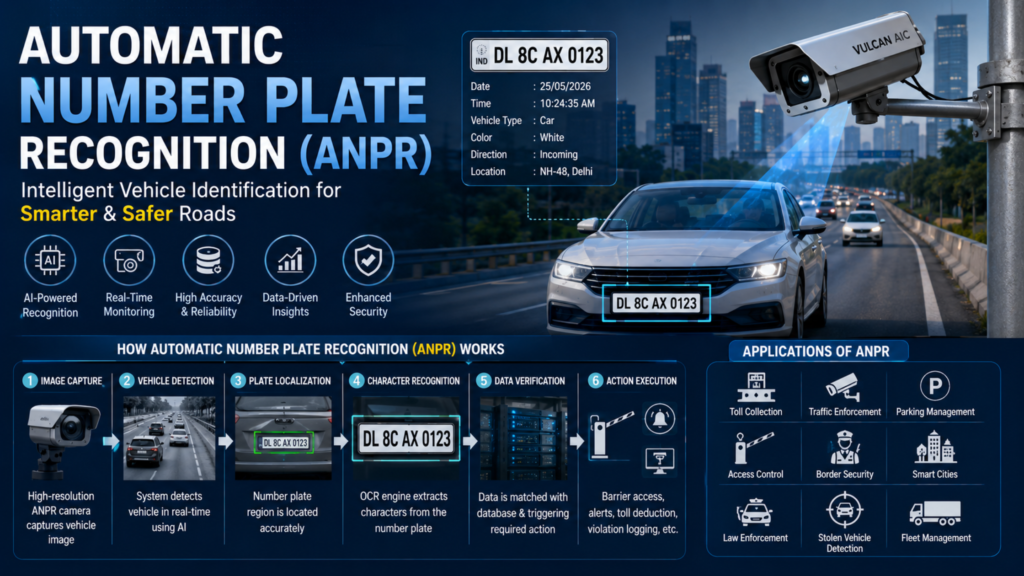
Road transportation is becoming increasingly intelligent with the adoption of advanced surveillance and traffic management technologies. Among these innovations, Automatic Number Plate Recognition (ANPR) has emerged as one of the most reliable systems for vehicle identification, traffic monitoring, law enforcement, and highway automation.
Automatic Number Plate Recognition (ANPR) combines high-resolution imaging, optical character recognition (OCR), artificial intelligence (AI), and computer vision to automatically capture, detect, and read vehicle registration plates in real time. The technology plays a vital role in Intelligent Transportation Systems (ITS) by improving road safety, reducing traffic violations, enhancing toll collection, and supporting smart city initiatives.
In this article, we will explore how Automatic Number Plate Recognition (ANPR) works, its core components, applications, benefits, implementation challenges, and why it has become an essential technology for modern transportation infrastructure.
What Is Automatic Number Plate Recognition (ANPR)?
Automatic Number Plate Recognition (ANPR) is an intelligent image-processing technology that automatically identifies vehicles by recognizing their license plate numbers.
The system captures vehicle images using dedicated cameras and processes them using AI-powered algorithms and Optical Character Recognition (OCR). The extracted registration number is then compared with databases for applications such as toll collection, parking management, access control, traffic enforcement, and security monitoring.
ANPR enables authorities and infrastructure operators to monitor vehicle movement without manual intervention, improving operational efficiency and reducing human error.
How Automatic Number Plate Recognition (ANPR) Works
An Automatic Number Plate Recognition (ANPR) system follows a structured workflow to ensure accurate vehicle identification.
Step 1: Image Acquisition
High-resolution ANPR cameras capture vehicle images under various lighting and weather conditions.
Step 2: Vehicle Detection
AI-based image processing identifies the presence of a vehicle within the camera’s field of view.
Step 3: License Plate Localization
Computer vision algorithms locate the number plate region within the captured image.
Step 4: Character Segmentation
The detected number plate is segmented into individual characters.
Step 5: Optical Character Recognition (OCR)
OCR software converts the segmented characters into machine-readable text.
Step 6: Data Verification
The recognized registration number is validated against predefined databases or integrated management systems.
Step 7: Action Execution
Depending on the application, the system may trigger barrier access, generate traffic violation records, collect toll fees, or send alerts.
Key Components of an Automatic Number Plate Recognition (ANPR) System
An effective ANPR solution consists of several integrated hardware and software components.
ANPR Camera
Industrial-grade cameras capture high-resolution vehicle images with infrared (IR) illumination for day and night operation.
Image Processing Unit
Processes captured images using AI and computer vision algorithms.
Optical Character Recognition (OCR) Engine
Extracts alphanumeric characters from license plates with high accuracy.
Database Server
Stores vehicle records, logs, and recognition history for reporting and analytics.
Network Infrastructure
Transfers image data securely between cameras, servers, and monitoring centers.
Management Software
Provides dashboards, search capabilities, reporting tools, and system integration.
Technologies Behind Automatic Number Plate Recognition (ANPR)
Modern Automatic Number Plate Recognition (ANPR) systems rely on multiple technologies working together.
- Artificial Intelligence (AI)
- Machine Learning
- Deep Learning
- Optical Character Recognition (OCR)
- Computer Vision
- Infrared Imaging
- High-Speed Image Processing
- Edge Computing
- Cloud-Based Analytics
These technologies significantly improve recognition accuracy under varying environmental conditions.
Benefits of Automatic Number Plate Recognition (ANPR)
Improved Traffic Enforcement
Automatically detects traffic violations, speeding, and unauthorized vehicles.
Enhanced Road Safety
Supports law enforcement by identifying stolen, suspicious, or blacklisted vehicles.
Faster Toll Collection
Enables electronic toll collection without stopping vehicles, reducing congestion.
Efficient Parking Management
Automates vehicle entry, exit, and billing in parking facilities.
Real-Time Monitoring
Provides instant vehicle tracking for traffic management centers.
Reduced Manual Intervention
Minimizes dependency on human operators and reduces operational costs.
Data-Driven Decision Making
Generates valuable traffic analytics for urban planning and infrastructure optimization.
Applications of Automatic Number Plate Recognition (ANPR)
Automatic Number Plate Recognition is widely deployed across transportation and security sectors.
Intelligent Transportation Systems (ITS)
Supports traffic monitoring, incident management, and highway automation.
Toll Plazas
Enables seamless electronic toll collection and vehicle classification.
Smart Cities
Improves urban traffic management and surveillance.
Parking Management
Automates access control in commercial buildings, airports, hospitals, and shopping malls.
Border Control
Assists in monitoring cross-border vehicle movement.
Law Enforcement
Identifies wanted or stolen vehicles through integrated databases.
Industrial Facilities
Provides secure vehicle access for factories, logistics hubs, and warehouses.
Residential Communities
Enhances security with automated visitor vehicle management.
Challenges in Automatic Number Plate Recognition (ANPR)
Despite its advantages, several factors influence system performance.
- Poor lighting conditions
- Dirty or damaged number plates
- High-speed vehicle movement
- Adverse weather conditions
- Non-standard license plate formats
- Camera positioning errors
- Motion blur
- Privacy and data security regulations
Proper system design and camera placement significantly improve recognition accuracy.
Best Practices for ANPR Deployment
For optimal performance, organizations should consider:
- Installing high-resolution industrial cameras
- Using infrared illumination for night operation
- Selecting AI-powered OCR software
- Maintaining proper camera angles and mounting heights
- Performing routine maintenance and calibration
- Integrating ANPR with traffic management platforms
- Ensuring compliance with local data protection regulations
The Role of Automatic Number Plate Recognition (ANPR) in Intelligent Transportation Systems
Automatic Number Plate Recognition is becoming a critical component of modern Intelligent Transportation Systems. By integrating ANPR with Variable Message Signs (VMS), traffic control centers, adaptive traffic signals, and surveillance networks, authorities can monitor vehicle movement in real time, improve incident response, optimize traffic flow, and enhance road safety.
At Vulcan AIC, intelligent transportation solutions are designed to support smart mobility through advanced traffic technologies. While ANPR systems operate independently or as part of a larger ITS ecosystem, their integration with digital signage, traffic monitoring, and highway automation solutions enables efficient traffic operations and data-driven decision-making.
Conclusion
Automatic Number Plate Recognition (ANPR) has transformed the way transportation authorities, toll operators, parking managers, and law enforcement agencies monitor and manage vehicle movement. By combining AI, OCR, and computer vision, ANPR delivers accurate, automated, and real-time vehicle identification across a wide range of applications.
As transportation infrastructure continues to evolve, ANPR will remain a key technology supporting safer roads, efficient traffic management, and smarter cities.
Frequently Asked Questions (FAQs)
What is Automatic Number Plate Recognition (ANPR)?
Automatic Number Plate Recognition (ANPR) is a technology that uses cameras, AI, and OCR to automatically detect and read vehicle registration numbers.
How accurate is ANPR?
Modern AI-powered ANPR systems can achieve recognition accuracy above 95% under proper installation and lighting conditions.
Where is ANPR commonly used?
ANPR is used in toll plazas, highways, smart cities, parking facilities, border checkpoints, airports, and law enforcement applications.
Does ANPR work at night?
Yes. Most professional ANPR systems use infrared (IR) cameras and illuminators for reliable day-and-night operation.
Can ANPR integrate with Intelligent Transportation Systems?
Yes. ANPR integrates seamlessly with ITS platforms, traffic management centers, Variable Message Signs (VMS), and surveillance systems.

