
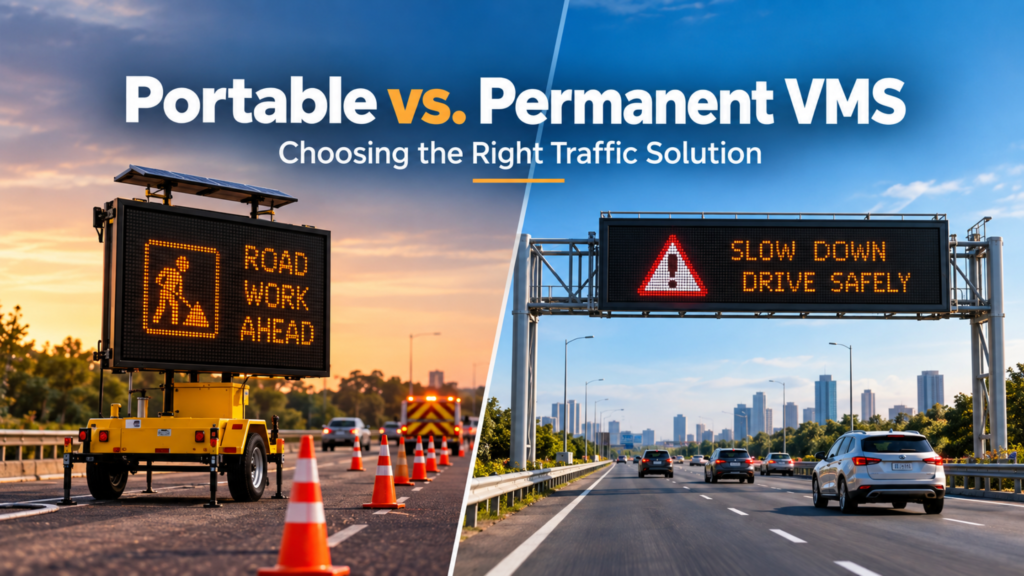
Portable vs Permanent VMS is an important consideration when planning traffic management and intelligent highway infrastructure. While both solutions use electronic displays to communicate information to road users, they are designed for different operating requirements.
Choosing between a portable and permanent VMS? Here is a practical breakdown of where each solution fits, what makes them different, and how to select the right option for your traffic management needs.
A Variable Message Sign (VMS) may look like a straightforward LED display from the road, but its role in intelligent transportation is much bigger. It provides drivers with timely information about traffic conditions, incidents, diversions, lane closures, warnings and other important road situations.
The right type of VMS, however, depends heavily on where it will be used, how long it needs to remain in operation, how frequently it needs to be relocated, and what kind of information it needs to communicate.
This is where the difference between a Portable VMS and a Permanent VMS becomes important.
A permanent VMS is designed to become part of the road infrastructure. It is installed at a fixed location and is typically used where continuous communication with road users is required.
A portable VMS, on the other hand, is designed to provide flexibility. It can be moved to different locations when traffic conditions, construction activity, incidents or temporary requirements change.
At Vulcan AIC, we work in the field of intelligent infrastructure and LED-based traffic information systems, where selecting the right display solution is about more than simply choosing a screen. It is about understanding the road, the application, the information requirement and the operating environment.
So, how do you decide between the two?
What Is a VMS?
A Variable Message Sign (VMS) is an electronic traffic information system capable of displaying changing messages to road users. Unlike a conventional fixed traffic sign, a VMS can communicate different information depending on current road conditions.
For example, a VMS can display messages related to:
- Traffic congestion
- Road closures
- Lane closures
- Diversions
- Accidents and incidents
- Travel-time information
- Weather-related warnings
- Speed-related alerts
- Road safety messages
- Construction activity
- Special traffic conditions
The display itself commonly uses LED technology, allowing messages, characters and symbols to be clearly presented to drivers. The important point is that a VMS is not simply an outdoor LED screen. It is a traffic-control and information device designed around the requirements of road users and transportation operations.
Official transportation guidance also distinguishes between permanent and portable changeable message signs, with both using electronic displays while serving different operational requirements.
Portable vs Permanent VMS
The biggest difference is simple: Permanent VMS is built for a fixed location. Portable VMS is built for flexibility. But the practical difference goes much deeper.
A permanent installation may remain at one location for years and become an integral part of a highway’s intelligent transportation infrastructure.
A portable system can be transported and positioned where information is temporarily needed.
For example, imagine a highway undergoing major maintenance.
A permanent VMS at the beginning of the corridor may continue providing regular traffic information. But if a particular lane suddenly needs to be closed for maintenance, traffic needs to be diverted because of an incident, or construction activity moves from one section to another, a portable VMS can be deployed closer to the changing situation.
This flexibility is one of the primary reasons portable systems are useful in temporary traffic management.
Portable VMS: What Is It?
A Portable Variable Message Sign (PVMS) is a movable electronic message display designed to communicate information where and when it is needed.
Portable systems are commonly mounted on trailers or other transportable platforms. Their design generally incorporates the display, control system, power source and equipment required for mounting and transportation.
Because they can be relocated, portable VMS solutions are particularly useful for situations where traffic conditions are temporary or constantly changing.
Typical Portable VMS Applications
Portable VMS can be useful for:
1. Road Construction
Construction zones can move as work progresses. A portable display can be relocated accordingly, helping drivers receive information closer to the affected area.
2. Lane Closures
When one or more lanes are temporarily closed, a portable sign can provide advance information to approaching drivers.
3. Accident and Incident Management
Unexpected incidents can create immediate traffic problems. A portable VMS can be deployed to communicate warnings or changes in traffic movement.
4. Traffic Diversions
When vehicles need to follow an alternate route, portable messaging can provide information before drivers reach the decision point.
5. Special Events
Large public events can temporarily change traffic patterns. Portable displays can be positioned where additional guidance is required.
6. Emergency Situations
Unexpected road conditions may require temporary traffic information. A movable system allows authorities and traffic operators to respond to changing conditions.
Transportation guidance identifies portable changeable message signs as particularly useful for temporary traffic-control situations, including road closures, incidents, diversions, adverse conditions and changes in road-user patterns.
Permanent VMS: What Is It?
A Permanent VMS is a fixed electronic message sign installed as part of the long-term road infrastructure. Unlike a portable unit, it is not designed to be regularly moved from one location to another.
Permanent VMS installations are commonly positioned on highways, expressways, major corridors, approaches to interchanges and other locations where continuous traffic information is required.
The location itself becomes part of the traffic management strategy.
A permanent VMS may be used to communicate information such as:
- Current traffic conditions
- Congestion warnings
- Route information
- Travel times
- Lane closures
- Diversion information
- Incident alerts
- Weather warnings
- Road safety messages
- Emergency information
Permanent changeable message signs are generally positioned strategically upstream of bottlenecks, crash-prone locations and major decision points so drivers have sufficient time to respond to the information displayed.
Where Permanent VMS Makes More Sense
Permanent VMS is generally suited to locations where information needs to be available continuously or repeatedly over the long term.
1. Expressways
High-speed roads require information to reach drivers before they reach an incident, interchange, congestion point or route decision.
A permanent VMS can become part of the corridor’s long-term communication infrastructure.
2. Major Highways
Busy highway corridors may require regular communication about traffic, incidents, diversions and road conditions.
3. Interchanges
Strategically positioned VMS can provide information before drivers reach major route decisions.
4. Toll Plazas and Managed Corridors
Permanent display infrastructure can communicate operational information to road users in a consistent location.
5. Intelligent Transportation Systems
Permanent VMS can be integrated with larger traffic management ecosystems, where information is collected from different systems and presented to road users through roadside displays.
This is where a VMS becomes more than a display.
It becomes part of a connected transportation infrastructure system.
Portable VMS vs. Permanent VMS: The Key Differences
While both systems communicate changing information, their operating environments are different.
Installation
Portable VMS:
Designed for temporary or relocatable deployment.
Permanent VMS:
Installed at a fixed location as part of long-term infrastructure.
Mobility
Portable VMS:
Can be moved according to operational requirements.
Permanent VMS:
Remains at its designated location.
Primary Purpose
Portable VMS:
Best suited to changing, temporary or incident-driven traffic situations.
Permanent VMS:
Best suited to continuous traffic information and long-term corridor management.
Power
Portable systems need a suitable onboard or deployable power arrangement because they may operate away from permanent infrastructure. Permanent systems can be connected to a dedicated site power system and supporting infrastructure.
Structural Installation
Portable VMS requires a transportable mounting arrangement. Permanent VMS generally requires a dedicated structural support system designed for the installation location and environmental conditions.
Deployment
Portable systems can be positioned relatively quickly when operational needs change. Permanent systems require planning, civil works, structural installation, electrical connections and commissioning.
Is Portable VMS Less Advanced Than Permanent VMS?
Not necessarily.
This is an important distinction. Portable and permanent describe how and where the system is deployed, not automatically how technologically advanced it is. A portable VMS can still include sophisticated control, communication and display capabilities.
Similarly, a permanent VMS can be a relatively straightforward electronic message display or can form part of a much larger intelligent transportation system.
The technology should therefore be evaluated based on the actual specification and application, rather than assuming that one type is automatically more advanced.
At Vulcan AIC, this distinction matters because intelligent infrastructure is not about putting the same technology everywhere. It is about matching the technology to the operational requirement.
How Do You Choose the Right VMS?
There is no single VMS solution that fits every road.
Before selecting a system, traffic authorities, infrastructure companies and project teams should consider several factors.
1. How Long Will the System Be Needed?
If the requirement is for a temporary project, a portable system may be appropriate. If the location will require continuous traffic communication for years, a permanent installation may be more suitable.
The expected operating period is one of the first questions to answer.
2. Will the Traffic Situation Change?
Consider whether the problem exists at one fixed location or moves throughout the project. For example, construction activity can shift from one section of a highway to another.
In such a situation, mobility becomes an important requirement.
If the information point must move, a portable VMS provides an operational advantage.
3. Is the Location Part of a Long-Term Traffic Management Strategy?
If a corridor is being developed as an intelligent transportation network, permanent VMS may be integrated into the overall system.
The display can become one component within a larger ecosystem involving:
- Traffic monitoring
- Sensors
- CCTV
- Traffic management systems
- Communication networks
- Centralized control platforms
- Incident management
- Data analytics
This approach allows roadside information to become part of a wider flow of transportation data.
4. What Kind of Information Needs to Be Displayed?
The messaging requirement also matters.
A VMS may need to communicate simple warnings, or it may need to support changing information such as traffic conditions, travel times, diversions and incidents.
The system should therefore be specified according to the required message formats, visibility, display characteristics and control architecture.
5. What Are the Environmental Conditions?
A highway VMS operates outdoors.
That means the system needs to be designed around environmental exposure, visibility requirements, temperature, dust, rain, sunlight, wind and other site-specific conditions.
The physical structure and electronics are just as important as the message displayed on the front.
This is particularly important for permanent installations, where the system is expected to remain operational at the same location for a long period.
The Role of LED Technology in VMS
Both portable and permanent VMS can use LED-based electronic displays. But calling a VMS simply an “LED screen” does not tell the complete story.
A commercial LED display may primarily be designed to show visual content.
A highway VMS, by comparison, is designed around traffic information and road-user communication.
The display is only one part of the overall system.
Behind it are components such as:
- LED modules
- Power systems
- Control electronics
- Communication systems
- Structural components
- Brightness control
- Monitoring systems
- Software and control platforms
Depending on the system architecture, these components can work together to receive information, process it and communicate the required message to road users.
That is why the difference between a highway VMS and a conventional commercial display is not simply the type of LED used.
The application defines the system.
Portable VMS for Temporary Traffic Management
One of the strongest advantages of a portable VMS is its ability to respond to changing conditions. Imagine a highway maintenance project covering several kilometres. During the first stage, work may be concentrated near one section.
A portable VMS can be positioned before that zone. As the project progresses, the work area changes. The display can move with it. This creates a flexible communication layer around temporary traffic conditions. Portable signs are specifically recognized in transportation guidance for situations such as temporary traffic-control zones, lane or roadway closures, incident management, diversions and unexpected road conditions.
The value is therefore not just the display itself.
It is the ability to take information where it is needed.
Permanent VMS for Long-Term Highway Infrastructure
Permanent VMS takes a different approach. Instead of following a temporary situation, it becomes part of the road. A strategically located permanent VMS can continue communicating with drivers day after day. For major corridors, this can create a consistent communication network along the route.
For example, multiple permanent VMS installations can be positioned at different locations so that drivers receive relevant information before reaching:
- Congestion
- Major intersections
- Interchanges
- Diversion points
- Incident locations
- Roadwork areas
The placement of each sign therefore becomes an important part of the overall traffic management strategy.
It is not simply about installing a display where there is available space.
It is about putting the right information at the right point on the journey.
Where Smart VMS Fits Into the Picture
There is another important distinction worth understanding.
Portable vs. permanent describes the deployment format.
Smart vs. conventional describes the level of intelligence and connectivity.
These are not necessarily the same comparison.
A VMS can be permanent and connected to a centralized intelligent transportation system. A portable system can also incorporate sophisticated controls and communication capabilities depending on its design.
At VULCAN AIC, our Smart VMS approach goes beyond simply displaying a message. The system can support capabilities such as centralized device-health monitoring, screen and connectivity status, remote power control, message scheduling, dynamic updates, traffic information, travel-time information, weather information, emergency messaging, AI-based traffic analytics and integration with broader traffic management platforms.
This is where roadside display technology starts becoming part of a larger intelligent infrastructure ecosystem.
A Simple Way to Think About It
If you need a VMS that can move with the situation, think portable.
If you need a VMS that becomes part of the road infrastructure, think permanent.
If you need the system to connect with data, monitoring and wider traffic-management platforms, look beyond the physical installation type and evaluate the intelligence and integration capabilities of the system.
The best solution starts with the operational requirement.
Portable or Permanent VMS: Which One Does Your Project Need?
Before making a decision, ask these questions:
Is the requirement temporary?
A portable solution may provide the flexibility required.
Is the requirement long-term?
A permanent installation may be better suited to the application.
Will the traffic situation move?
Mobility can become a key consideration.
Is the VMS part of a larger intelligent transportation system?
Integration, communication and centralized management should be considered.
Does the project require real-time information?
Look at the data sources, communication architecture and control platform — not just the display.
What are the environmental and visibility requirements?
The display, electronics, structure and control system all need to be considered together.
Ultimately, choosing a VMS is not simply a decision between a movable sign and a fixed sign.
It is a decision about how information needs to reach road users.
Building Better Traffic Communication
Road infrastructure is becoming increasingly connected.
As highways move towards intelligent transportation systems, roadside displays are becoming an important interface between digital information and the people travelling on the road.
A VMS takes information from a traffic management environment and turns it into something a driver can understand in seconds.
Sometimes that information needs to follow a temporary work zone.
Sometimes it needs to remain at a strategic highway location for years.
Sometimes it needs to connect with a much larger ecosystem of sensors, traffic systems, analytics and centralized control.
That is why there is no universal answer to the portable-versus-permanent question.
The right solution depends on the road, the application, the duration, the traffic condition and the level of intelligence required.
At VULCAN AIC, we look at VMS as part of the larger intelligent infrastructure landscape — where display technology, engineering, communication and real-time information come together to support safer and more informed movement on the road.
Because ultimately, the purpose of a VMS is not just to display a message.
It is to make the right information visible when it matters.
Portable vs. Permanent VMS: Quick Takeaway
Portable VMS
Best suited for temporary traffic management, construction zones, incidents, diversions and changing road conditions.
Permanent VMS
Best suited for long-term highway infrastructure, strategic locations and continuous traffic information.
Smart VMS
Adds another layer of intelligence through monitoring, connectivity, real-time data, centralized control and system integration.
And the three concepts don’t have to be treated as completely separate categories. The right solution depends on the project’s operational and technical requirements.
Frequently Asked Questions
What is the difference between portable VMS and permanent VMS?
The primary difference is deployment. A portable VMS is designed to be relocated as traffic conditions or project requirements change, while a permanent VMS is installed at a fixed location as part of long-term road infrastructure.
Where is portable VMS commonly used?
Portable VMS is commonly used around construction zones, temporary lane closures, incidents, diversions, special events and other situations where traffic information requirements can change.
Where is permanent VMS used?
Permanent VMS is commonly used on highways, expressways, major corridors, interchanges and other locations where continuous traffic information is required.
Does a VMS use an LED display?
Yes. Electronic VMS commonly use LED-based display technology to present changing messages, symbols and traffic information.
Is portable VMS less advanced than permanent VMS?
Not necessarily. Portable and permanent describe the deployment approach. The technical capabilities of a VMS depend on its design, control system, communication capabilities and integration.
Can VMS be connected to a traffic management system?
Yes. Depending on the system architecture, VMS can be integrated with traffic management platforms and other intelligent transportation systems.
What should I consider before choosing a VMS?
Consider the duration of deployment, location, mobility requirements, traffic conditions, environmental conditions, message requirements, communication architecture and required integration with other systems.
Final Thought
A highway is constantly changing. Traffic moves. Incidents happen. Construction zones shift. Weather conditions change. Routes need to adapt. The technology communicating with road users needs to work within that reality.
Sometimes that means a portable VMS that can move with the situation.
Sometimes it means a permanent VMS that becomes part of the highway infrastructure.
And increasingly, it means systems that can connect real-time information with intelligent traffic management. At Vulcan AIC, our focus is on building technology that helps bridge that gap — from information and data to the road in front of you.
The right VMS is not simply the one that displays a message. It is the one designed for the way that message needs to reach the road user.

