
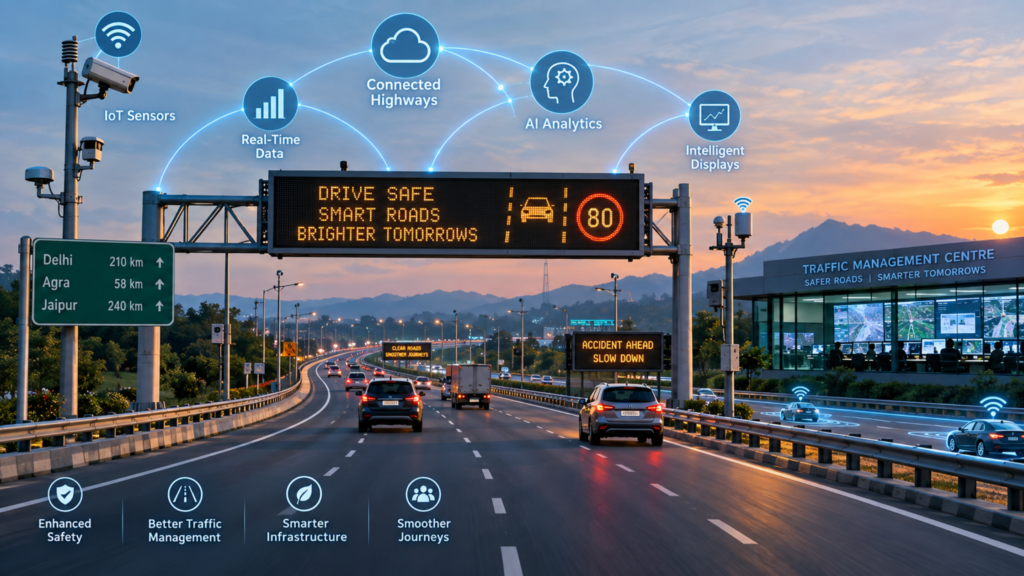
A highway is no longer just a stretch of asphalt connecting two destinations.
Modern transportation infrastructure is becoming increasingly connected, intelligent and data-driven. Sensors collect information. Communication networks transfer it. Artificial intelligence analyses it. Intelligent displays communicate important information back to drivers and highway operators.
This is the idea behind Connected Highways.
A connected highway brings together technologies such as the Internet of Things (IoT), Artificial Intelligence (AI), intelligent transportation systems (ITS), real-time data, roadside infrastructure and digital displays to create a more responsive transportation environment.
Instead of relying entirely on static signs and manual monitoring, highway operators can use connected systems to understand what is happening on the road and communicate relevant information more efficiently.
For infrastructure developers, highway authorities and system integrators, this shift represents an important evolution from conventional road infrastructure towards smart road infrastructure.
What Are Connected Highways?
Connected Highways are transportation corridors where road infrastructure, monitoring systems, communication technologies and digital information systems work together to exchange and use data.
The objective is not simply to put more technology on a highway. The objective is to create an infrastructure ecosystem where different systems can sense, communicate, analyse and respond.
A connected highway may combine:
- IoT sensors
- Traffic monitoring systems
- CCTV and video analytics
- Weather monitoring
- Variable Message Signs (VMS)
- Vehicle Actuated Speed Displays (VASD)
- Lane control systems
- Traffic signals
- Communication networks
- Traffic Management Centres
- Artificial Intelligence
- Cloud-based platforms
- Real-time data analytics
- Connected vehicle technologies
The exact combination depends on the road, application and project requirements.
The U.S. Department of Transportation describes connected transportation environments as systems in which vehicles, infrastructure and other devices can communicate, while ITS architectures provide frameworks for integrating different transportation technologies.
In simple terms:
IoT collects information → connectivity moves information → AI analyses information → intelligent systems help operators respond → displays communicate information to road users.
That connection is what makes a highway more responsive.
Why Are Connected Highways Becoming Important?
Road networks are becoming more complex. Highways and expressways need to deal with changing traffic volumes, road construction, incidents, weather conditions, diversions and safety requirements. Traditional infrastructure can communicate information through static signs, road markings and manually operated systems. However, many situations change faster than static infrastructure can communicate.
Consider a simple example.
An accident occurs several kilometres ahead.
A conventional road sign may continue showing the same information because it cannot automatically respond to the incident.
In a connected highway environment, information can potentially move through multiple layers:
Detection → Data → Analysis → Decision → Communication
A camera or sensor detects an event. The information reaches the relevant management system. Analytics can help identify or classify the event. An operator or automated system determines an appropriate response. An intelligent display can then communicate information to drivers.
This creates a more dynamic approach to highway management.
AI is increasingly being researched and deployed for transportation applications including traffic management, computer vision, predictive analytics and infrastructure-related decision support.
How IoT Connects Highway Infrastructure
The Internet of Things (IoT) is one of the foundational technologies behind connected infrastructure. IoT allows physical devices to collect and exchange data through connected networks. On a highway, this can include sensors and devices that monitor different conditions.
Examples include:
- Traffic flow
- Vehicle speed
- Road conditions
- Weather
- Visibility
- Equipment status
- Traffic density
- Environmental conditions
- Infrastructure performance
The value of IoT is not simply the number of sensors installed. The value comes from the information generated by those sensors and how that information is integrated into highway operations.
For example, a connected sensor can provide information about changing conditions. That data can then be transferred to a central platform where operators or analytics systems can interpret it.
This creates a continuous information loop.
From Physical Road to Digital Information
A connected highway can essentially create a digital layer around physical infrastructure. The physical highway remains the same. But sensors, communication networks and software create a digital representation of what is happening on the road.
This can help transportation teams move from periodic observation towards more continuous monitoring.
The U.S. DOT’s AI transportation research describes the use of diverse sources such as sensor feeds, video, vehicle data and imagery to create richer transportation datasets.
How AI Makes Highway Data Useful
IoT can generate enormous amounts of data. But data alone does not automatically create better traffic management. This is where Artificial Intelligence (AI) and analytics become important. AI can help transportation systems identify patterns, classify information and support decision-making.
For example, computer vision can analyse video feeds to identify certain roadway events or traffic conditions.
Machine learning can be used to analyse historical and real-time datasets. Predictive analytics can help transportation teams understand patterns that may not be obvious from individual data points.
The result is a shift from:
“What is happening?”
towards:
“What does the data indicate, and what action may be appropriate?”
Transportation research is already exploring AI applications involving computer vision, machine learning, sensor data, roadway imagery and traffic information. However, AI should not be treated as a replacement for every human decision.
For critical transportation infrastructure, AI-based systems need appropriate validation, cybersecurity, governance and operational oversight. The U.S. DOT has specifically highlighted the importance of responsible and trustworthy AI deployment in transportation.
The Role of Intelligent Displays
Collecting and analyzing information is only one part of the connected highway. The information also needs to reach people. This is where intelligent displays become important. Highway displays can act as a communication layer between the transportation management system and road users.
Depending on the application, these may include:
- Variable Message Signs (VMS)
- Smart VMS
- Portable VMS
- Vehicle Actuated Speed Displays
- LED Arrow Signs
- Lane Control Signs
- Variable Speed Limit Signs
- Overhead Lane Signals
- Toll plaza displays
- Tunnel displays
A display can communicate information such as:
- Traffic conditions
- Speed restrictions
- Lane status
- Diversions
- Road closures
- Construction information
- Safety warnings
- Incident information
- Travel information
The National Highways Authority of India’s ATMS technical specifications include Variable Message Signs as part of highway traffic management infrastructure. This makes intelligent displays more than digital signboards. They become information delivery interfaces for intelligent infrastructure.
How IoT, AI and Intelligent Displays Work Together
The real power of Connected Highways comes from integration. IoT, AI and intelligent displays should not operate as isolated technologies.
Think of the system as a chain.
Step 1: Detect
Sensors, cameras or connected infrastructure collect information.
Step 2: Connect
Communication networks transfer the information to relevant systems.
Step 3: Analyse
Software, analytics and AI can process the information.
Step 4: Decide
The system or traffic management team determines the appropriate response.
Step 5: Communicate
Intelligent displays and other communication channels provide information to road users.
Step 6: Monitor
The system continues monitoring conditions and can update information as circumstances change. This creates a feedback loop rather than a one-way communication system.
Road → Data → Intelligence → Action → Road User → New Data
That is the fundamental idea behind connected infrastructure.
Connected Highways and Real-Time Traffic Management
One of the biggest advantages of connected infrastructure is the ability to support real-time traffic management. Traffic conditions can change rapidly. A highway that is moving normally at 10:00 AM may experience congestion at 10:20 AM because of an accident, weather event, roadwork or sudden traffic volume.
A connected system can help operators understand those changes more quickly.
For example:
Traffic monitoring system
↓
Detects abnormal traffic movement
↓
Data reaches the traffic management platform
↓
Analytics help identify the situation
↓
Operator/system determines an appropriate response
↓
VMS communicates information to drivers
↓
Traffic conditions continue to be monitored
This kind of integrated approach is increasingly associated with Advanced Traffic Management Systems and intelligent transportation systems.
Modern ITS programmes also explore connected vehicles, real-time traveller information, decision-support systems, AI, machine learning and infrastructure monitoring as components of advanced transportation operations.
Connected Highways and Road Safety
Road safety is one of the most important applications of intelligent highway infrastructure. A driver cannot respond to information they do not receive. Connected infrastructure can help create more timely communication between highway systems and road users.
For example, intelligent displays can communicate warnings about:
- Accidents
- Road work
- Lane closures
- Speed restrictions
- Diversions
- Congestion
- Hazardous conditions
- Tunnel restrictions
Vehicle-to-infrastructure and broader V2X technologies can also support communication between vehicles and roadside infrastructure. The U.S. DOT describes V2X as enabling communication among vehicles, infrastructure and other road users or devices.
The important point is that no single technology creates a connected highway.
Safety comes from coordinated systems.
Sensors provide visibility.
Connectivity provides communication.
AI provides analysis.
Traffic management systems provide operational control.
Displays provide information to drivers.
Together, these technologies can create a more informed road environment.
Applications of Connected Highway Technology
Connected highway technology can support many different infrastructure applications.
1. Expressways
Large expressways can use intelligent systems to communicate traffic conditions, incidents, diversions and operational information.
2. National Highways
Connected systems can support traffic monitoring and highway safety across long-distance corridors.
3. Urban Roads
Urban transportation networks can integrate traffic information with intelligent displays and monitoring systems.
4. Tunnels
Tunnel infrastructure can use lane control signs, variable speed information, LED displays and monitoring technologies.
5. Toll Plazas
Intelligent displays and lane signalling systems can communicate lane availability and operational information.
6. Construction Zones
Digital signage can provide changing instructions around temporary traffic arrangements.
7. Incident Management
Connected systems can help operators detect and communicate information about road incidents.
8. Smart City Infrastructure
Highway technology can become part of a larger smart mobility ecosystem connecting roads, traffic systems and urban infrastructure.
The Role of VMS in Connected Highways
A Variable Message Sign (VMS) is one of the most visible components of a connected highway. Unlike a conventional static road sign, a VMS can display changing information. That makes it particularly useful when road conditions change.
For example, the same display may communicate different messages depending on the situation:
NORMAL TRAFFIC
Later:
REDUCE SPEED
Later:
ACCIDENT AHEAD
And after the incident:
TRAFFIC NORMAL
The display itself does not necessarily determine why the message changes. It can be part of a larger system where information comes from traffic monitoring, operators, sensors, incident management systems or other connected sources.
This is why the future of VMS is closely connected to the future of intelligent transportation systems.
The display is the visible interface.
The intelligence exists behind it.
What Makes a Highway Truly Connected?
Simply installing digital displays does not automatically make a highway connected. A truly connected highway requires integration.
Several layers need to work together.
1. Sensing Layer
Cameras, sensors and monitoring equipment collect information.
2. Communication Layer
Networks move information between field equipment and control systems.
3. Intelligence Layer
Analytics and AI help interpret information.
4. Management Layer
Traffic management platforms and operators coordinate responses.
5. Communication Layer
VMS and other displays communicate relevant information to drivers.
6. Feedback Layer
The system continues monitoring the result. This layered approach is important because transportation infrastructure contains equipment from different manufacturers and technologies. Interoperability therefore becomes a major consideration.
ITS architecture programmes emphasize standards and interoperable deployment so that different transportation technologies can work together as part of a larger system.
Challenges in Building Connected Highways
Connected highways offer significant possibilities, but implementation requires careful planning.
Integration
Different equipment and software systems need to communicate reliably.
Connectivity
Highway infrastructure can cover large geographic areas, so communication reliability is important.
Data Management
Connected infrastructure can generate substantial amounts of information. Systems need appropriate methods to store, process and use that data.
Cybersecurity
More connectivity also means more potential digital exposure.
Transportation infrastructure is increasingly dependent on information systems, making cybersecurity an important part of connected ITS deployments.
Environmental Conditions
Highway equipment needs to operate in demanding outdoor environments, including heat, dust, rain and varying visibility conditions.
Maintenance
Connected equipment needs planned maintenance to ensure that sensors, displays, communication systems and supporting infrastructure remain operational.
Human Oversight
Automation should support transportation professionals rather than eliminate the need for appropriate human oversight, particularly for safety-critical decisions.
What Should Infrastructure Projects Consider?
Before implementing connected highway technology, project teams should consider the complete ecosystem rather than selecting individual products in isolation.
Define the objective
Is the project focused on:
- Safety?
- Traffic management?
- Incident response?
- Traveller information?
- Tunnel management?
- Toll operations?
- Smart city integration?
Identify the required data
What information needs to be collected?
Plan the communication architecture
How will field devices communicate with central systems?
Consider interoperability
Can different technologies and systems work together?
Plan cybersecurity
How will connected equipment and data be protected?
Consider scalability
Can the system accommodate future technologies?
Plan maintenance
How will equipment be monitored, serviced and upgraded?
Design the driver communication layer
How will important information reach road users?
A successful connected highway is therefore not just a hardware project. It is an infrastructure, software, communication and operations project working together.
The Future of Connected Highways
The next stage of highway development is likely to involve even deeper integration between infrastructure, vehicles, data and intelligent systems.
Future connected transportation ecosystems may increasingly involve:
- AI-powered traffic analytics
- Computer vision
- Predictive traffic management
- Connected vehicles
- V2X communication
- Digital twins
- Cloud-based traffic platforms
- Real-time traveller information
- Automated incident detection
- Predictive infrastructure maintenance
- Advanced decision-support systems
Research programmes are already exploring combinations of AI, IoT, computer vision and transportation data to improve planning, safety analysis and infrastructure decision-making.
The important shift is from reactive infrastructure to increasingly data-informed infrastructure.
Instead of waiting for a problem to become visible to an operator, connected systems can continuously collect information and help identify changing conditions.
The road becomes more than physical infrastructure.
It becomes a connected information environment.
Why Intelligent Infrastructure Matters
The future of mobility will not be defined by one technology.
AI alone cannot create a smart highway.
IoT alone cannot manage traffic.
A VMS alone cannot understand the entire road environment. A traffic management centre alone cannot communicate with every road user. The real opportunity lies in connecting these technologies.
IoT provides the data.
AI provides intelligence.
Traffic management systems provide coordination.
Intelligent displays provide communication.
And the highway provides the physical environment where all these technologies come together. That is the foundation of Connected Highways. For infrastructure developers and highway authorities, the question is therefore moving beyond:
“Which display should we install?”
towards: “How can our infrastructure collect, understand and communicate information more intelligently?”
That shift can shape the next generation of highways.
How Vulcan AIC Supports Intelligent Infrastructure
At Vulcan AIC, intelligent infrastructure is built around technologies designed for real-world transportation environments.
The company’s portfolio includes intelligent LED displays and road-safety technologies designed for applications across highways, tunnels and toll infrastructure. Its product ecosystem includes solutions such as VMS, Smart VMS, PVMS, VASD, LASB, VSLS, LCS, OHLS and other intelligent display systems.
Vulcan AIC’s approach aligns with the broader evolution of transportation infrastructure: moving from isolated signage towards connected systems where information, intelligence and communication work together.
For highway projects, the right solution depends on factors such as road environment, traffic conditions, communication architecture, visibility requirements, operational objectives and system integration.
The future of highway infrastructure will increasingly depend on how effectively these individual components work together.
And that is where the concept of Connected Highways becomes important.
Conclusion
Connected Highways are changing the way transportation infrastructure can sense, analyse and communicate information.
IoT can provide continuous data from connected infrastructure. AI can help transform large datasets into useful insights. Intelligent transportation systems can coordinate information and operations. And intelligent displays can deliver important information to drivers in real time.
Together, these technologies can create a more responsive and information-driven highway environment. The future is not simply about putting more technology on roads. It is about connecting the technology already present across the road ecosystem and making it work together.
As highways become more connected, intelligent infrastructure will play an increasingly important role in traffic management, road safety, incident response and traveller communication.
The connected highway is not just a smarter road. It is a road that can communicate, respond and evolve with changing conditions.
Frequently Asked Questions
What are Connected Highways?
Connected Highways are road networks where sensors, communication systems, traffic management platforms, AI and intelligent displays work together to collect, analyse and communicate information.
How does IoT help Connected Highways?
IoT enables connected sensors and devices to collect information about traffic, road conditions, weather, equipment status and other infrastructure conditions.
What role does AI play in highway traffic management?
AI can analyse large amounts of transportation data, identify patterns, support traffic monitoring and assist with decision-making and predictive analytics.
What are intelligent highway displays?
Intelligent highway displays are digital communication systems such as VMS, Smart VMS, lane control signs and speed displays that can communicate changing information to road users.
Is VMS part of a Connected Highway?
Yes. A VMS can serve as an important communication interface within an intelligent transportation system, allowing changing information to be presented to drivers.
What is the difference between a smart highway and a traditional highway?
A traditional highway relies more heavily on physical infrastructure and static communication. A smart or connected highway incorporates digital monitoring, communications, data and intelligent systems to support more dynamic operations.
What technologies are used in Connected Highways?
Depending on the project, technologies can include IoT sensors, CCTV, AI, machine learning, VMS, traffic management systems, communication networks, V2X, cloud platforms and other intelligent transportation technologies.

