
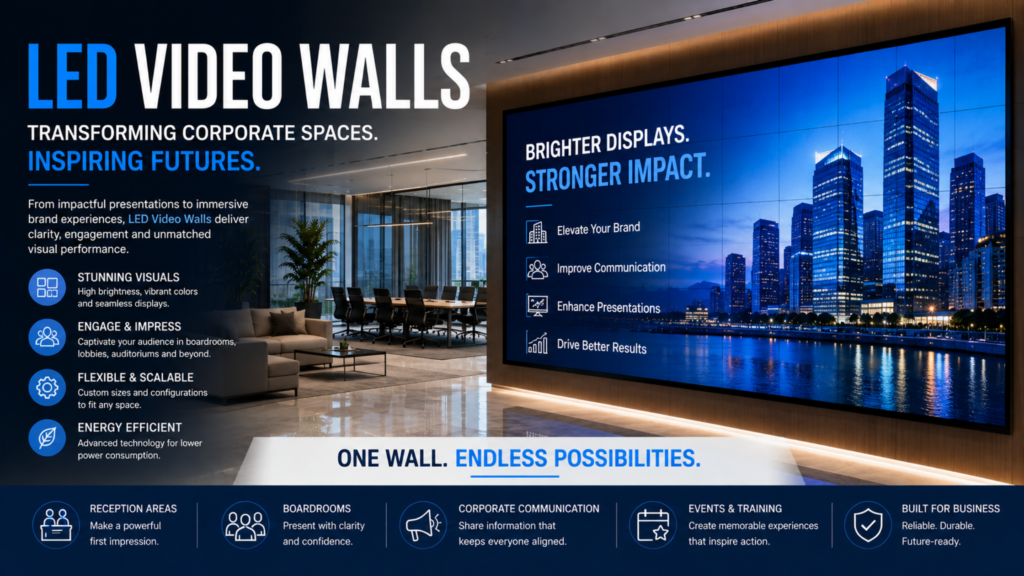
Corporate LED Video Walls are becoming an increasingly visible part of modern workplaces. Walk into a contemporary corporate headquarters, reception area, experience centre, boardroom or collaboration space, and the traditional projector or collection of small screens is increasingly being replaced by large-format LED displays.
The reason is simple: modern businesses need more than a screen.
They need a communication platform that can make information easier to see, presentations more immersive, branding more memorable and workplace spaces more engaging.
A corporate LED video walls can serve all of these purposes from one carefully designed display system.
Unlike conventional displays, an LED video wall can be built in large, customized formats without being restricted to a fixed television size. It can become the visual centrepiece of a reception, a presentation environment, a command center, an auditorium or an employee communication space.
According to AVIXA, video walls are flexible display configurations that can combine multiple display technologies into a large visual canvas, while LED is one of the major technologies used for video wall applications. AVIXA also highlights visibility, engagement and communication as important benefits of video wall systems.
For businesses planning a new office or upgrading an existing workspace, that makes LED technology worth considering.
What Is a Corporate LED Video Walls?
A corporate LED video walls is a large-format direct-view LED display designed for professional business environments. Instead of projecting an image onto a separate surface, LED video walls produce the image directly through thousands or millions of LED pixels.
This allows businesses to create large visual surfaces for:
- Corporate presentations
- Reception branding
- Boardrooms
- Conference rooms
- Experience centres
- Auditoriums
- Training rooms
- Employee communication
- Product demonstrations
- Data visualization
- Corporate events
- Command and control environments
The size and configuration can be designed according to the room, viewing distance and content requirements. This is one reason corporate LED video walls are moving beyond traditional advertising and entertainment applications and entering mainstream commercial environments.
AVIXA describes digital signage as an important professional AV segment that sits at the intersection of AV, IT and content.
Why Are Corporate Offices Switching to LED Video Walls?
The shift isn’t simply about having a bigger screen.
Modern offices are becoming more experience-driven.
Companies want their workplaces to communicate their identity from the moment a visitor enters the building.
At the same time, meeting rooms need to support increasingly visual presentations, remote collaboration, product demonstrations and data-heavy discussions.
This creates demand for displays that are:
- Large
- Bright
- Flexible
- Visually impressive
- Easy to integrate
- Suitable for professional environments
- Capable of showing different types of content
This is where corporate LED video walls can provide an advantage.
1. Corporate LED Video Walls Create Better First Impressions
A corporate reception is often the first physical interaction a visitor has with a company.
A reception desk may tell someone where to go.
A large LED display can tell them who the company is.
Businesses can use a corporate LED video wall to showcase:
- Brand films
- Company milestones
- Product videos
- Corporate achievements
- Welcome messages
- Sustainability initiatives
- Project portfolios
- Leadership messages
- Customer stories
Instead of a static wall containing a logo and a few printed photographs, the entire visual environment can become dynamic. For companies operating in technology, infrastructure, finance, automotive, manufacturing, healthcare or other highly competitive sectors, this can help create a more contemporary workplace identity.
The important point, however, is not simply installing the biggest possible screen. The display should be designed around the architecture. Screen dimensions, viewing distance, brightness, content layout and ambient lighting all influence the final experience.
2. Corporate LED Video Walls for Better Presentations and Meetings
Corporate meetings have changed dramatically. Presentations now include high-resolution videos, dashboards, product demonstrations, live data, video conferencing and interactive content. A small screen can make this information difficult to see when a room is large. A projector can provide a large image, but it can also introduce challenges involving ambient light, shadows, projection distance and screen positioning.
A direct-view LED system provides a different approach.
The display itself becomes the visual canvas.
This can be especially useful for:
- Boardrooms
- Large conference rooms
- Training centres
- Town halls
- Auditoriums
- Experience centres
- Executive briefing rooms
Corporate LED video walls can also be configured around the physical dimensions of the room rather than forcing the room to adapt to a standard television size.
That flexibility is particularly valuable for architects and AV consultants designing premium corporate environments.
3. Corporate LED Video Walls for Stronger Corporate Branding
Branding inside an office is no longer limited to wall graphics and signage. A modern corporate environment can continuously communicate brand identity through visual content. A corporate LED video wall can display brand colours, motion graphics, campaigns, corporate films and announcements.
For example, a technology company might display:
Innovation → Products → Research → People → Global Presence
A manufacturing company could showcase:
Factories → Processes → Products → Quality → Sustainability
A real estate company could use its LED wall to present:
Projects → Locations → Architecture → Amenities → Investment Opportunities
This transforms the display from a simple electronic screen into a communication asset.
The content can also change according to the audience.
A visitor entering the reception area in the morning could see a welcome message.
During an executive meeting, the same display could become a presentation surface.
During an event, it could become a branded visual backdrop.
That flexibility is one of the strongest arguments for investing in corporate LED video walls.
4. Better Internal Communication
One of the less obvious applications of LED displays is employee communication. Large organisations often have information that needs to reach employees quickly.
Emails can become buried.
Internal portals require employees to actively open them.
Printed notices become outdated.
Digital displays create a more visible communication layer.
Corporate offices can use LED displays to show:
- Company announcements
- Employee achievements
- Safety messages
- Upcoming events
- Performance dashboards
- Internal campaigns
- Training reminders
- Corporate values
- Celebrations
- Sustainability information
AVIXA notes that digital signage systems can combine displays, media players and content management software, allowing content to be updated and managed dynamically.
This means the value of a corporate display isn’t limited to its physical hardware. The content ecosystem matters just as much.
5. Corporate LED Video Walls: One Display, Multiple Business Purposes
One of the biggest advantages of corporate LED video walls is versatility. The same display can serve completely different purposes throughout the day.
Morning
Employee announcements and corporate communication.
Afternoon
Executive presentation or client meeting.
Evening
Corporate event or product launch.
Special Event
Branded visual backdrop, keynote presentation or live content. This versatility can make an LED wall more valuable than a display that performs only one function. Businesses should therefore evaluate an LED wall based on its total usage, rather than looking only at its initial purchase price.
A display that supports multiple departments and multiple use cases may deliver considerably more value over its operational life.
6. Corporate LED Video Walls: Better Visibility in Large Corporate Spaces
Large offices often have a basic problem: People sitting farther away cannot clearly see smaller displays.
This becomes particularly important in:
- Auditoriums
- Town halls
- Training centres
- Large conference rooms
- Corporate experience centres
- Exhibition spaces
A properly designed LED wall can create a large visual canvas that remains visible across the room.
However, bigger doesn’t automatically mean better. The correct display should consider the distance between the screen and the audience. This is where pixel pitch becomes important.
Why Pixel Pitch Matters in Corporate LED Video Walls
Pixel pitch refers to the distance between individual LED pixels. A smaller pixel pitch generally allows viewers to sit closer to the screen while maintaining a detailed image. For example, a fine-pitch LED solution may be suitable for a boardroom where people sit only a few metres from the display.
A larger-pitch solution may be appropriate when the viewing distance is considerably greater.
The correct selection depends on:
- Viewing distance
- Screen size
- Content type
- Room dimensions
- Camera requirements
- Budget
- Required image detail
There is no universal “best” pixel pitch. The right specification is the one that matches the actual application. This is why businesses should involve an experienced display manufacturer or AV integrator before finalising specifications.
7. Corporate LED Video Walls Support Future-Ready Workplaces
Modern workplaces are becoming increasingly connected.
Meetings can involve people from different cities and countries.
Corporate dashboards can contain real-time information.
Digital signage can be updated remotely.
Events can involve live feeds and multiple content sources.
A large LED display can become part of this connected environment.
Instead of treating the LED wall as an isolated screen, businesses can integrate it with:
- Video conferencing
- Media players
- Content management systems
- Presentation systems
- Cameras
- Data dashboards
- Control systems
- Network infrastructure
AVIXA’s coverage of corporate AV workflows highlights the growing role of LED video walls in corporate environments and lobby experiences.
The result is a workplace where the display is part of the overall AV infrastructure rather than simply a piece of furniture.
Where Can Corporate LED Video Walls Be Used?
The application possibilities extend far beyond reception areas.
Corporate Reception
Use the display for branding, welcome messages, company films and visitor information.
Boardrooms
Use fine-pitch LED displays for presentations, dashboards, video conferencing and executive meetings.
Conference Rooms
Large meeting spaces can benefit from high-visibility displays for presentations and collaboration.
Auditoriums
LED walls can become the primary visual surface for town halls, conferences and corporate events.
Experience Centres
Companies can create immersive product and technology demonstrations.
Training Centres
Large displays can improve visibility during technical training and workshops.
Control Rooms
Data-heavy environments can use large visual surfaces for monitoring and situational awareness.
Employee Areas
Displays can communicate company news, achievements and important internal messages.
Vulcan AIC already works across intelligent LED display applications, including HD LED displays and indoor videowall solutions for control rooms, command centres and indoor media environments.
Corporate LED Video Walls vs Projector for Corporate Offices
Projectors still have their place in professional AV.
However, businesses should compare the technologies according to the application.
| Feature | LED Video Wall | Projector |
|---|---|---|
| Brightness | High | Depends on projector and room |
| Large-format capability | Excellent | Excellent |
| Ambient-light performance | Strong | Can be affected |
| Installation | Requires structured installation | Requires projector + screen |
| Content flexibility | Excellent | Excellent |
| Custom sizing | Highly flexible | More dependent on projection setup |
| Corporate branding | Excellent | Good |
| Maintenance | Component-based | Lamp/laser and optical maintenance varies |
| Close viewing | Depends on pixel pitch | Depends on resolution and projection setup |
There isn’t one solution that is right for every office. The decision should consider room size, lighting, viewing distance, content, budget and long-term maintenance.
AVIXA similarly recommends considering display technology, physical space, electrical requirements, lighting and installation requirements during video wall planning.
What Should Businesses Consider Before Buying?
Choosing corporate LED video walls should not begin with a price quotation.
It should begin with the application.
1. Viewing Distance
How close will people sit to the screen?
2. Screen Size
What visual area is actually required?
3. Pixel Pitch
Does the content require fine detail?
4. Brightness
How much ambient light is present?
5. Content
Will the display show presentations, videos, dashboards, text or mixed media?
6. Camera Usage
If the display will be used during video conferences, camera compatibility and image behaviour become important.
7. Installation
Will the wall be flush-mounted, freestanding, recessed or integrated into architectural elements?
8. Serviceability
How easily can components be accessed if maintenance is required?
9. Processing
The display needs appropriate processing and signal management for the intended content sources.
10. Long-Term Support
A commercial display is an infrastructure investment. Supplier capability, technical support and spare-part availability should therefore be part of the evaluation.
Why Choose a Manufacturer for Corporate LED Video Walls?
For a corporate project, the display is only one part of the solution. The final result depends on engineering, cabinet design, modules, power systems, receiving cards, processing, mounting structures, configuration and installation. Working directly with a manufacturer can provide more control over customization and technical specifications. This becomes particularly useful for projects with unusual dimensions or specific architectural requirements.
Vulcan AIC is an Indian OEM working across intelligent LED displays and related infrastructure technologies. The company states that its solutions are conceptualized, engineered and manufactured in India, with experience across government and private infrastructure projects.
Its current portfolio includes HD LED displays, digital LED billboards and indoor videowall solutions.
For businesses exploring commercial display solutions, this manufacturing and engineering background can be relevant when a project requires more than an off-the-shelf screen.
Corporate LED Video Walls for Modern Indian Workplaces
India’s corporate environment is changing quickly. New offices increasingly focus on experience, technology, collaboration and brand identity. From technology companies and financial institutions to manufacturing organisations, real estate companies and global enterprises, the workplace is becoming an extension of the brand. That creates an opportunity for commercial display technology.
A well-designed corporate LED video walls can combine communication, presentation, branding and experience into a single visual platform. But successful implementation requires more than purchasing an LED screen. The display needs to be engineered around the room. The content needs to be planned around the audience. And the technology needs to be selected around the actual application.
This is where manufacturers, AV consultants, architects, system integrators and corporate decision-makers need to work together.
The Future of Corporate Display Is Bigger Than the Screen
The biggest shift isn’t simply from small screens to large screens. It is from display hardware to visual communication infrastructure. A modern office may need one display to perform multiple jobs. It may welcome visitors in the morning, support a board meeting in the afternoon and become an event backdrop in the evening.
That flexibility makes corporate LED video walls increasingly relevant for modern workplaces.
The right system doesn’t just occupy a wall. It makes the wall useful. It communicates. It presents. It informs. It represents the brand.
And when properly engineered, it becomes part of the workplace infrastructure itself. For organisations planning a new corporate office, experience centre, auditorium or conference facility, an LED video wall should therefore be considered as part of the overall workplace and AV strategy, not simply as another display purchase.
Frequently Asked Questions
How much does a corporate LED video walls cost?
The cost depends on screen size, pixel pitch, cabinet type, brightness, processing, installation, mounting structure and other project requirements. A custom quotation is usually more meaningful than a generic per-screen price.
Which pixel pitch is best for a corporate office?
It depends primarily on viewing distance and content requirements. Fine-pitch LED is often considered for close-viewing environments such as boardrooms, while larger spaces can use different specifications.
Are Corporate LED video walls suitable for conference rooms?
Yes. Properly specified LED video walls can be used for presentations, video conferencing, dashboards, product demonstrations and collaborative meetings.
Can an LED video wall be customized according to office design?
Yes. LED systems can be designed in different sizes and configurations, subject to the selected technology and installation requirements.
Are corporate LED video walls better than projectors?
Neither technology is universally better. LED can provide strong brightness and a large direct-view canvas, while projectors can still be appropriate for specific room and budget requirements.
Can one LED wall display different types of content?
Yes. Depending on the processing and content infrastructure, a display can show presentations, videos, dashboards, graphics, live feeds and other content formats.
Who should design a corporate LED video walls?
Ideally, the project should involve the client, architect, AV consultant or integrator and an experienced LED display manufacturer. This helps ensure that the display is matched to the physical environment and intended use.
Conclusion
Corporate LED Video Walls are becoming an important part of the modern commercial workplace because businesses expect their physical spaces to do more.
They want reception areas to communicate.
They want boardrooms to present better.
They want employees to stay informed.
They want visitors to experience the brand.
And they want technology that can adapt as the business evolves.
A properly designed LED video wall can bring these requirements together in one powerful visual platform.
For organizations evaluating commercial LED display technology, the most important question isn’t simply: “How big should our screen be?”
It is: “What should this screen help our workplace achieve?”
Once that question is answered, the right technology, pixel pitch, size, brightness, processing and installation approach become much easier to determine.
Vulcan AIC’s expansion into commercial LED display solutions positions the company to bring its existing LED engineering and manufacturing experience into corporate and commercial visual environments as well.
Because the future office won’t just be connected. It will be visual.

