
When businesses invest in a commercial LED display, one of the first questions they ask is: How long does an LED display last?
Understanding LED Display Lifespan is essential because an LED display is not just a digital screen-it is a long-term infrastructure investment. Whether installed in a corporate office, shopping mall, airport, retail showroom, control room, auditorium, or experience center, a high-quality LED display is expected to operate reliably for many years.
However, the actual LED Display Lifespan depends on several factors, including LED quality, cabinet design, power management, thermal performance, installation environment, maintenance practices, and manufacturing standards.
At Vulcan AIC, we design and manufacture commercial LED display solutions with reliability, efficiency, and long-term performance at the core of every product. By combining premium components, precision engineering, and strict quality control, our displays are built to deliver consistent performance in demanding commercial environments.
In this comprehensive guide, we’ll explore the factors that influence LED Display Lifespan, common misconceptions, maintenance practices, and how businesses can maximize the return on their LED display investment.
What is LED Display Lifespan?
LED Display Lifespan refers to the total operational life of an LED display before its brightness, color accuracy, or overall performance declines below acceptable levels.
Unlike traditional display technologies, LED displays rarely stop working suddenly. Instead, they experience gradual wear over time.
The LED Display Lifespan is typically measured by the number of operating hours until the display reaches approximately 50% of its original brightness, commonly referred to as L50.
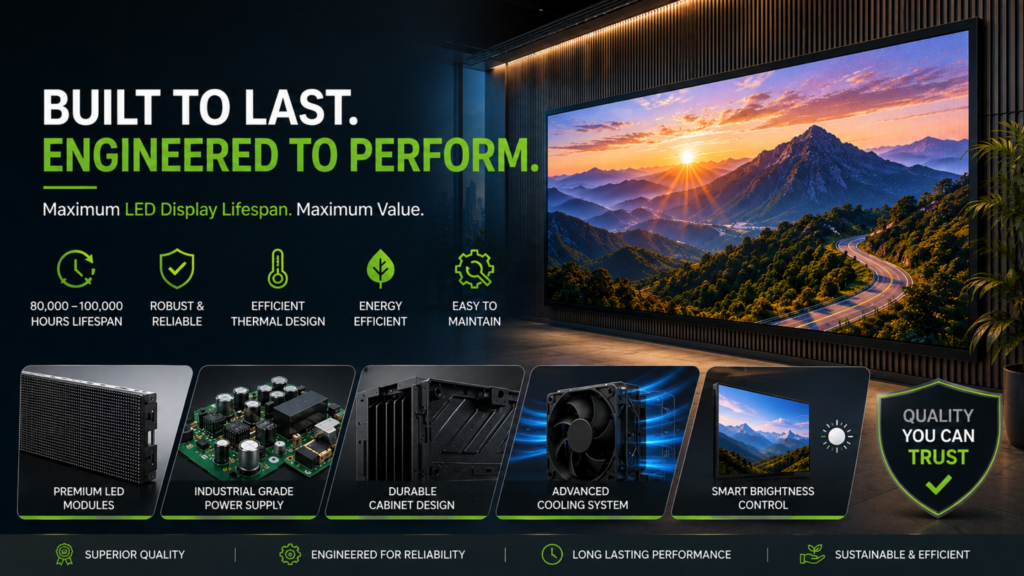
Modern commercial LED displays generally offer an estimated operational lifespan of 80,000 to 100,000 hours, depending on usage conditions, component quality, and maintenance practices.
This makes LED displays one of the most durable and cost-effective visual communication technologies available today.
Why LED Display Lifespan Matters
A commercial LED display is a strategic business asset. Its longevity directly affects:
- Return on investment (ROI)
- Maintenance costs
- Operational efficiency
- Brand image
- Customer experience
- Business continuity
A longer LED Display Lifespan means fewer repairs, reduced downtime, and lower total cost of ownership over the display’s lifecycle.
For organizations operating multiple displays across different locations, maximizing LED Display Lifespan can significantly reduce operational expenses.
Average LED Display Lifespan
Although the exact LED Display Lifespan varies depending on the application and operating environment, modern commercial displays generally perform within the following range:
| Display Type | Estimated Lifespan |
|---|---|
| Indoor Commercial LED Display | 80,000–100,000 hours |
| Outdoor Commercial LED Display | 70,000–100,000 hours |
| Fine Pixel Pitch LED Display | Up to 100,000 hours |
| Control Room LED Display | 100,000+ hours (with proper maintenance) |
| Retail LED Display | 80,000–100,000 hours |
| Corporate Video Wall | Up to 100,000 hours |
These figures assume proper installation, adequate ventilation, stable power supply, and regular preventive maintenance.
Factors That Affect LED Display Lifespan
Several engineering and environmental factors influence LED Display Lifespan. Understanding these variables helps businesses make informed purchasing decisions.
1. LED Chip Quality
The LED chip is the most important component affecting LED Display Lifespan.
High-quality LED chips provide:
- Consistent brightness
- Better color accuracy
- Reduced heat generation
- Lower power consumption
- Longer operational life
Inferior LED chips may lose brightness quickly, develop color inconsistencies, or fail prematurely.
At Vulcan AIC, component selection is based on long-term reliability and performance to ensure dependable operation in commercial applications.
2. Manufacturing Quality
Precision manufacturing directly impacts LED Display Lifespan.
Critical manufacturing processes include:
- PCB assembly
- LED placement accuracy
- Soldering quality
- Cabinet alignment
- Quality inspection
- Burn-in testing
Poor manufacturing standards can result in loose connections, overheating, and inconsistent display performance.
This is why choosing an experienced manufacturer is just as important as selecting the display itself.
3. Power Supply Quality
A stable power supply plays a vital role in extending LED Display Lifespan.
Industrial-grade SMPS (Switched Mode Power Supplies) help maintain consistent voltage while protecting sensitive electronic components from electrical fluctuations.
Reliable power management contributes to:
- Stable brightness
- Improved efficiency
- Reduced stress on components
- Lower failure rates
4. Thermal Management
Heat is one of the biggest factors affecting LED Display Lifespan.
Every LED display generates heat during operation. If this heat is not properly managed, it can shorten the lifespan of LEDs, power supplies, controllers, and other internal components.
Effective thermal management includes:
- Optimized airflow
- Efficient cabinet ventilation
- High-quality cooling fans
- Proper heat dissipation
- Temperature monitoring
At Vulcan AIC, cabinet design prioritizes airflow and thermal efficiency to ensure reliable performance even during continuous operation.
How Brightness Affects LED Display Lifespan
Brightness plays an important role in determining LED Display Lifespan. Running an LED display at maximum brightness around the clock can accelerate LED aging and increase power consumption. Modern commercial LED displays use automatic brightness control, which adjusts the screen’s brightness based on ambient light conditions.
Benefits include:
- Reduced power consumption
- Lower operating temperatures
- Improved visual comfort
- Extended LED Display Lifespan
This intelligent feature helps balance performance with long-term reliability.
Why Choosing the Right Manufacturer Matters
The quality of engineering behind an LED display has a direct impact on its lifespan.
A reputable manufacturer focuses on:
- High-quality components
- Precision manufacturing
- Strict quality control
- Comprehensive testing
- Reliable after-sales support
At Vulcan AIC, every commercial LED display undergoes rigorous testing to ensure durability, performance, and long-term reliability. From cabinet design and thermal management to power systems and quality assurance, every stage of manufacturing contributes to maximizing LED Display Lifespan.
5. Environmental Conditions Affect LED Display Lifespan
One of the most overlooked factors affecting LED Display Lifespan is the environment in which the display operates. Commercial LED displays are often installed in locations exposed to varying temperatures, humidity, dust, pollution, and sunlight. These environmental conditions can significantly influence long-term performance.
Common environmental challenges include:
- High ambient temperatures
- Excessive humidity
- Dust accumulation
- Heavy rainfall
- UV exposure
- Coastal salt corrosion
- Industrial pollution
Displays engineered with appropriate IP ratings, weather-resistant cabinets, and high-quality sealing provide greater durability in challenging environments.
At Vulcan AIC, every outdoor commercial LED display is designed to perform reliably under demanding environmental conditions while maintaining optimal LED Display Lifespan.
6. Installation Quality
Even the best commercial LED display can experience a reduced LED Display Lifespan if it is not installed correctly.
Professional installation ensures:
- Proper structural support
- Accurate cabinet alignment
- Stable electrical connections
- Effective ventilation
- Secure cable routing
- Safe grounding
Incorrect installation may cause excessive vibration, uneven loading, overheating, or electrical faults that reduce display reliability.
Why Proper Installation Matters
Correct installation helps maintain:
- Uniform image quality
- Stable electrical performance
- Better cooling efficiency
- Simplified maintenance
- Long-term structural stability
For large commercial video walls, installation quality is just as important as manufacturing quality.
7. Continuous Operating Hours
The daily operating schedule has a direct impact on LED Display Lifespan.
Commercial LED displays may operate:
- 8 hours per day
- 12 hours per day
- 16 hours per day
- 24×7 in mission-critical applications
Displays used continuously require superior thermal management, industrial-grade electronics, and preventive maintenance to maintain long-term reliability. Control rooms, airports, transportation hubs, and command centers typically require displays designed specifically for continuous operation.
8. Preventive Maintenance
Routine maintenance is one of the simplest ways to extend LED Display Lifespan.
Preventive maintenance includes:
- Cleaning cabinet filters
- Inspecting cooling fans
- Checking electrical connections
- Updating controller firmware
- Cleaning LED surfaces
- Verifying brightness consistency
- Inspecting communication cables
Small maintenance activities performed regularly help prevent major failures later.
Recommended Maintenance Schedule
Monthly
- Clean exterior surfaces
- Check display operation
- Inspect power indicators
Quarterly
- Inspect internal wiring
- Test cooling systems
- Verify cabinet seals
Annually
- Complete electrical inspection
- Firmware updates
- Brightness calibration
- Performance testing
Following a maintenance schedule helps maximize LED Display Lifespan while reducing unexpected downtime.
9. Display Usage Patterns
How a display is used also affects LED Display Lifespan.
Examples include:
Static Content
Displaying the same image continuously may cause uneven LED aging over extended periods.
Dynamic Content
Regularly changing content distributes workload more evenly across the display.
Brightness Settings
Operating at unnecessarily high brightness increases:
- Heat generation
- Power consumption
- Component stress
Automatic brightness adjustment helps improve efficiency while extending LED Display Lifespan.
10. Quality of Internal Components
An LED display is only as reliable as its internal components.
Important components include:
- LED Modules
- SMPS
- Receiving Cards
- Sending Cards
- Industrial Controllers
- Power Distribution Units
- Communication Modules
- Cooling Fans
- Connectors
- Signal Cables
Industrial-grade components provide better stability and significantly improve LED Display Lifespan.
Indoor vs Outdoor LED Display Lifespan
Although both indoor and outdoor displays use similar technologies, operating environments create different challenges.
| Feature | Indoor LED Display | Outdoor LED Display |
|---|---|---|
| Environmental Exposure | Low | High |
| Temperature Variation | Minimal | Significant |
| Dust & Moisture | Low | High |
| UV Exposure | None | Continuous |
| IP Protection | Moderate | High |
| Maintenance Frequency | Lower | Higher |
| Expected LED Display Lifespan | 80,000–100,000 Hours | 70,000–100,000 Hours |
Outdoor displays generally require stronger cabinet construction, better sealing, and more robust thermal management.
Common Reasons LED Displays Fail Early
A reduced LED Display Lifespan is often the result of avoidable issues rather than manufacturing defects.
Some common causes include:
Poor Power Quality
Voltage fluctuations can damage sensitive electronic components.
Overheating
Blocked ventilation or failed cooling systems accelerate component aging.
Moisture Ingress
Water entering the cabinet may damage controllers, power supplies, and LED modules.
Dust Accumulation
Dust restricts airflow and increases operating temperatures.
Low-Quality Components
Inferior power supplies, controllers, and LEDs often fail earlier than industrial-grade alternatives.
Improper Maintenance
Ignoring routine inspections allows minor issues to develop into costly failures.
How Businesses Can Extend LED Display Lifespan
Organizations can maximize LED Display Lifespan by following a few practical best practices:
- Choose a trusted manufacturer.
- Use industrial-grade components.
- Schedule preventive maintenance.
- Keep ventilation pathways clear.
- Enable automatic brightness adjustment.
- Protect displays from power fluctuations.
- Clean the display regularly.
- Replace worn cooling fans before failure.
- Install displays according to manufacturer guidelines.
- Monitor performance using remote diagnostics.
These simple measures help improve reliability while reducing total ownership costs.
Why Engineering Matters
The difference between an average LED display and a premium commercial LED display often comes down to engineering. At Vulcan AIC, maximizing LED Display Lifespan begins during product development.
Our engineering approach focuses on:
- Precision cabinet manufacturing
- Efficient thermal management
- Industrial-grade electronics
- Reliable power architecture
- High-quality LED components
- Rigorous quality testing
- Long-term serviceability
This commitment ensures our commercial LED displays deliver dependable performance across corporate offices, retail environments, airports, control rooms, experience centers, and other demanding applications.
How Vulcan AIC Maximizes LED Display Lifespan
At Vulcan AIC, we believe that maximizing LED Display Lifespan starts long before a product reaches the customer. Every stage of engineering, manufacturing, and testing is designed to ensure long-term reliability in demanding commercial environments.
Rather than focusing only on brightness and visual performance, we engineer complete display systems that combine high-quality components, efficient thermal management, intelligent electronics, and precision manufacturing.
Premium LED Components
The foundation of a long LED Display Lifespan begins with premium-grade LED chips and electronic components.
Our displays are engineered using carefully selected industrial components that provide:
- Stable brightness
- Uniform color reproduction
- Reduced power consumption
- Better heat resistance
- Longer operational life
Selecting quality components significantly reduces the likelihood of premature failures.
Precision Cabinet Engineering
Cabinet design has a major influence on LED Display Lifespan.
A well-designed cabinet provides:
- Better airflow
- Structural rigidity
- Easier maintenance
- Efficient cable management
- Improved heat dissipation
At Vulcan AIC, cabinet engineering focuses on long-term performance as well as ease of servicing.
Advanced Thermal Management
Temperature is one of the biggest enemies of electronic equipment.
To maximize LED Display Lifespan, our commercial LED displays incorporate:
- Optimized airflow paths
- Industrial cooling fans
- Heat-efficient cabinet structures
- Intelligent ventilation design
- Temperature monitoring
Maintaining stable operating temperatures helps preserve LED brightness and protects critical electronic components.
Reliable Power Architecture
Electrical stability plays an important role in extending LED Display Lifespan.
Our power architecture includes:
- Industrial-grade SMPS
- Stable power distribution
- Electrical protection
- Efficient load management
- Reliable grounding
These features reduce stress on electronic components while improving overall system reliability.
Comprehensive Quality Testing
Before every commercial LED display leaves our manufacturing facility, it undergoes extensive testing.
Typical quality inspections include:
- Brightness consistency
- Color calibration
- Burn-in testing
- Cabinet inspection
- Electrical testing
- Signal verification
- Thermal evaluation
- Functional testing
This rigorous testing process helps ensure every Vulcan AIC display performs reliably throughout its operational life.
Myths vs Facts About LED Display Lifespan
Many misconceptions exist regarding LED Display Lifespan.
Let’s separate myths from reality.
Myth 1: LED Displays Last Forever
Fact
Although modern displays offer exceptional LED Display Lifespan, no electronic product lasts forever. Brightness gradually decreases over time, making regular maintenance and proper operation essential.
Myth 2: Higher Brightness Means Better Performance
Fact
Operating continuously at maximum brightness may reduce LED Display Lifespan by increasing heat generation and component stress. Automatic brightness adjustment provides better efficiency while preserving display health.
Myth 3: Maintenance Isn’t Necessary
Fact
Even premium displays require preventive maintenance. Cleaning, inspections, firmware updates, and cooling system checks all contribute to extending LED Display Lifespan.
Myth 4: Indoor and Outdoor Displays Have the Same Requirements
Fact
Outdoor displays face additional environmental challenges, including:
- Rain
- Dust
- UV exposure
- Temperature variation
- Humidity
These conditions require specialized cabinet engineering and higher protection standards.
Myth 5: All LED Displays Offer Similar Lifespans
Fact
The actual LED Display Lifespan varies significantly depending on:
- Component quality
- Manufacturing standards
- Installation
- Maintenance
- Operating environment
- Engineering design
Choosing a trusted manufacturer makes a substantial difference.
Signs Your LED Display Requires Servicing
Even with excellent engineering, regular inspections help maintain LED Display Lifespan.
Common warning signs include:
Uneven Brightness
Sections of the display appear dimmer than others.
Color Inconsistency
Colors begin shifting across different areas of the display.
Dead Pixels
Individual LEDs stop functioning.
Flickering
Intermittent flickering may indicate controller or power supply issues.
Increased Operating Temperature
Unusually high cabinet temperatures may signal cooling problems.
Communication Errors
Displays fail to receive content reliably.
Abnormal Power Consumption
Unexpected increases in energy usage may indicate internal electrical issues. Addressing these issues early helps protect LED Display Lifespan while reducing repair costs.
Best Practices to Maximize LED Display Lifespan
Organizations can significantly extend LED Display Lifespan by following industry best practices.
Choose a Trusted Manufacturer
Engineering quality is the foundation of long-term reliability.
Install Professionally
Proper installation improves cooling, electrical safety, and structural integrity.
Maintain Stable Power
Use surge protection and industrial-grade electrical infrastructure.
Schedule Preventive Maintenance
Routine inspections help detect issues before failures occur.
Clean Regularly
Removing dust improves airflow and cooling efficiency.
Use Automatic Brightness Control
Dynamic brightness adjustment reduces power consumption and component stress.
Monitor System Health
Remote diagnostics allow proactive maintenance and improve operational efficiency.
Future Innovations That Will Improve LED Display Lifespan
The future of LED Display Lifespan will be driven by advancements in engineering, artificial intelligence, and materials science.
Several emerging technologies are expected to further increase reliability.
AI-Based Predictive Maintenance
Artificial Intelligence will continuously analyze display health and predict failures before they occur. This reduces downtime while extending LED Display Lifespan.
Smarter Thermal Management
Future displays will use intelligent cooling systems that automatically optimize airflow based on operating conditions.
Advanced LED Packaging
Technologies such as COB and GOB continue improving durability, environmental protection, and long-term reliability.
Higher Efficiency Components
Next-generation power supplies and controllers will consume less energy while generating less heat.
Remote Diagnostics
Cloud-connected monitoring platforms will provide real-time performance insights across thousands of displays simultaneously.
Sustainable Engineering
Future display designs will emphasize recyclable materials, energy efficiency, and environmentally responsible manufacturing without compromising LED Display Lifespan.
Why LED Display Lifespan Is a Strategic Business Investment
When businesses invest in commercial LED displays, they are investing in years of communication, branding, and operational efficiency.
A longer LED Display Lifespan provides:
- Lower maintenance costs
- Higher return on investment
- Better reliability
- Reduced downtime
- Improved sustainability
- Greater operational efficiency
This is why organizations increasingly evaluate engineering quality and manufacturing expertise—not just technical specifications.
At Vulcan AIC, every commercial LED display is engineered to deliver long-term value, dependable performance, and reliable visual communication across corporate offices, retail environments, airports, control rooms, educational institutions, and smart infrastructure projects.
Frequently Asked Questions (FAQs)
What is the average LED Display Lifespan?
The average LED Display Lifespan of a commercial LED display ranges from 80,000 to 100,000 operating hours, depending on component quality, installation, operating environment, maintenance practices, and usage patterns.
Premium commercial LED displays engineered with industrial-grade components can deliver reliable performance for more than a decade under normal operating conditions.
What factors affect LED Display Lifespan the most?
Several factors influence LED Display Lifespan, including:
- LED chip quality
- Cabinet design
- Power supply stability
- Thermal management
- Operating temperature
- Brightness settings
- Preventive maintenance
- Installation quality
- Environmental conditions
- Manufacturing standards
Selecting a trusted manufacturer and following regular maintenance schedules significantly improves long-term reliability.
Can LED Display Lifespan be extended?
Yes.
Businesses can increase LED Display Lifespan by:
- Cleaning displays regularly
- Maintaining proper ventilation
- Using automatic brightness adjustment
- Protecting displays from voltage fluctuations
- Performing preventive maintenance
- Replacing worn cooling fans
- Updating display controllers
- Using genuine replacement components
These practices help reduce component stress and improve operational reliability.
Do outdoor LED displays have a shorter lifespan?
Outdoor displays often experience harsher operating conditions than indoor installations.
Factors such as:
- Rain
- Dust
- UV radiation
- Temperature fluctuations
- Humidity
- Wind
can affect LED Display Lifespan if the display is not engineered for outdoor applications.
High-quality outdoor displays with appropriate IP ratings and robust thermal management can still achieve an excellent service life.
Does higher brightness reduce LED Display Lifespan?
Running a display continuously at maximum brightness may accelerate LED aging.
Modern commercial LED displays use automatic brightness control, adjusting brightness according to ambient light conditions. This reduces power consumption, lowers operating temperatures, and helps maximize LED Display Lifespan.
How often should a commercial LED display be serviced?
Routine inspections are recommended to maintain LED Display Lifespan.
Typical maintenance includes:
- Cleaning LED modules
- Checking cooling fans
- Inspecting power supplies
- Verifying communication systems
- Tightening electrical connections
- Updating firmware
- Checking cabinet seals
Preventive maintenance minimizes downtime and helps identify potential issues before they become major failures.
Why choose Vulcan AIC for long-lasting commercial LED displays?
At Vulcan AIC, we design and manufacture commercial LED display solutions with a strong emphasis on reliability, precision engineering, and long-term performance.
Our engineering process focuses on:
- Premium LED components
- Precision cabinet manufacturing
- Efficient thermal management
- Intelligent power architecture
- Industrial-grade electronics
- Comprehensive quality testing
- Easy maintenance and serviceability
These practices help maximize LED Display Lifespan while delivering dependable performance across corporate offices, retail stores, airports, control rooms, auditoriums, hospitality spaces, and smart infrastructure projects.
Why LED Display Lifespan Matters for Businesses
A commercial LED display is more than a visual communication tool—it is a long-term investment.
A longer LED Display Lifespan offers significant business benefits, including:
- Lower maintenance costs
- Reduced total cost of ownership
- Higher return on investment
- Improved operational efficiency
- Consistent brand presentation
- Enhanced customer engagement
- Fewer service interruptions
Organizations that prioritize LED Display Lifespan during the purchasing process often experience greater reliability and lower operating costs throughout the product lifecycle.
How Vulcan AIC Delivers Reliable Commercial LED Displays
At Vulcan AIC, our approach to maximizing LED Display Lifespan goes beyond product specifications. Every display is developed through a combination of engineering expertise, manufacturing precision, and stringent quality assurance.
Our commercial LED display solutions are designed for:
- Corporate Offices
- Retail Chains
- Shopping Malls
- Airports
- Hotels
- Educational Institutions
- Command & Control Centers
- Auditoriums
- Experience Centers
- Public Infrastructure
Every solution undergoes comprehensive testing to ensure dependable performance in real-world operating environments.
Conclusion
Understanding LED Display Lifespan is essential for businesses planning to invest in commercial display technology.
While modern LED displays are capable of operating for 80,000 to 100,000 hours, their actual lifespan depends on several critical factors, including engineering quality, component selection, thermal management, installation practices, and preventive maintenance.
Choosing the right manufacturer is equally important. Displays built with premium components, efficient power management, and robust cabinet designs provide better long-term performance and lower lifecycle costs.
At Vulcan AIC, we engineer commercial LED displays that are designed for durability, efficiency, and continuous operation. From precision cabinet manufacturing and intelligent cooling systems to industrial-grade electronics and rigorous quality testing, every stage of our process is focused on maximizing LED Display Lifespan.
As businesses continue to embrace digital communication, investing in reliable, future-ready display technology will remain a key factor in achieving long-term operational success.

