
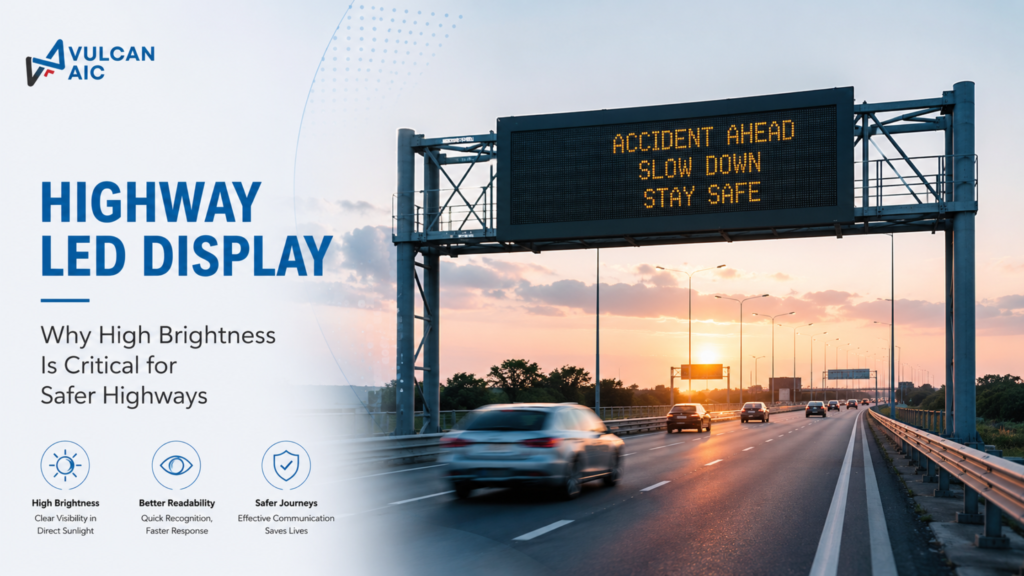
A Highway LED Display operates in one of the most demanding visual environments imaginable. Unlike an indoor display, it must remain clearly readable under direct sunlight, changing weather, vehicle headlights, dust, fog, and rapidly changing ambient light.
More importantly, drivers often have only a few seconds to see, understand, and respond to the information displayed.
This makes brightness much more than a display specification. It directly contributes to visibility, readability, response time, and effective traffic communication.
Variable Message Signs (VMS), Variable Speed Limit Signs (VSLS), lane control systems, and other highway displays communicate information such as accidents ahead, lane closures, speed restrictions, congestion, diversions, weather warnings, and emergency instructions.
At Vulcan AIC, we design and manufacture intelligent display and transportation solutions for highways, expressways, tunnels, and other critical infrastructure environments. For such applications, display performance must be engineered around actual field conditions—not simply how impressive a display looks in a controlled environment.
This article explains why high brightness matters in a Highway LED Display, how brightness affects visibility and what engineers should consider when designing LED displays for modern highways.
What Is a Highway LED Display?
A Highway LED Display is an electronic display system designed to communicate real-time information to road users.
Depending on the highway infrastructure, these systems may be installed overhead on gantries, beside carriageways, at tunnel entrances, near toll plazas, at interchanges, or at other strategically important locations.
Highway displays may communicate:
- Traffic congestion warnings
- Accident information
- Speed restrictions
- Lane closures
- Diversion instructions
- Weather alerts
- Roadwork information
- Emergency messages
- Travel-time information
- Safety instructions
A Highway LED Display is therefore not conventional advertising signage. It forms part of an operational traffic management ecosystem where information must be communicated quickly and accurately.
Why Does Highway LED Display Brightness Matter?
Imagine driving on an expressway during a bright afternoon.
Sunlight is falling directly onto an LED display installed ahead. If the display cannot produce enough luminance to overcome surrounding ambient light, its message can appear faded or washed out. A driver may technically be able to see the display, but that does not necessarily mean they can read and understand it quickly enough.
That distinction is critical.
High brightness helps maintain sufficient contrast between illuminated LED pixels and their surroundings. This allows letters, symbols, arrows, speed indications, and warnings to remain distinguishable. For intelligent transportation applications, the objective isn’t maximum brightness at all times. The objective is appropriate visibility under changing environmental conditions.
Understanding Brightness in Highway LED Displays
LED display brightness is commonly expressed in nits, where one nit represents one candela per square metre (cd/m²). A higher nit value indicates greater luminance.
However, specifying a very high maximum brightness figure alone does not guarantee an effective Highway LED Display.
Engineers must also consider:
- Contrast
- Viewing angle
- Pixel pitch
- LED quality
- Optical design
- Character size
- Viewing distance
- Ambient light
- Automatic dimming
- Colour performance
An effective highway display balances these parameters to maintain readability throughout different operating conditions.
9 Reasons a Highway LED Display Needs High Brightness
1. Direct Sunlight Can Reduce Display Visibility
One of the biggest challenges for any outdoor LED display is sunlight.
During peak daylight hours, ambient illumination can be extremely strong. When sunlight falls directly or indirectly on a display surface, insufficient luminance can cause displayed information to lose visual contrast.
A high-brightness Highway LED Display is engineered to maintain visibility even under demanding daylight conditions.
This becomes particularly important on open expressways where there may be little surrounding shade.
2. Drivers Have Limited Reading Time
Highway users don’t stand in front of a display and read it like a billboard. They are approaching it at speed. Depending on vehicle speed, display location and viewing distance, a driver may have only a short period to:
Detect → Read → Understand → Respond
The information must therefore become visually recognizable as early as possible. Adequate brightness, contrast, character height, spacing and message simplicity collectively improve legibility.
This is why a Highway LED Display must be engineered as a traffic communication system rather than treated simply as a large LED screen.
3. Highway Conditions Change Throughout the Day
A display may experience completely different environmental conditions within a few hours.
Morning sunlight may strike from one direction. Midday conditions may create extremely high ambient illumination. Evening introduces rapidly decreasing light, while nighttime creates a dark environment. A single fixed brightness setting is therefore inefficient.
Modern highway displays can incorporate automatic brightness control, enabling luminance to respond to surrounding ambient conditions. This allows strong output during daylight while reducing brightness appropriately at night.
4. High Brightness Supports Critical Safety Communication
Consider messages such as:
ACCIDENT AHEAD – SLOW DOWN
LANE CLOSED – MERGE RIGHT
FOG AHEAD – REDUCE SPEED
ROAD WORK – DRIVE CAREFULLY
These aren’t optional pieces of information.
They can influence immediate driving behaviour.
The effectiveness of a Highway LED Display therefore depends on whether the message reaches the driver clearly and at the right moment. High visibility helps traffic authorities communicate critical warnings before drivers reach a hazard.
5. Outdoor Displays Face Challenging Weather
Highway infrastructure operates continuously despite changing weather.
Depending on geography and season, displays may face:
- Heavy rain
- Dust
- Fog
- Heat
- Humidity
- Winter conditions
- Monsoon conditions
Weather can reduce visual clarity and change how light is perceived.
High brightness alone cannot eliminate every visibility problem caused by severe weather, but sufficient luminance combined with good contrast and optical design helps preserve readability across a wider range of operating conditions.
This is especially important for 24×7 highway infrastructure.
6. Viewing Distance Requires Strong Visual Performance
A Highway LED Display must often be readable well before a vehicle reaches the sign.
The appropriate viewing distance depends on several factors, including:
- Character height
- Vehicle speed
- Sign dimensions
- Installation height
- Road geometry
- Number of lanes
- Pixel pitch
- Viewing angle
Brightness becomes one part of this complete visual engineering equation.
The goal is not simply to make the sign visible from far away. The message should become readable at an appropriate distance, giving road users sufficient time to interpret and act upon it.
7. High Brightness Helps Maintain Contrast
Brightness and contrast work together.
A display could technically have powerful LEDs yet still perform poorly if its optical design allows excessive external light reflection.
High-quality outdoor LED systems may therefore use features such as carefully designed LED modules, optical elements and dark display surfaces to improve contrast.
For a Highway LED Display, engineers should evaluate brightness as part of the complete display architecture rather than as an isolated number.
8. High-Speed Roads Require Immediate Recognition
Expressways and national highways have fundamentally different communication requirements from low-speed urban streets.
At higher vehicle speeds, information needs to be processed faster.
Messages therefore need:
- Strong visibility
- Simple wording
- Clear typography
- Appropriate character size
- High contrast
- Correct placement
- Adequate viewing distance
Brightness contributes directly to the driver’s ability to identify the display against the surrounding visual environment.
The faster the operating environment, the more important effective visual communication becomes.
9. Highway Displays Must Perform Reliably 24×7
Highway traffic management systems are expected to operate continuously.
A display may be required during ordinary traffic conditions, but its importance becomes even greater during incidents, severe weather, road closures or emergency situations.
This requires engineering for more than peak brightness.
A professional Highway LED Display should consider:
- Thermal management
- Power efficiency
- LED lifetime
- Environmental protection
- Electrical protection
- Communication reliability
- Remote diagnostics
- Maintenance accessibility
- System redundancy where required
High brightness must therefore be achieved without compromising long-term operational reliability.
Highway LED Display Brightness vs Readability
One common misconception is: More brightness = better display.
That’s not always true.
Excessive brightness can create its own problems, especially at night. A display that is unnecessarily bright in a dark environment may cause glare and reduce comfortable readability.
The correct approach is adaptive brightness.
During strong daylight, the display increases luminance to maintain visibility. As ambient light decreases, the display output should also decrease.
This provides three major benefits:
Better readability: Appropriate contrast is maintained throughout the day.
Lower energy consumption: LEDs don’t need to operate at maximum output continuously.
Potentially improved component longevity: Sensible operation reduces unnecessary thermal and electrical stress.
The best Highway LED Display is therefore not necessarily the one with the highest brightness specification. It is the one that manages brightness intelligently.
Automatic Brightness Control in Highway LED Displays
Ambient light sensors can measure surrounding illumination and allow the display controller to adjust output accordingly.
A simplified operating pattern might be:
Bright sunlight → Higher display output
Cloudy conditions → Moderate output
Evening → Reduced output
Night → Significantly lower output
Actual control parameters should be engineered according to the project requirements, applicable standards and operating environment. Automatic control also reduces the need for operators to manually adjust display intensity as conditions change. For connected ITS environments, brightness control can form part of a wider remote monitoring and control architecture.
Highway LED Display vs Tunnel LED Display
Highways and tunnels require different display engineering approaches. An outdoor Highway LED Display must primarily compete with sunlight and changing weather. Tunnel environments create different challenges.
At tunnel entrances and exits, drivers experience rapid changes in ambient illumination. Inside tunnels, lighting is controlled but visibility conditions can vary by zone, traffic conditions and tunnel geometry.
Tunnel displays may communicate:
- Lane availability
- Speed limits
- Emergency warnings
- Incident information
- Evacuation instructions
- Traffic restrictions
Vulcan AIC develops intelligent display solutions for both highway and tunnel environments, allowing display characteristics and control strategies to be engineered according to the operating application.
Engineering Factors Beyond High Brightness
Brightness should never be evaluated alone when selecting a Highway LED Display.
Pixel Pitch
Pixel pitch determines the spacing between LEDs and influences viewing characteristics and display resolution.
The ideal pitch depends on viewing distance and application requirements.
Viewing Angle
A highway display may need to communicate with drivers across several lanes. Appropriate horizontal and vertical viewing characteristics help maintain readability from different positions.
Character Size
Text must be large enough to be interpreted from the required viewing distance.
Contrast
High contrast makes characters and symbols easier to distinguish from the display background.
Environmental Protection
Outdoor electronics must be protected from rain, dust, moisture and environmental exposure according to project requirements.
Thermal Management
High-brightness LEDs generate heat.
Effective thermal engineering is important for maintaining consistent output and long-term reliability.
Power Management
Highway displays may operate continuously, making power efficiency an important lifecycle consideration.
Remote Monitoring
Modern systems can allow operators to monitor display status, communication health, faults and other operational parameters from a control centre.
Highway LED Displays as Part of Intelligent Transportation Systems
A Highway LED Display becomes significantly more powerful when connected with other ITS technologies.
For example, traffic information may originate from:
- Automatic Traffic Counter & Classifier systems
- Radar detection
- Video analytics
- Incident detection systems
- Weather monitoring stations
- Traffic management software
- Command and Control Centres
The system can process this information and communicate relevant messages through Variable Message Signs or other roadside displays.
This creates a connected information chain:
Detection → Analysis → Decision → Communication → Driver Response
The display is therefore the visible end of a much larger intelligent infrastructure ecosystem.
Vulcan AIC and Highway LED Display Manufacturing
At Vulcan AIC, we design and manufacture intelligent display systems and ITS solutions for demanding infrastructure applications.
Our approach to Highway LED Display engineering considers not only visual performance but also the complete operational environment in which the system will function.
This includes factors such as:
- Highway operating conditions
- Viewing distance
- Ambient brightness
- Weather exposure
- Structural integration
- Electrical systems
- Communication architecture
- Remote monitoring
- Maintenance requirements
- System lifecycle
Our intelligent infrastructure portfolio supports applications across highways, expressways, tunnels and traffic management environments.
By combining display engineering, electronics, software, system integration and manufacturing capabilities, Vulcan AIC works toward one objective: infrastructure that communicates clearly and performs reliably when it matters.
Why Manufacturing Quality Matters
High brightness places significant demands on an LED display. Higher output can increase power consumption and thermal load. Poor thermal management may affect LED performance, electronics and long-term reliability. Manufacturing quality therefore plays a major role in the lifecycle of the system.
Important considerations include:
- LED selection and binning
- PCB quality
- Power supply design
- Cabinet engineering
- Thermal management
- Wiring quality
- Environmental sealing
- Controller reliability
- Factory testing
- Calibration
At Vulcan AIC, engineering and manufacturing are treated as connected processes. Highway and tunnel systems must be designed for field performance from the beginning rather than simply assembled from individual components.
Frequently Asked Questions
Why does a Highway LED Display need high brightness?
High brightness helps the display maintain sufficient visibility and contrast under strong ambient light, particularly during daylight and direct sunlight.
Is maximum brightness always better?
No. Excessive brightness at night can create glare. Automatic brightness adjustment is generally more effective than operating continuously at maximum output.
What affects Highway LED Display readability?
Brightness, contrast, character size, viewing distance, pixel pitch, viewing angle, ambient conditions and message design all influence readability.
Can Highway LED Displays operate at night?
Yes. Highway LED displays are designed for 24×7 operation. Their brightness should be reduced appropriately at night to maintain comfortable readability.
Are Highway LED Displays part of ITS?
Yes. Variable Message Signs and related LED displays are commonly integrated with Intelligent Transportation Systems to communicate real-time traffic and safety information.
Does Vulcan AIC manufacture highway display systems?
Vulcan AIC designs and manufactures intelligent display and transportation solutions for highway and tunnel infrastructure, integrating hardware, electronics, software and control technologies according to project requirements.
Conclusion
A Highway LED Display is much more than a bright electronic sign. It is a critical communication interface between traffic management systems and road users. High brightness enables displays to remain visible during demanding daylight conditions, but effective highway communication requires much more: appropriate contrast, viewing distance, character size, optical design, automatic brightness adjustment, environmental protection and reliable electronics.
The objective should never be maximum brightness for its own sake.
The objective is maximum clarity when information matters most.
At Vulcan AIC, we design and manufacture intelligent highway and tunnel display solutions with a focus on visibility, reliability and real-world infrastructure performance. By integrating intelligent displays with traffic detection, communication and control technologies, we help create transportation infrastructure that can inform drivers, support operators and contribute to safer journeys.
Because on a highway, information is useful only when it can be seen, understood and acted upon in time.

