
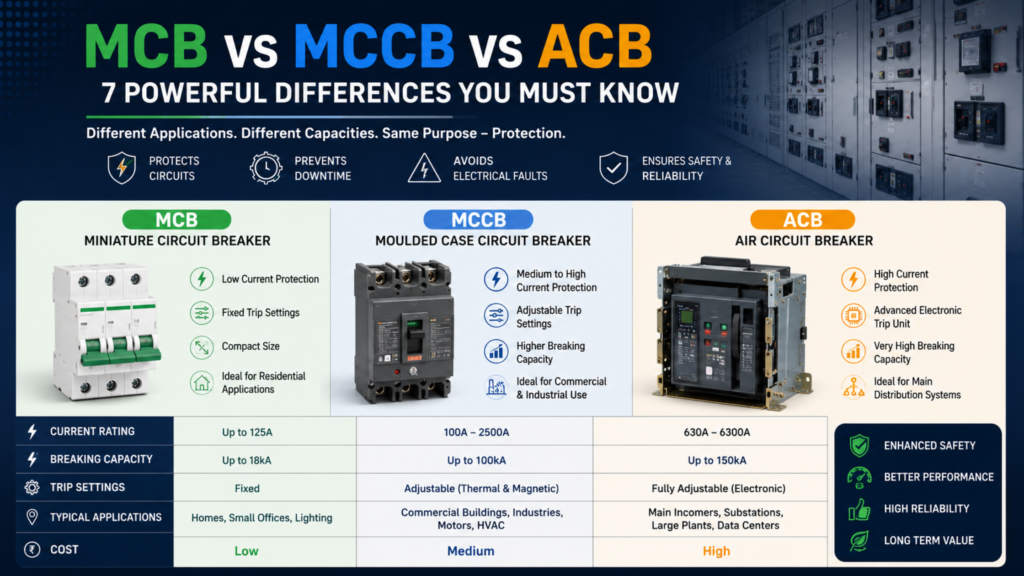
Modern electrical systems rely on effective protection devices to prevent overloads, short circuits, and electrical faults. Among the most commonly used protective devices are MCB vs MCCB vs ACB. Although all three are circuit breakers designed to protect electrical equipment, they differ significantly in their operating capacity, applications, interrupting ratings, and installation environments.
Understanding MCB vs MCCB vs ACB is essential for electrical engineers, facility managers, industrial operators, consultants, and infrastructure developers. Selecting the wrong breaker can lead to equipment damage, system downtime, safety hazards, and increased maintenance costs.
This guide explains everything you need to know about MCB vs MCCB vs ACB, including working principles, features, differences, advantages, applications, and selection criteria.
What is an MCB?
An MCB (Miniature Circuit Breaker) is a low-voltage protective device used to safeguard electrical circuits against overloads and short circuits. It automatically disconnects the power supply whenever abnormal current flows through the circuit.
MCBs are commonly installed in:
- Residential buildings
- Small commercial offices
- Lighting circuits
- Socket outlets
- Small machinery
Features of MCB
- Current Rating: Up to 125A
- Breaking Capacity: Up to 18kA
- Compact design
- Maintenance-free
- Fast fault interruption
- Easy installation
MCBs are ideal where current demand is relatively low.
What is an MCCB?
An MCCB (Moulded Case Circuit Breaker) is designed for medium and high-current applications where adjustable protection settings are required.
Compared to an MCB, an MCCB offers:
- Higher current capacity
- Adjustable trip settings
- Better fault protection
- Improved reliability
- Greater flexibility
Features of MCCB
- Current Rating: 100A–2500A
- Breaking Capacity: Up to 100kA
- Adjustable thermal protection
- Adjustable magnetic protection
- Manual or motorized operation
MCCBs are widely used in commercial buildings, factories, industrial plants, and critical infrastructure.
What is an ACB?
An ACB (Air Circuit Breaker) is a high-capacity circuit breaker that uses air as the arc-extinguishing medium. It is installed in low-voltage distribution systems requiring very high current protection.
ACBs are designed for:
- Main incomers
- Generator protection
- Industrial substations
- Large manufacturing plants
- Data centres
- Smart infrastructure
Features of ACB
- Current Rating: 630A–6300A
- Breaking Capacity: Up to 150kA
- Intelligent electronic trip units
- Remote operation
- Communication support
- High operational life
MCB vs MCCB vs ACB: Key Differences
| Feature | MCB | MCCB | ACB |
|---|---|---|---|
| Full Form | Miniature Circuit Breaker | Moulded Case Circuit Breaker | Air Circuit Breaker |
| Current Rating | Up to 125A | 100A–2500A | 630A–6300A |
| Breaking Capacity | Up to 18kA | Up to 100kA | Up to 150kA |
| Trip Setting | Fixed | Adjustable | Fully Adjustable |
| Installation | Homes | Industries | Main Distribution Panels |
| Cost | Low | Medium | High |
| Maintenance | Minimal | Moderate | Regular |
| Automation | No | Optional | Advanced |
| Communication | No | Limited | Yes |
Why Understanding MCB vs MCCB vs ACB Matters
Selecting the correct breaker ensures:
- Electrical safety
- Equipment protection
- Reduced downtime
- Improved reliability
- Regulatory compliance
- Lower maintenance costs
For critical infrastructure projects, understanding MCB vs MCCB vs ACB is essential to designing safe and efficient power distribution systems.
Advantages of MCB
Cost-Effective
MCBs are affordable and ideal for residential applications.
Easy Installation
Compact DIN rail mounting simplifies installation.
Maintenance-Free
No periodic servicing is typically required.
Quick Fault Detection
Trips instantly during overloads or short circuits.
Advantages of MCCB
Adjustable Protection
Users can modify overload and short-circuit settings.
Higher Current Capacity
Suitable for medium and large electrical loads.
Better Equipment Protection
Provides enhanced protection for motors, transformers, and industrial machinery.
Flexible Applications
Can be integrated into automation systems.
Advantages of ACB
Highest Protection Level
Ideal for critical electrical infrastructure.
Intelligent Monitoring
Modern ACBs support:
- IoT monitoring
- Remote diagnostics
- Power analytics
- SCADA integration
High Reliability
Designed for continuous industrial operation.
Long Service Life
Built for thousands of switching operations.
Applications of MCB vs MCCB vs ACB
Residential Buildings
MCBs protect:
- Lighting circuits
- Fans
- Appliances
- Socket outlets
Commercial Buildings
MCCBs protect:
- HVAC systems
- Elevators
- Distribution panels
- Office equipment
Industrial Plants
MCCBs and ACBs are widely used for:
- Motors
- Compressors
- Pumps
- Manufacturing equipment
Smart Infrastructure
In modern infrastructure projects, MCB vs MCCB vs ACB each play a vital role.
Applications include:
- Intelligent Transportation Systems (ITS)
- Highway Control Rooms
- Variable Message Signs (VMS)
- Smart City Command Centres
- EV Charging Stations
- Solar Power Systems
- Battery Energy Storage Systems
- Industrial Automation Panels
Companies like Vulcan AIC integrate advanced electrical protection systems into intelligent infrastructure solutions to ensure reliable and uninterrupted operations.
How to Choose Between MCB vs MCCB vs ACB
Consider the following factors:
Current Load
Higher loads require MCCBs or ACBs.
Fault Current
High fault levels demand higher breaking capacity.
Future Expansion
Choose breakers that accommodate future growth.
Protection Requirements
Adjustable settings are better for industrial systems.
Communication Features
Smart facilities benefit from ACBs with digital monitoring.
Common Mistakes to Avoid
- Selecting a breaker with insufficient current rating
- Ignoring fault current calculations
- Overlooking adjustable trip settings
- Using MCBs for heavy industrial loads
- Failing to maintain ACBs periodically
Working Principle of MCB vs MCCB vs ACB
Although MCB vs MCCB vs ACB are all protective devices, each operates differently based on the application and current level.
MCB Working Principle
An MCB uses two tripping mechanisms:
- Thermal Trip: A bimetallic strip bends during overload conditions and trips the breaker.
- Magnetic Trip: An electromagnetic coil instantly trips the breaker during a short circuit.
This combination provides quick and reliable protection for residential and light commercial circuits.
MCCB Working Principle
An MCCB functions similarly to an MCB but includes adjustable trip settings.
Modern MCCBs allow users to configure:
- Long-time delay
- Short-time delay
- Instantaneous trip
- Ground fault protection
This flexibility makes MCCBs ideal for industrial and commercial power distribution.
ACB Working Principle
An ACB interrupts electrical faults using air as the arc-quenching medium.
When a fault occurs:
- Contacts separate.
- An electric arc forms.
- Arc chutes divide and cool the arc.
- The arc extinguishes safely.
- Power is disconnected.
Modern ACBs use electronic trip units that continuously monitor voltage, current, power quality, and fault conditions.
Importance of MCB vs MCCB vs ACB in Smart Infrastructure
Modern infrastructure depends heavily on uninterrupted electricity.
Whether it’s a smart highway, airport, metro station, command centre, or industrial automation facility, electrical protection devices ensure uninterrupted operation.
For infrastructure companies like Vulcan AIC, selecting the right breaker is essential for:
- Intelligent Transportation Systems (ITS)
- Variable Message Signs (VMS)
- Highway Traffic Management Systems
- Command & Control Centres
- Smart City Projects
- Digital Display Networks
- Solar Power Backup Systems
- EV Charging Infrastructure
Using the appropriate solution from MCB vs MCCB vs ACB helps minimize downtime, improve equipment life, and enhance operational safety.
How Circuit Breakers Improve Electrical Safety
Electrical faults are one of the leading causes of equipment failure and fire hazards.
Properly selected circuit breakers provide protection against:
- Overloads
- Short circuits
- Ground faults
- Equipment damage
- Fire risks
- Electrical shock
- Voltage abnormalities
Understanding MCB vs MCCB vs ACB enables engineers to build safer and more reliable electrical systems.
Future Trends in Circuit Breaker Technology
The electrical industry is rapidly evolving with smarter and more connected protection systems.
Key innovations include:
Smart Digital Breakers
Real-time monitoring through cloud-based dashboards.
IoT Connectivity
Remote diagnostics and predictive maintenance.
AI-Based Fault Detection
Artificial intelligence identifies abnormal electrical behaviour before failures occur.
Energy Monitoring
Advanced breakers measure:
- Energy consumption
- Demand trends
- Power factor
- Harmonics
- Voltage quality
Integration with Smart Grids
Modern ACBs and MCCBs are increasingly integrated into smart grid infrastructure, enabling automated fault isolation and improved power reliability.
Frequently Asked Questions
Which is better: MCB or MCCB?
MCBs are suitable for residential applications, while MCCBs are preferred for commercial and industrial installations due to their higher capacity and adjustable protection.
Where is an ACB used?
ACBs are used in main electrical distribution systems, substations, manufacturing plants, data centres, and large infrastructure projects.
Can an MCCB replace an MCB?
Yes, in many commercial and industrial applications. However, it depends on the current rating, fault level, and system design.
Which breaker offers the highest protection?
Among MCB vs MCCB vs ACB, the Air Circuit Breaker (ACB) offers the highest current handling capacity, advanced protection functions, and intelligent monitoring capabilities.
Conclusion
Understanding the differences between MCB vs MCCB vs ACB is essential for designing safe, reliable, and efficient electrical systems. While MCBs are ideal for residential use, MCCBs serve commercial and industrial environments with greater flexibility, and ACBs provide the highest level of protection for critical infrastructure and large-scale power distribution.
Choosing the right circuit breaker depends on factors such as current rating, fault level, operational requirements, and future scalability. By selecting the appropriate protection device, organizations can improve system reliability, reduce downtime, and ensure long-term electrical safety.

