Imagine leaving home on time for an important meeting only to spend the next 40 minutes stuck at the same traffic signal. The roads aren’t blocked by accidents or roadwork—there are simply too many vehicles moving without efficient coordination.
This challenge is becoming increasingly common in growing cities and expanding highway networks. As vehicle ownership continues to rise, traditional traffic control methods are no longer enough to manage modern transportation demands.
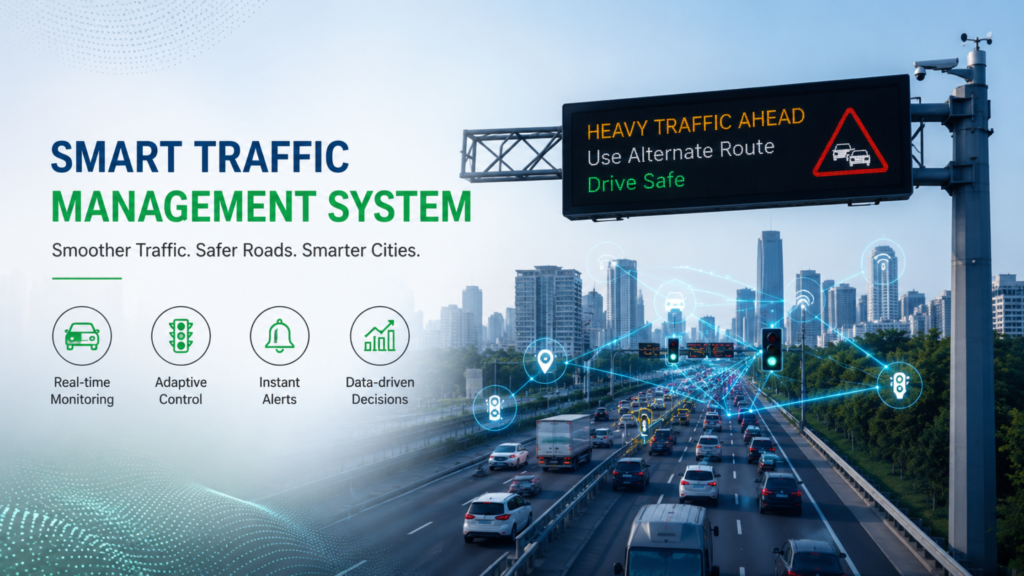
A Traffic Management System provides a smarter solution. By combining sensors, cameras, intelligent software, communication networks, and real-time data, it helps traffic authorities monitor road conditions, reduce congestion, improve safety, and respond quickly to changing situations.
At Vulcan Advance Intelligence Computing Pvt. Ltd. (Vulcan AIC), intelligent transportation technologies are an important part of building safer highways, smarter cities, and more efficient road infrastructure. Solutions such as Variable Message Signs (VMS), intelligent LED displays, and integrated traffic systems help authorities communicate critical information to drivers in real time.
In this article, we’ll explore how a Traffic Management System works, why it is becoming essential for modern infrastructure, and how it helps reduce congestion while improving the overall travel experience.
What is a Traffic Management System?
A Traffic Management System is an integrated network of hardware, software, communication technologies, and traffic control devices that continuously monitor and manage vehicle movement.
Unlike conventional traffic signals that operate on fixed schedules, modern systems analyze live traffic conditions and adjust operations dynamically.
A typical Traffic Management System collects data from multiple sources, processes it in real time, and delivers actionable information to traffic control centers and road users.
These systems are widely deployed across:
- National Highways
- Expressways
- Smart Cities
- Metro Corridors
- Airports
- Tunnels
- Urban Road Networks
- Industrial Corridors
The primary objective is simple: keep traffic moving safely and efficiently.
Why Traffic Congestion Is Increasing
Traffic congestion is influenced by several factors beyond the growing number of vehicles.
Some of the most common causes include:
- Increasing urban population
- Poor signal coordination
- Road accidents
- Construction activities
- Weather conditions
- Limited road capacity
- Inefficient traffic monitoring
- Delayed incident response
Without intelligent monitoring and real-time decision-making, these challenges quickly lead to longer travel times, fuel wastage, and increased emissions.
A Traffic Management System addresses these issues through automation and data-driven traffic control.
How a Traffic Management System Works
A modern Traffic Management System operates by collecting, analyzing, and responding to live traffic information.
The process generally follows these steps:
1. Data Collection
Traffic cameras, radar sensors, ANPR cameras, IoT devices, GPS systems, and vehicle detectors continuously gather information about traffic flow, vehicle speed, and road occupancy.
2. Data Processing
The collected information is transmitted to a centralized Traffic Management Center (TMC), where advanced software analyzes current road conditions.
Artificial Intelligence and predictive analytics can identify congestion before it becomes severe.
3. Decision Making
Based on real-time analysis, the system automatically recommends or applies corrective measures, including:
- Signal timing adjustments
- Lane management
- Speed regulation
- Incident notifications
- Route diversions
4. Driver Communication
Information is shared instantly through:
- Variable Message Signs (VMS)
- Mobile navigation applications
- Traffic information displays
- Highway advisory systems
- Public transport information boards
Providing drivers with timely information allows them to make safer and more informed travel decisions.
Key Components of a Traffic Management System
Several technologies work together to make a Traffic Management System effective.
Intelligent Traffic Signals
Adaptive traffic signals adjust green light durations based on live vehicle density rather than fixed timers.
Variable Message Signs (VMS)
VMS displays communicate:
- Traffic congestion alerts
- Accident warnings
- Lane closures
- Speed advisories
- Weather information
- Diversion routes
At Vulcan AIC, intelligent Variable Message Signs are designed to provide high-visibility, real-time communication that supports safer and more efficient highway operations.
CCTV Surveillance
High-definition surveillance cameras provide continuous monitoring and help operators quickly detect incidents.
Automatic Number Plate Recognition (ANPR)
ANPR cameras identify vehicles for:
- Toll management
- Traffic enforcement
- Stolen vehicle detection
- Traffic analytics
Environmental Sensors
Weather stations monitor:
- Rainfall
- Fog
- Wind speed
- Temperature
- Visibility
The Traffic Management System can automatically issue warnings during adverse weather conditions.
Benefits of a Traffic Management System
Reduces Traffic Congestion
Real-time monitoring helps optimize traffic flow and minimizes unnecessary delays.
Improves Road Safety
Quick detection of accidents allows emergency services to respond faster while warning approaching drivers.
Better Signal Coordination
Adaptive signal control reduces waiting time at intersections.
Lower Fuel Consumption
Less idling means reduced fuel usage and lower operating costs for commuters and commercial vehicles.
Reduced Carbon Emissions
Smoother traffic flow contributes to improved air quality and supports sustainable urban transportation.
Enhanced Traveler Information
Drivers receive timely updates about road conditions, helping them avoid congestion and choose efficient routes.
Advanced Technologies Used in a Traffic Management System
Modern cities are moving beyond traditional traffic control by integrating advanced technologies into every Traffic Management System. These technologies enable authorities to make faster decisions, predict congestion, and improve the overall efficiency of transportation networks.
Artificial Intelligence (AI)
Artificial Intelligence helps analyze traffic patterns in real time. Instead of reacting after congestion occurs, AI predicts traffic build-up based on historical data, weather conditions, special events, and live vehicle movement.
AI-powered traffic management can:
- Predict congestion before it occurs
- Optimize traffic signal timing
- Detect accidents automatically
- Improve emergency response
- Reduce overall travel time
Internet of Things (IoT)
IoT devices connect traffic infrastructure into a single intelligent ecosystem.
Connected devices include:
- Traffic sensors
- Smart cameras
- Weather stations
- Vehicle detectors
- Environmental monitoring systems
- Variable Message Signs (VMS)
The data collected is continuously shared with the Traffic Management System, enabling faster and more informed decision-making.
Intelligent Transportation Systems (ITS)
A modern Traffic Management System is one of the core components of an Intelligent Transportation System (ITS). ITS combines multiple technologies to improve road safety and transportation efficiency.
Key ITS components include:
- Variable Message Signs (VMS)
- Adaptive Traffic Signals
- Automatic Number Plate Recognition (ANPR)
- CCTV Surveillance
- Emergency Call Systems
- Incident Detection Systems
- Traffic Control Centers
At Vulcan Advance Intelligence Computing Pvt. Ltd. (Vulcan AIC), these technologies come together to support smarter highways, tunnels, urban roads, and public infrastructure. Intelligent LED displays and Variable Message Signs help traffic authorities communicate critical information in real time, improving both mobility and road safety.
Real-World Applications of a Traffic Management System
A Traffic Management System is now an essential part of modern transportation infrastructure.
Smart Cities
Cities use intelligent traffic systems to reduce congestion, improve public transportation, and optimize traffic flow at busy intersections.
National Highways
Highway authorities deploy Traffic Management Systems to monitor traffic conditions, detect incidents, display travel information, and manage lane operations.
Expressways
Real-time monitoring helps maintain smoother vehicle movement while reducing delays caused by accidents or road maintenance.
Tunnels
Tunnel operators use intelligent traffic systems to monitor vehicle movement, manage ventilation, display emergency instructions, and improve overall tunnel safety.
Airports
Airport access roads rely on smart traffic management to coordinate passenger vehicles, taxis, buses, and service traffic efficiently.
Metro Rail Corridors
Integrated traffic systems improve coordination between road traffic and public transport, reducing congestion around metro stations.
Traffic Management System vs Traditional Traffic Control
| Feature | Traditional Traffic Signals | Traffic Management System |
|---|---|---|
| Signal Timing | Fixed | Adaptive |
| Traffic Monitoring | Manual | Real-Time |
| Incident Detection | Slow | Automatic |
| Driver Information | Limited | Live Updates |
| Congestion Management | Reactive | Predictive |
| Data Analytics | Minimal | Advanced |
| Smart City Integration | No | Yes |
Why Traffic Management Systems Matter for Smart Cities
As cities continue to expand, simply building wider roads is no longer enough.
Future-ready transportation depends on intelligent systems that can:
- Reduce travel time
- Improve emergency response
- Increase road safety
- Lower fuel consumption
- Reduce vehicle emissions
- Enhance commuter experience
- Support sustainable urban development
A Traffic Management System enables authorities to achieve these goals while making better use of existing road infrastructure.
Future of Traffic Management Systems
The next generation of Traffic Management Systems will become even more intelligent through technologies such as:
- Artificial Intelligence
- Machine Learning
- Digital Twins
- Connected Vehicles
- Vehicle-to-Infrastructure (V2I) Communication
- 5G Networks
- Cloud-Based Traffic Analytics
- Autonomous Vehicle Integration
These innovations will allow transportation agencies to predict traffic conditions with greater accuracy and manage road networks more efficiently.
Frequently Asked Questions
What is a Traffic Management System?
A Traffic Management System is an integrated platform that monitors, controls, and optimizes vehicle movement using real-time data, intelligent software, and connected traffic infrastructure.
How does a Traffic Management System reduce congestion?
It collects live traffic information, adjusts traffic signals, provides driver alerts through Variable Message Signs, and recommends alternate routes to maintain smoother traffic flow.
What technologies are used in a Traffic Management System?
Modern systems use AI, IoT, CCTV cameras, ANPR, GPS, adaptive traffic signals, Variable Message Signs (VMS), communication networks, and centralized traffic control software.
Why are Variable Message Signs important?
Variable Message Signs provide drivers with real-time information about accidents, weather conditions, congestion, lane closures, and speed advisories, helping improve road safety and traffic efficiency.
Is a Traffic Management System important for Smart Cities?
Yes. It plays a vital role in improving mobility, reducing congestion, supporting public transportation, lowering emissions, and enhancing overall road safety.
Conclusion
As urban populations grow and transportation demands increase, traditional traffic control methods are no longer sufficient. A Traffic Management System enables cities and highway authorities to move from reactive traffic control to intelligent, data-driven traffic management.
By combining real-time monitoring, Artificial Intelligence, IoT, adaptive traffic signals, and Variable Message Signs, these systems help reduce congestion, improve safety, optimize travel times, and create more sustainable transportation networks.
At Vulcan Advance Intelligence Computing Pvt. Ltd. (Vulcan AIC), intelligent transportation solutions are designed to support the evolving needs of highways, tunnels, smart cities, and public infrastructure. Through advanced Variable Message Signs (VMS), intelligent LED displays, and integrated ITS solutions, Vulcan AIC helps authorities deliver timely information, improve operational efficiency, and build safer, smarter roads for the future.

