
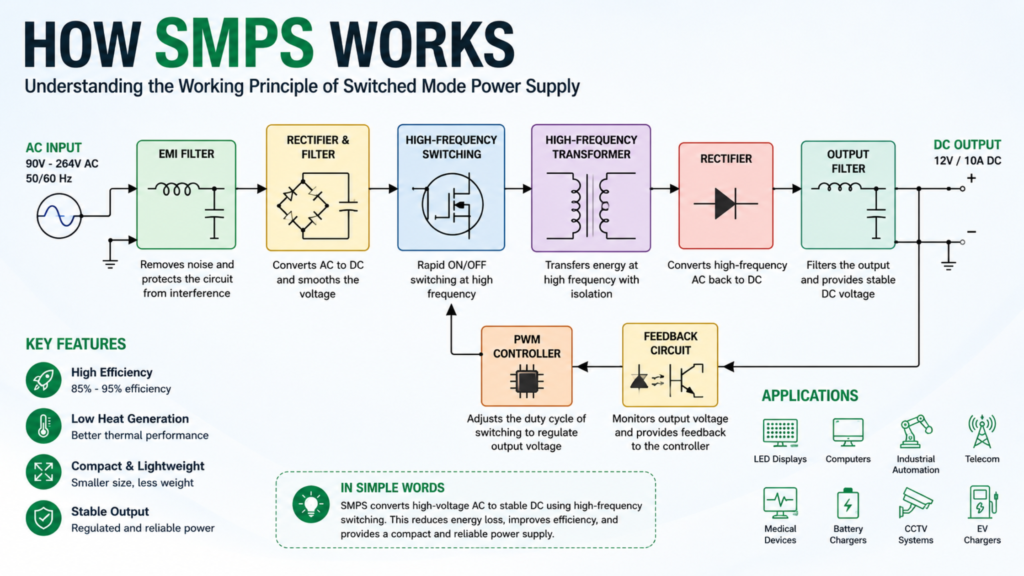
Imagine turning on an LED display, industrial controller, or traffic management system. Within milliseconds, every component receives stable and regulated power. This seamless operation is possible because of a technology known as SMPS.
Whether you’re working on LED displays, Intelligent Transportation Systems (ITS), industrial automation, or communication equipment, understanding How Switched Mode Power Supply Works helps you design more reliable and energy-efficient systems.
In this guide, we’ll explain the working principle of SMPS in simple language, covering its components, operation, advantages, and real-world applications.
What Is SMPS?
SMPS stands for Switched Mode Power Supply.
It is an electronic power supply that converts electrical power efficiently using high-frequency switching devices instead of relying on large transformers.
Unlike conventional linear power supplies, an SMPS provides:
- Higher efficiency
- Lower heat generation
- Compact size
- Lightweight design
- Stable output voltage
Because of these advantages, SMPS technology is widely used in LED displays, computers, televisions, industrial equipment, EV chargers, medical devices, and smart transportation systems.
How SMPS Works
it’s important to know that an SMPS does not regulate voltage by dissipating excess energy as heat. Instead, it rapidly switches electrical current on and off at very high frequencies-often tens or hundreds of kilohertz.
This high-frequency switching allows the power supply to efficiently convert AC power into a stable DC output while keeping energy losses to a minimum.
The complete process happens in just a few milliseconds and consists of several stages.
Main Components of an SMPS
Every SMPS consists of multiple electronic components working together.
AC Input Filter
The AC input filter removes electrical noise and protects the power supply from interference coming from the mains supply.
It also prevents switching noise generated by the SMPS from travelling back into the electrical network.
Rectifier and Filter Capacitor
The incoming AC voltage is converted into pulsating DC using a bridge rectifier.
Large electrolytic capacitors smooth this voltage before it reaches the switching stage.
High-Frequency Switching Circuit
This is the heart of the SMPS.
MOSFETs or IGBTs rapidly switch the DC voltage ON and OFF thousands of times every second.
High-frequency switching significantly improves efficiency while reducing transformer size.
High-Frequency Transformer
Unlike traditional transformers operating at 50 Hz, an SMPS transformer works at much higher frequencies.
This allows it to be:
- Smaller
- Lighter
- More efficient
It also provides electrical isolation between the input and output circuits.
Output Rectifier
The transformer output is converted back into DC using high-speed rectifier diodes or synchronous rectifiers.
Output Filter
Inductors and capacitors smooth the DC output, removing ripple voltage and providing stable power to electronic devices.
Feedback Circuit
The feedback circuit constantly monitors the output voltage.
If the voltage changes because of varying load conditions, the controller automatically adjusts the switching duty cycle to maintain a constant output.
This closed-loop control is one of the reasons SMPS units are highly reliable.
Step-by-Step: How Switched Mode Power Supply Works
Now that we’ve covered the major components, let’s understand
Step 1: AC Power Enters the SMPS
The process begins when alternating current (AC) from the mains enters the power supply through the input terminal.
Before reaching the internal circuit, the electricity passes through an EMI (Electromagnetic Interference) filter. This filter removes unwanted electrical noise and protects both the SMPS and other connected equipment.
Step 2: AC Is Converted into DC
The filtered AC voltage is then sent to a bridge rectifier. The rectifier converts AC into pulsating DC. Large capacitors smooth the voltage, creating a stable DC source for the next stage.
Step 3: High-Speed Switching Begins
This is where How Switched Mode Power Supply Works becomes different from a traditional power supply. Instead of continuously supplying power, the switching transistor (usually a MOSFET) rapidly turns ON and OFF at frequencies ranging from 20 kHz to several hundred kHz.
This high-frequency switching greatly reduces energy loss while improving efficiency.
Step 4: High-Frequency Transformer Transfers Power
The switched voltage enters a compact high-frequency transformer. Unlike conventional transformers, this transformer operates at much higher frequencies, allowing it to be much smaller and lighter while still transferring power efficiently.
The transformer also provides electrical isolation between the input and output circuits, improving safety.
Step 5: Output Is Converted Back to DC
After leaving the transformer, the high-frequency AC signal is rectified again using fast recovery diodes or synchronous rectifiers.
This converts the signal back into direct current (DC).
Step 6: Output Filtering
The output still contains small voltage ripples.
Inductors and capacitors smooth the voltage, producing a clean and stable DC output suitable for powering electronic devices.
Step 7: Feedback Regulation
A feedback controller continuously monitors the output voltage.
If the load increases or decreases, the controller adjusts the switching frequency or duty cycle automatically.
This keeps the output voltage stable, ensuring reliable operation even when power demand changes.
Types of Switched Mode Power Supply
Different applications require different SMPS designs.
Buck Converter
A Buck Converter reduces voltage while maintaining high efficiency. Common applications include LED drivers, battery chargers, and industrial electronics.
Boost Converter
A Boost Converter increases voltage from a lower input level.
It is widely used in renewable energy systems, automotive electronics, and portable devices.
Buck-Boost Converter
This design can either increase or decrease voltage depending on system requirements.
It provides flexibility in applications where the input voltage varies significantly.
Flyback Converter
Flyback converters are compact and cost-effective, making them ideal for low- to medium-power applications such as televisions, adapters, and communication equipment.
Forward Converter
Forward converters offer better efficiency and are commonly used in industrial power supplies and networking equipment.
Advantages
Understanding How Switched Mode Power Supply Works offers several practical benefits for engineers and technicians.
Higher Efficiency
Modern units typically achieve efficiencies between 85% and 95%, reducing wasted energy.
Compact Design
High-frequency transformers require less space, allowing manufacturers to design smaller and lighter equipment.
Lower Heat Generation
Efficient switching minimizes heat, reducing cooling requirements and improving reliability.
Stable Output Voltage
Feedback regulation maintains consistent voltage even under varying load conditions.
Wide Input Voltage Range
Many SMPS units can operate across different input voltages, making them suitable for global applications.
Applications of Switched Mode Power Supply
SMPS technology is used in nearly every modern electronic system.
Some common applications include:
- LED Display Systems
- Variable Message Signs (VMS)
- Intelligent Transportation Systems (ITS)
- Industrial Automation
- CCTV Systems
- Medical Equipment
- Computers and Servers
- Telecommunication Equipment
- Consumer Electronics
- Battery Charging Systems
Vulcan Advance Intelligence Computing Pvt. Ltd. (Vulcan AIC), reliable SMPS technology supports intelligent display solutions, traffic management systems, and other mission-critical electronic infrastructure.
Common Switched Mode Power Supply Failures
Although SMPS units are highly reliable, certain issues can affect performance.
Common failures include:
- Overheating
- Capacitor aging
- MOSFET failure
- Short circuits
- Overvoltage conditions
- Dust accumulation
- Poor ventilation
- Input power surges
Regular inspection and preventive maintenance can significantly extend the lifespan of an SMPS.
Frequently Asked Questions
Why is SMPS more efficient than a linear power supply?
SMPS minimizes energy loss by switching electronic components rapidly instead of dissipating excess energy as heat.
Where is SMPS used?
SMPS is widely used in LED displays, computers, networking equipment, industrial automation, medical devices, and Intelligent Transportation Systems (ITS).
Does SMPS provide electrical isolation?
Yes. Most isolated SMPS designs use a high-frequency transformer to provide electrical isolation between input and output.
Why does an SMPS use a high-frequency transformer?
Higher switching frequencies allow the transformer to be much smaller, lighter, and more efficient than traditional 50 Hz transformers.
What is the role of the feedback circuit?
The feedback circuit continuously monitors the output voltage and automatically adjusts the switching operation to maintain stable output.

