
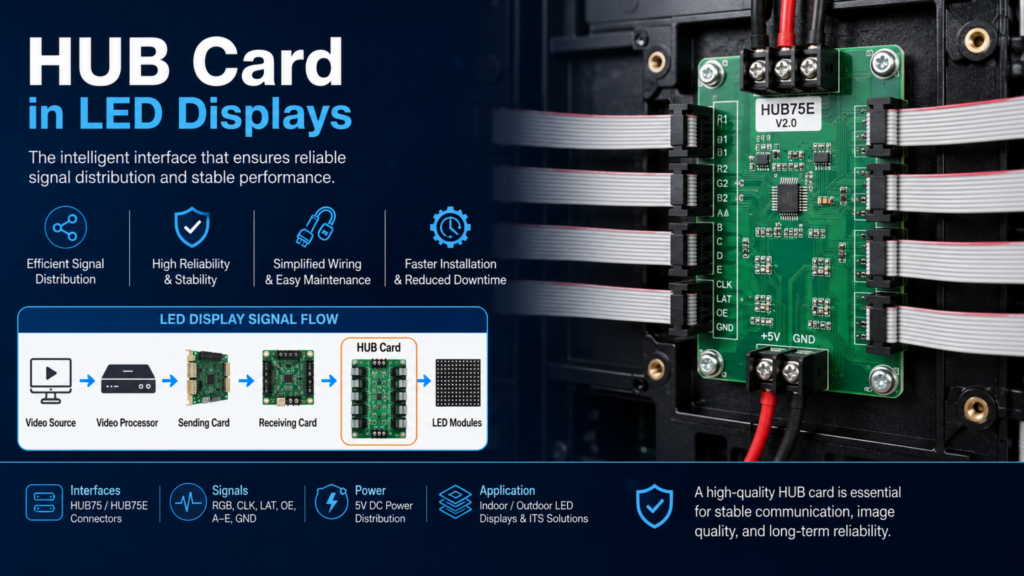
What Is a HUB Card in LED Displays?
In modern LED display systems, reliable signal distribution is critical for achieving accurate image reproduction, stable refresh rates, and long-term operational performance. While controllers, sending cards, and receiving cards often receive the most attention, the interface module is equally important in the signal transmission architecture.
A HUB Card is a passive interface board installed inside an LED display cabinet that provides electrical and mechanical connectivity between the LED receiving card and multiple LED display modules. It distributes RGB data signals, control signals, power, and grounding connections while eliminating complex point-to-point wiring.
Whether used in Variable Message Signs (VMS), Tunnel Signage, Overhead Lane Signals (OHLS), Digital Billboards, Sports Displays, or Fine-Pitch Indoor LED Walls, the HUB Card simplifies cabinet integration and improves system reliability.
HUB Card Architecture
A interface module is a multilayer PCB specifically designed to distribute signals received from the LED receiving card to multiple LED modules.
Unlike an active electronic controller, a connector board contains no processing unit or memory. Instead, it acts as a high-speed distribution interface that ensures low-loss signal transmission across LED modules.
A standard interface module generally consists of:
- HUB75 or customized interface connectors
- Ribbon cable sockets
- Power distribution terminals
- Ground planes
- Signal routing traces
- Mounting points
- Optional voltage protection circuitry
The PCB layout is carefully engineered to minimize impedance mismatch, signal reflection, and electromagnetic interference (EMI).
Function of a HUB Card
The primary purpose of a signal distribution board is to provide organized distribution of electrical signals.
Its major functions include:
- Distribution of RGB parallel data
- Clock signal routing
- Latch (LAT) signal distribution
- Output Enable (OE) routing
- Address line distribution (A–E)
- Ground reference distribution
- Power distribution to LED modules
Rather than connecting every LED module directly to the receiving card, the HUB Card consolidates all interconnections through standardized connectors. This significantly reduces installation complexity and improves serviceability.
Working Principle of a HUB Card
The complete LED display communication architecture follows this sequence:
Media Source
↓
Video Processor
↓
Sending Card
↓
Network Cable (Gigabit Ethernet)
↓
Receiving Card
↓
HUB Card
↓
LED Module Driver IC
↓
LED Pixels
The receiving card decodes image data received from the controller. The decoded parallel data is then transferred to the signal distribution board, which distributes synchronized signals to every LED module connected within the cabinet.
Each module receives:
- Pixel data
- Scan control signals
- Clock synchronization
- Address information
- Power supply
The LED driver ICs convert these digital signals into constant-current outputs that illuminate individual LEDs.
Signal Distribution Through HUB Card
A HUB Card distributes several critical digital signals simultaneously.
RGB Data
Transfers Red, Green, and Blue pixel information.
Clock (CLK)
Synchronizes serial data transfer between receiving card and driver IC.
Latch Signal (LAT)
Stores incoming pixel data inside driver IC registers.
Output Enable (OE)
Controls LED brightness through PWM timing.
Address Lines
Address signals determine which scan row is activated during multiplexing.
Common configurations include:
- A
- B
- C
- D
- E
Higher scan ratios require additional address lines.
Power Distribution
Most HUB Cards include low-resistance copper traces that distribute 5V power across multiple LED modules while maintaining voltage stability.
HUB Card vs Receiving Card
These two components are frequently confused.
| Feature | HUB Card | Receiving Card |
|---|---|---|
| Signal Processing | No | Yes |
| FPGA | No | Yes |
| Image Decoding | No | Yes |
| Memory | No | Yes |
| Signal Distribution | Yes | Limited |
| Controls LED Modules | Indirectly | Directly |
| Firmware | No | Yes |
The receiving card processes incoming Ethernet data, while the HUB Card simply distributes processed signals to LED modules.
HUB75 Interface Standard
The HUB75 interface is the most widely adopted connection standard for LED display modules.
Typical HUB75 signals include:
- R1
- G1
- B1
- R2
- G2
- B2
- CLK
- LAT
- OE
- A
- B
- C
- D
- E
- GND
Modern HUB75E interfaces support high-resolution LED modules and higher scan configurations.
PCB Design Considerations
A high-quality signal distribution board requires careful PCB engineering.
Important design factors include:
Controlled Signal Routing
Maintains timing integrity between modules.
Ground Plane Optimization
Reduces EMI and improves signal quality.
Copper Thickness
Higher copper thickness minimizes voltage drop across power lines.
Connector Reliability
Industrial-grade connectors improve lifecycle performance under vibration and temperature variations.
Thermal Stability
Proper PCB material selection prevents warping during long operating cycles.
Advantages of Using a HUB Card
A properly designed HUB Card provides several engineering advantages.
Simplified Cabinet Wiring
Reduces hundreds of individual wire connections.
Improved Signal Integrity
Shorter transmission paths reduce data corruption.
Faster Installation
Predefined connectors reduce assembly time.
Easier Maintenance
Modules can be replaced independently without rewiring.
Improved Reliability
Fewer wiring errors reduce system failures.
Scalable Architecture
Supports modular cabinet expansion.
Applications of HUB Card
The signal distribution board is used across virtually every professional LED display application.
These include:
- Variable Message Signs (VMS)
- Intelligent Transportation Systems (ITS)
- Highway Information Displays
- Tunnel Guidance Systems
- Sports Scoreboards
- Airport Flight Information Displays
- Railway Passenger Information Systems
- Indoor LED Video Walls
- Command & Control Centers
- Broadcast Studios
- Retail Digital Signage
- Corporate Display Systems
For mission-critical infrastructure such as highways and tunnels, high-quality signal distribution board contribute significantly to display reliability.
Selecting the Right HUB Card
When choosing a HUB Card, engineers should evaluate:
Interface Compatibility
HUB75, HUB320, or manufacturer-specific interface.
Receiving Card Support
Compatible with NovaStar, Colorlight, Huidu, Linsn, or other control systems.
Module Resolution
Pixel pitch and scan ratio compatibility.
Power Requirements
Adequate current-carrying capability.
Mechanical Compatibility
Connector orientation and cabinet dimensions.
Environmental Conditions
Industrial-grade PCBs for outdoor installations with wide operating temperature ranges.
HUB Card in Vulcan AIC LED Display Solutions
At Vulcan AIC, intelligent LED display systems are engineered using industrial-grade electronic components designed for high availability and long operational life.
Our LED display solutions for ITS, Variable Message Signs, Tunnel Signage, Lane Control Systems, and Smart Traffic Infrastructure utilize optimized cabinet architectures where signal integrity, cable management, and maintenance accessibility are key design priorities.
Selecting the appropriate signal distribution board ensures reliable communication between receiving cards and LED modules, contributing to stable display performance even in demanding environmental conditions.
Conclusion
Although passive in operation, the signal distribution board is a fundamental component of the LED display ecosystem. It provides the physical interface that enables efficient signal and power distribution while simplifying installation and maintenance.
In industrial and transportation-grade LED displays, where reliability and uptime are critical, proper HUB Card selection directly influences system performance, serviceability, and long-term operational stability.
FAQs
Is a HUB Card an active electronic device?
No. A HUB Card is a passive PCB that distributes signals and power without processing image data.
Does the HUB Card affect refresh rate?
Indirectly. While the receiving card determines refresh performance, a well-designed HUB Card maintains signal integrity necessary for stable high-refresh operation.
Can one HUB Card support multiple LED modules?
Yes. Depending on its design, a signal distribution board can distribute signals to several LED modules within a cabinet.
Is HUB75 the only interface available?
No. Besides HUB75, interfaces such as HUB320 and manufacturer-specific HUB Cards are also used for specialized LED display configurations.
Why is PCB quality important in a HUB Card?
A high-quality PCB minimizes signal loss, voltage drop, EMI, and connector failures, ensuring reliable operation in professional LED display systems.

