
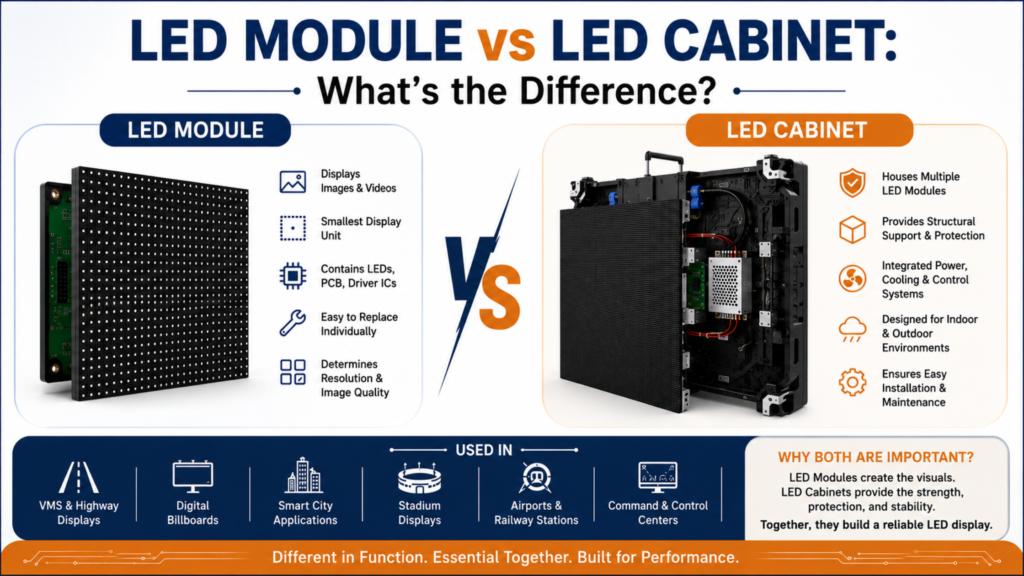
When planning an LED display project, you’ll often hear two terms used together-LED Module and LED Cabinet. Although they are closely related, they perform very different functions within an LED display system.
Understanding the difference between LED Module vs LED Cabinet helps engineers, system integrators, consultants, and buyers choose the right display solution for applications such as digital billboards, Variable Message Signs (VMS), command centers, stadiums, transportation hubs, and smart city infrastructure.
In this guide, we’ll explain what each component does, how they work together, and why both are essential for building a reliable LED display.
What Is an LED Module?
An LED Module is the smallest display unit that produces images, text, and videos on an LED screen. It contains multiple LEDs mounted on a Printed Circuit Board (PCB), along with driver ICs and connectors.
Several LED modules are combined to create a complete display.
Main Components of an LED Module
- LED Chips
- PCB (Printed Circuit Board)
- Driver IC
- HUB Connector
- Power Connector
- Plastic Frame
The LED module is responsible for image quality, brightness, color accuracy, and pixel resolution.
What Is an LED Cabinet?
An LED Cabinet is the structural enclosure that houses multiple LED modules. It provides mechanical support, electrical connections, protection against environmental conditions, and simplifies installation and maintenance.
The cabinet acts as the backbone of the LED display system.
Components of an LED Cabinet
- Aluminum or Steel Cabinet
- Receiving Card
- Power Supply
- Cooling System
- Signal Cables
- Locking Mechanism
- Mounting Structure
Depending on the application, cabinets are available in indoor and outdoor configurations.
LED Module vs LED Cabinet: Key Differences
| Feature | LED Module | LED Cabinet |
|---|---|---|
| Purpose | Displays images and videos | Supports and protects modules |
| Size | Small unit | Large structural frame |
| Material | PCB + Plastic | Aluminum or Steel |
| Function | Visual output | Structural support |
| Replaceability | Easy to replace individually | Replaced only when required |
| Heat Management | Limited | Integrated cooling and airflow |
| Installation | Mounted inside cabinet | Installed on wall, pole, or structure |
| Application | Building block of display | Complete display assembly |
How LED Module vs LED Cabinet Work Together
Think of an LED display as a puzzle.
Each LED Module is a single puzzle piece responsible for displaying content.
The LED Cabinet brings multiple modules together into one strong, durable display while housing the power supply, receiving card, and communication components. Without LED modules, there is no display. Without the cabinet, there is no structural support or protection.
Together, they create a complete LED display system capable of operating in indoor and outdoor environments.
Advantages of LED Modules
- High image quality
- Easy replacement during maintenance
- Different pixel pitch options
- Flexible display sizes
- Lower repair costs
- Lightweight design
Advantages of LED Cabinets
- Strong structural support
- Better heat dissipation
- Easy installation
- Improved weather protection
- Simplified cable management
- Enhanced durability
Indoor vs Outdoor LED Cabinets
Indoor Cabinets
- Lightweight
- Slim profile
- Front service access
- Lower brightness requirement
Outdoor Cabinets
- IP65/IP66 protection
- Aluminum construction
- High brightness
- Weather-resistant
- Better thermal management
Applications of LED Modules and LED Cabinets
Both components are widely used in:
- Variable Message Signs (VMS)
- Highway Information Displays
- Smart Traffic Management Systems
- Digital Billboards
- Shopping Mall Displays
- Airports
- Railway Stations
- Stadium Displays
- Command and Control Centers
- Smart City Projects
Which One Should You Choose?
The answer isn’t LED Module vs LED Cabinet-both are essential.
Choose the LED module based on:
- Pixel pitch
- Brightness
- Resolution
- Viewing distance
Choose the LED cabinet based on:
- Indoor or outdoor installation
- Mounting requirements
- Environmental conditions
- Maintenance access
- Structural strength
Selecting the right combination ensures long-term reliability and consistent display performance.
Common Mistakes to Avoid
- Choosing the wrong cabinet for outdoor environments
- Ignoring heat management requirements
- Selecting incompatible modules and cabinets
- Overlooking maintenance accessibility
- Focusing only on pixel pitch instead of the complete system
Tip
For large infrastructure projects such as highways, tunnels, airports, and smart cities, engineers should evaluate the entire display system-including LED modules, cabinets, controllers, power supplies, and communication hardware-to achieve optimal performance and long-term reliability.
Frequently Asked Questions
What is the difference between an LED module and an LED cabinet?
An LED module is the display unit that produces images, while an LED cabinet is the enclosure that holds multiple modules and protects the entire system.
Can an LED module work without a cabinet?
An LED module requires structural support and electrical integration, which are typically provided by an LED cabinet in commercial display systems.
Which material is commonly used for LED cabinets?
Outdoor LED cabinets are generally made from aluminum due to its strength, lightweight properties, and excellent heat dissipation.
How many LED modules fit inside one cabinet?
The number depends on the cabinet size and pixel pitch. A cabinet may contain anywhere from 4 to 36 or more LED modules.
Why are aluminum cabinets preferred?
Aluminum offers better thermal performance, corrosion resistance, and reduced weight, making it suitable for outdoor applications.
Conclusion
Understanding LED Module vs LED Cabinet is essential when designing or selecting an LED display system. While the LED module is responsible for displaying content, the LED cabinet provides the structural framework, protection, power integration, and thermal management needed for reliable operation.
For applications such as Variable Message Signs (VMS), digital signage, transportation hubs, and smart city infrastructure, choosing compatible modules and cabinets is key to achieving long-lasting performance.
At Vulcan Advance Intelligence Computing Pvt. Ltd. (Vulcan AIC), engineering expertise extends beyond manufacturing complete display solutions. By understanding the role of every component-from LED modules and cabinets to controllers and communication systems-organizations can make informed decisions for efficient, durable, and future-ready LED display installations.

