
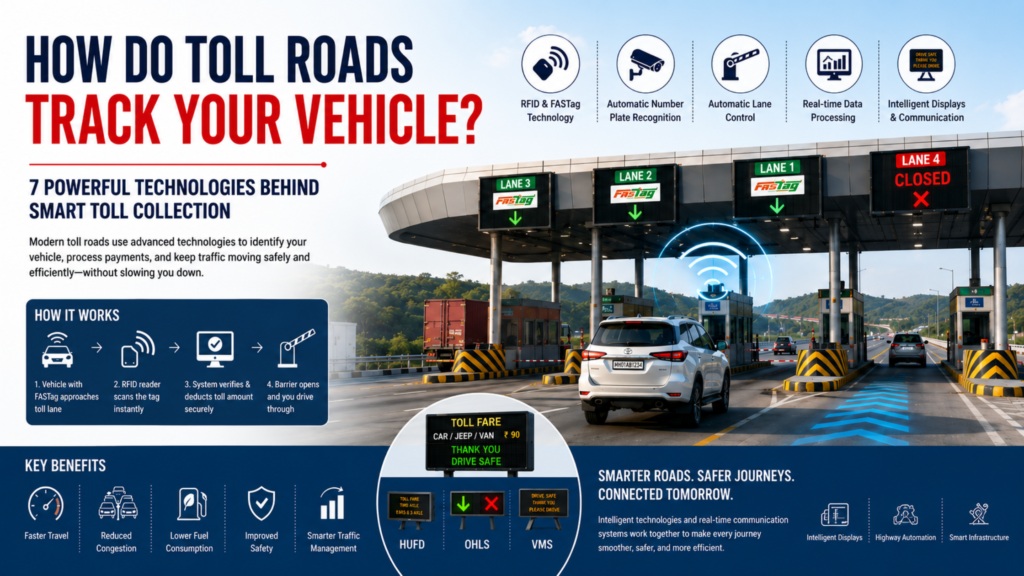
How Do Toll Roads Track Your Vehicle?
You’re driving on a highway, The toll plaza appears ahead, You slow down slightly and The barrier opens automatically then a toll deduction notification arrives on your phone And within seconds, you’re back on the road.
No cash, No manual processing, No lengthy waiting lines.
Most drivers experience this every day, yet few stop to ask an interesting question: How Do Toll Roads Track Your Vehicle?
It feels almost effortless.
But behind that smooth experience is a sophisticated network of RFID readers, cameras, communication systems, intelligent displays, and highway automation technologies working together in real time.
The answer to How Do Toll Roads Track Your Vehicle reveals how modern transportation infrastructure is becoming smarter, faster, and more connected than ever before.
The Evolution of Toll Collection
Not long ago, toll collection was a completely different experience.
Drivers waited in queues.
Cash payments were processed manually.
Receipts were printed one vehicle at a time.
During holidays and peak travel seasons, congestion near toll plazas often stretched for kilometers.
The system worked.
But it wasn’t designed for today’s traffic volumes.
As highway networks expanded and vehicle numbers increased rapidly, transportation authorities needed faster and more efficient solutions. This led to electronic toll collection systems that could process vehicles without requiring them to stop completely. Today, toll plazas have evolved into intelligent transportation hubs. And that’s where things become fascinating.
How Do Toll Roads Track Your Vehicle Using FASTag?
If you’ve traveled on Indian highways recently, you’ve likely used FASTag. FASTag is one of the most common answers to the question: How Do Toll Roads Track Your Vehicle?
The system uses RFID technology, which stands for Radio Frequency Identification. A small RFID tag is attached to the vehicle windshield. As the vehicle approaches a toll lane, an RFID reader communicates with the tag instantly.
Within milliseconds, the system verifies:
- Vehicle identity
- Tag validity
- Linked account information
- Toll payment authorization
The toll amount is deducted automatically.
No cash exchange is required.
No manual intervention is necessary.
The process happens so quickly that most drivers never realize how much technology is involved.
RFID Technology Explained
But here’s the interesting part.
The RFID tag doesn’t store extensive personal information. Instead, it contains a unique digital identifier.
Think of it as a digital license plate.
When the RFID reader scans the tag, it connects with the toll management system to retrieve the necessary information.
The benefits are substantial:
- Faster vehicle processing
- Reduced congestion
- Lower fuel consumption
- Improved travel times
- Better toll collection efficiency
What once required several minutes now takes only a fraction of a second.
Cameras and Automatic Number Plate Recognition
RFID technology is only one part of the system. Modern toll roads also rely heavily on Automatic Number Plate Recognition (ANPR). High-resolution cameras are installed throughout toll plazas. These cameras capture vehicle registration numbers automatically.
Advanced software analyzes the images and converts them into readable vehicle information.
Why is this important?
ANPR systems help:
- Verify vehicle identity
- Detect invalid FASTags
- Monitor toll violations
- Improve transaction accuracy
- Support highway enforcement operations
Most drivers never notice these systems. But they play a critical role in modern toll infrastructure.
How Do Toll Roads Track Your Vehicle Without Stopping Traffic?
One of the biggest goals of modern toll infrastructure is maintaining traffic flow.
Stopping every vehicle creates delays.
Delays create congestion.
Congestion increases travel time and fuel consumption.
This is why modern toll roads combine multiple technologies.
As vehicles approach a toll lane:
- RFID readers identify the vehicle
- Cameras verify registration details
- Lane management systems monitor traffic
- Toll software processes transactions
- Display systems communicate information
Everything happens simultaneously. The result is a smoother and more efficient journey for road users. This is another example of How Do Toll Roads Track Your Vehicle while minimizing disruption.
Beyond FASTag: The Technology Behind Modern Toll Plazas
Most people think toll collection begins and ends with FASTag. In reality, a modern toll plaza is much more than a payment collection point. It functions as an integrated traffic management system.
Multiple technologies operate together continuously.
These include:
- Toll collection systems
- Traffic monitoring platforms
- Lane control systems
- Driver information displays
- Communication networks
Each component plays a role in maintaining safety and operational efficiency. Without this coordination, traffic flow would quickly become chaotic.
Why Driver Communication Is Just As Important As Toll Collection
But here’s something most people rarely consider. Tracking vehicles is only part of the process. Drivers must also receive clear and accurate information.
Imagine approaching a toll plaza without knowing:
- Which lanes are open
- Which lanes are closed
- Current toll fares
- Traffic advisories
- Emergency alerts
Confusion would increase instantly. This is why intelligent display systems are critical to modern highway operations. Real-time communication helps drivers make better decisions and improves overall traffic efficiency.
How Intelligent Display Systems Improve Toll Operations
Modern toll infrastructure depends heavily on visual communication.
Several display technologies play a vital role.
Hybrid User Fare Display (HUFD)
HUFD systems display toll charges along with STOP and GO indicators.
Drivers receive clear lane-specific information in real time.
Overhead Lane Signals (OHLS)
OHLS systems indicate lane availability using directional arrows and lane status indicators.
These displays help maintain smoother traffic movement.
Variable Message Signs (VMS)
VMS displays provide traffic updates, safety advisories, weather alerts, and operational information.
Together, these systems create a safer and more organized toll environment.
How Do Toll Roads Track Your Vehicle in Intelligent Transportation Systems?
Modern highways are becoming increasingly connected. Toll collection is no longer an isolated process. It is now part of larger Intelligent Transportation Systems (ITS).
These systems integrate:
- RFID technology
- ANPR cameras
- Smart Traffic Monitoring
- Variable Message Signs
- Lane Control Systems
- Data Analytics Platforms
The goal is not simply toll collection. The goal is creating smarter transportation networks. This demonstrates how How Do Toll Roads Track Your Vehicle is closely connected to broader mobility and infrastructure strategies.
Building Smarter Highways Through Intelligent Infrastructure
India’s highways are undergoing a major transformation.
- Roads are becoming connected.
- Traffic systems are becoming intelligent.
- Infrastructure is becoming data-driven.
At Vulcan Advance Intelligence Computing Pvt. Ltd., we believe highways should do more than move vehicles.
They should communicate.
They should inform.
And they should help operators make better decisions.
Through technologies such as:
- Hybrid User Fare Displays (HUFD)
- Overhead Lane Signals (OHLS)
- Variable Message Signs (VMS)
- Smart Traffic Displays
- Highway Automation Solutions
modern transportation infrastructure is becoming safer, more efficient, and more responsive, the future of mobility depends not only on building roads but on building intelligent roads.
The Future of Toll Roads in India
The future of toll collection is likely to become even more seamless.
Emerging technologies may include:
- Barrier-free tolling
- AI-powered traffic management
- Vehicle-to-infrastructure communication
- Predictive traffic analytics
- Fully connected transportation ecosystems
The objective remains simple:
Reduce delays.
Improve safety.
Increase operational efficiency.
And create better travel experiences for everyone.
Conclusion
The next time you pass through a toll plaza, take a moment to think about everything happening behind the scenes. What seems like a simple toll transaction actually involves RFID readers, cameras, intelligent displays, communication networks, and transportation management systems working together instantly.
Understanding How Do Toll Roads Track Your Vehicle provides a fascinating glimpse into the future of modern infrastructure.
Because highways are no longer just roads. They are becoming intelligent ecosystems designed to keep people moving safely, efficiently, and intelligently.
Frequently Asked Questions
How Do Toll Roads Track Your Vehicle?
Toll roads track vehicles using RFID technology, FASTag systems, cameras, and intelligent transportation infrastructure.
Does FASTag Track Vehicle Location?
FASTag identifies vehicles when they pass through toll plazas but does not continuously track vehicle location.
What Is RFID Technology?
RFID stands for Radio Frequency Identification and enables automatic communication between vehicle tags and toll readers.
Why Are Cameras Used at Toll Plazas?
Cameras support Automatic Number Plate Recognition (ANPR), helping verify vehicles and improve toll collection accuracy.
What Is the Future of Toll Collection?
Future toll roads may use barrier-free tolling, AI-based traffic management, and connected transportation systems.

