
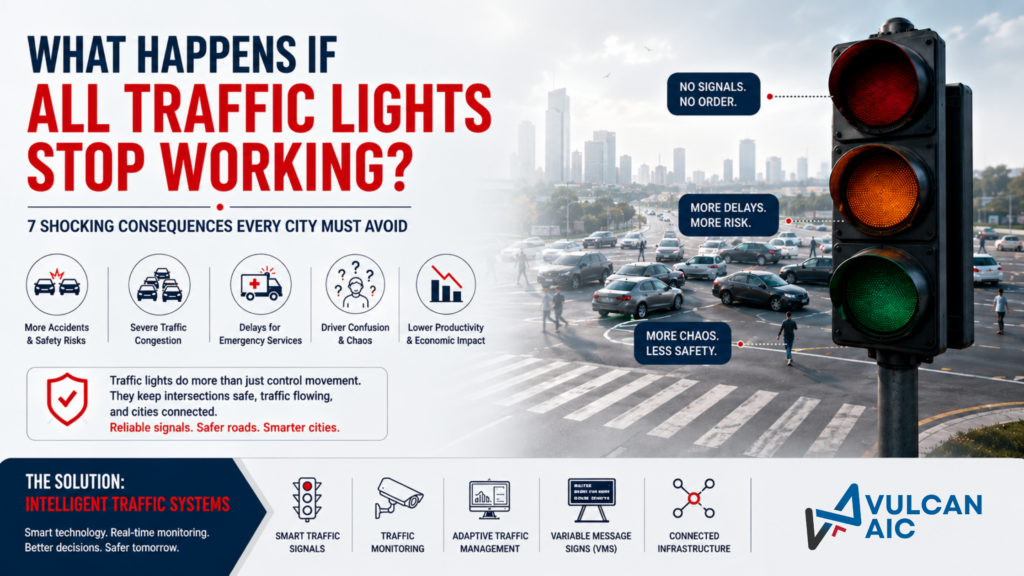
Imagine you’re driving to work on a busy Monday morning.
Traffic is moving normally. Signals are changing. Vehicles are flowing smoothly through intersections. Then suddenly, every traffic light in the city goes dark.
- No red.
- No yellow.
- No green.
At first, it may seem like a small inconvenience. Drivers slow down, Some hesitate, Others attempt to cross cautiously. But within minutes, confusion starts building. Intersections become unpredictable. Traffic begins backing up.
Travel times increase. And road safety risks multiply.
Understanding What Happens If All Traffic Lights Stop Working helps explain why traffic signals remain one of the most important pieces of transportation infrastructure in modern cities.
Most people barely notice them.
Yet they quietly coordinate millions of vehicle movements every single day. Without them, urban mobility would look very different.
Why Traffic Signals Are More Important Than Most People Think
Traffic lights do much more than tell drivers when to stop and go.
- They create order.
- They regulate movement.
- They reduce conflicts between vehicles.
- They improve road safety.
- They help pedestrians cross safely.
- And they keep cities moving efficiently.
Every intersection operates like a carefully coordinated system. Traffic signals help determine who moves, when they move, and how traffic flows across the network.
Without that coordination, even a well-designed road network can quickly become overwhelmed.
What Happens If All Traffic Lights Stop Working During Rush Hour?
Rush hour is already one of the most demanding periods for any transportation network. Thousands of vehicles enter roads simultaneously. Intersections process continuous streams of traffic.
Every second matters.
Now imagine peak-hour traffic without functioning signals.
Drivers would have to negotiate intersections manually.
- Some would stop.
- Others would proceed.
- Many would hesitate.
The result would be confusion, delays, and significantly reduced intersection efficiency. This is one reason What Happens If All Traffic Lights Stop Working is a serious concern for traffic engineers and city planners. Traffic signals help transform chaotic vehicle movement into organized traffic flow. Without them, congestion can spread rapidly throughout the city.
What Happens If All Traffic Lights Stop Working at Major Intersections?
Major intersections often handle thousands of vehicles every hour. These locations are critical nodes within the transportation network. When signals fail at these intersections, traffic flow can deteriorate rapidly.
- Vehicles begin queuing.
- Delays increase.
- Alternative routes become congested.
- Nearby roads become overloaded.
Understanding What Happens If All Traffic Lights Stop Working at major intersections highlights why signal reliability is essential for urban mobility. One failed intersection can affect dozens of surrounding roads.
The ripple effect spreads quickly.
Increased Risk of Accidents
Perhaps the most immediate concern is safety.
Intersections are among the most complex locations on any road network.
Multiple traffic streams converge simultaneously.
Drivers must make quick decisions.
Pedestrians must cross safely.
Public transportation vehicles must maintain schedules.
Traffic signals help manage these interactions.
Without signals, drivers must determine right-of-way themselves.
This increases the likelihood of:
- Side-impact collisions
- Rear-end crashes
- Driver confusion
- Pedestrian conflicts
- Risky driving behavior
Traffic signals reduce uncertainty.
And on busy roads, reducing uncertainty often means reducing accidents.
Traffic Congestion Would Escalate Rapidly
Many people assume traffic congestion happens simply because there are too many vehicles.
In reality, congestion often results from inefficient traffic flow.
When signals stop functioning:
- Vehicles spend more time waiting
- Intersections process fewer cars
- Queue lengths increase
- Traffic speeds decrease
But here’s the interesting part. Congestion rarely stays isolated, One traffic backup creates another, One overloaded intersection affects nearby roads, Before long, the entire network feels the impact.
This is exactly why understanding What Happens If All Traffic Lights Stop Working is important for modern transportation planning.
Emergency Services Would Face Serious Delays
Now consider emergency response.
Ambulances.
Fire services.
Police vehicles.
Disaster response teams.
Every second matters during emergencies.
Modern traffic management systems often support emergency vehicle prioritization by adjusting signal timing.
Without functioning traffic signals, emergency responders may encounter:
- Longer travel times
- Increased congestion
- More route uncertainty
- Reduced operational efficiency
Another important aspect of What Happens If All Traffic Lights Stop Working is the potential impact on public safety beyond ordinary traffic conditions.
What Happens If All Traffic Lights Stop Working in Smart Cities?
Modern cities are becoming increasingly connected. Traffic management is no longer limited to standalone traffic lights.
Today’s transportation systems integrate:
- Smart Traffic Signals
- Vehicle Detection Systems
- Traffic Monitoring Cameras
- Adaptive Traffic Management Platforms
- Variable Message Signs (VMS)
If signals stop working, intelligent infrastructure helps transportation authorities respond quickly.
Variable Message Signs (VMS) can communicate real-time instructions.
Traffic monitoring systems can identify problem areas, Control centers can deploy response strategies faster. This demonstrates why What Happens If All Traffic Lights Stop Working is not just a traffic issue-it is an infrastructure challenge.
The Role of Intelligent Traffic Systems
As cities continue growing, Intelligent Traffic Systems are becoming increasingly important.
These systems combine technology, communication, and real-time monitoring to improve mobility.
Examples include:
- Smart Traffic Signals
- Traffic Monitoring Systems
- Intelligent Transportation Systems
- Highway Automation Solutions
- Variable Message Signs (VMS)
Together, these technologies help cities manage traffic more efficiently while improving safety and reducing congestion. Rather than reacting to problems after they occur, intelligent systems help identify and address issues proactively.
How Smart Infrastructure Prevents Traffic Disruptions
This is where modern infrastructure becomes truly valuable.
Advanced transportation systems can:
- Monitor signal health remotely
- Detect faults automatically
- Generate maintenance alerts
- Provide backup communication systems
- Support centralized traffic management
At Vulcan Advance Intelligence Computing Pvt. Ltd., we believe transportation infrastructure should not only guide traffic but also provide real-time information, intelligent communication, and operational resilience.
Solutions such as Variable Message Signs (VMS), Smart Traffic Signals, and Intelligent Transportation Systems are helping create safer and more connected transportation networks.
Because the future of mobility depends on infrastructure that can communicate, adapt, and respond.
The Future of Traffic Management
Cities are evolving rapidly, Traffic volumes continue increasing, Mobility demands continue changing.
The future will likely include:
- AI-powered traffic management
- Predictive traffic analytics
- Connected intersections
- Vehicle-to-infrastructure communication
- Real-time traffic optimization
Looking ahead, understanding What Happens If All Traffic Lights Stop Working reinforces why cities are investing heavily in intelligent transportation infrastructure.
The objective is simple:
- Safer roads.
- Reduced congestion.
- Better travel experiences.
- And smarter mobility.
Conclusion
Traffic lights may seem ordinary, But they are among the most important systems supporting modern transportation.
- They regulate movement.
- Improve safety.
- Reduce congestion.
And help millions of people reach their destinations every day. Understanding What Happens If All Traffic Lights Stop Working highlights just how much our cities depend on intelligent traffic management.
Because sometimes the infrastructure we notice the least is the infrastructure we rely on the most.
Frequently Asked Questions
What Happens If All Traffic Lights Stop Working?
Traffic congestion increases, road safety risks rise, intersections become less efficient, and emergency response operations may face delays.
What Happens If All Traffic Lights Stop Working During Rush Hour?
During rush hour, failed signals can quickly create severe congestion, longer travel times, and increased driver confusion.
Can Smart Traffic Systems Prevent Traffic Signal Failures?
Smart Traffic Systems can detect faults early, monitor signal health remotely, and help authorities respond more quickly.
Why Are Traffic Signals Important?
Traffic signals improve road safety, regulate traffic flow, reduce congestion, and support efficient transportation networks.
What Role Do Intelligent Traffic Systems Play?
Intelligent Traffic Systems combine monitoring, communication, and automation technologies to improve traffic management and road safety.

