
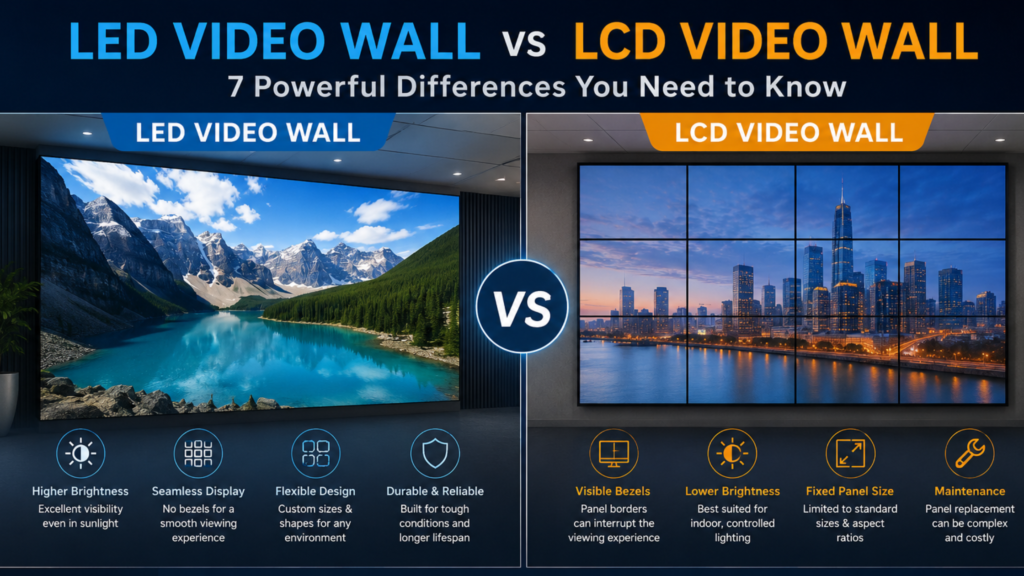
LED Video Wall vs LCD Video Wall is one of the most common comparisons businesses, infrastructure developers, retail brands, and system integrators make when choosing a large-format display solution.
At first glance, both technologies appear similar because they are used to display content on large screens. However, their construction, performance, maintenance requirements, and ideal applications are significantly different.
Understanding these differences can help organizations make better long-term investment decisions while selecting the right display technology for their environment.
Understanding LED Video Wall?
An LED video wall is a display system made up of multiple LED modules that work together to create a single seamless visual surface. Unlike traditional screens, LED video walls do not use LCD panels. Instead, they use Light Emitting Diodes (LEDs) that generate light directly.
This technology provides:
- Seamless viewing experience
- High brightness
- Better durability
- Flexible sizing options
- Superior outdoor performance
LED video walls are commonly used in:
- Control rooms
- Railway stations
- Metro stations
- Shopping malls
- Stadiums
- Corporate lobbies
- Outdoor advertising
understanding an LCD Video Wall?
An LCD video wall consists of multiple LCD panels placed together to form a larger display surface. Each panel contains its own screen and bezel.
LCD video walls are often used in:
- Monitoring centers
- Meeting rooms
- Indoor command centers
- Educational facilities
- Corporate environments
While LCD technology can deliver excellent image quality, visible bezels between panels remain one of its biggest limitations.
LED Video Wall vs LCD Video Wall: Brightness Comparison
One of the biggest differences in the LED Video Wall vs LCD Video Wall comparison is brightness. LED video walls typically offer much higher brightness levels than LCD displays.
Advantages of LED Video Walls:
- Excellent visibility in bright environments
- Suitable for indoor and outdoor applications
- Better viewing from long distances
Advantages of LCD Video Walls:
- Good image quality indoors
- Suitable for controlled lighting environments
When installed in public spaces such as transportation hubs, airports, railway stations, and commercial environments, LED technology generally provides better visibility.
LED Video Wall vs LCD Video Wall: Seamless Viewing Experience
Another major difference is screen continuity. LCD video walls contain bezels around every panel. Although modern LCD displays have thinner bezels than before, visible panel lines still exist.
LED video walls offer:
- Seamless visuals
- No visible panel borders
- Better large-format presentation
- More immersive viewing experience
This is why LED video walls are increasingly preferred for advertising, branding, and public communication applications.
LED Video Wall vs LCD Video Wall: Flexibility and Design
Flexibility is another area where LED technology often has a significant advantage.
LED video walls can be customized into:
- Curved displays
- Large-format installations
- Custom dimensions
- Creative architectural displays
LCD video walls are generally limited by fixed panel sizes. Organizations looking for unique visual experiences often choose LED solutions because of their design flexibility. Modern Digital Video Walls are increasingly being integrated into transportation infrastructure, corporate spaces, retail environments, and public communication systems.
LED Video Wall vs LCD Video Wall: Maintenance and Durability
When evaluating LED Video Wall vs LCD Video Wall, maintenance is an important consideration.
LED Video Walls:
- Modular repair capability
- Easy component replacement
- Long operational lifespan
- Better outdoor durability
LCD Video Walls:
- Reliable indoor performance
- Lower initial investment in some cases
- Panel replacement can be more complex
For mission-critical applications where uptime is important, durability often becomes a deciding factor.
LED Video Wall vs LCD Video Wall: Energy Efficiency
Energy efficiency is becoming increasingly important for organizations investing in display infrastructure.
Modern LED video walls are designed to provide:
- Optimized power consumption
- Intelligent brightness adjustment
- Better long-term operational efficiency
While both technologies continue improving, LED systems are increasingly being developed with advanced energy-management capabilities.
LED Video Wall vs LCD Video Wall for Advertising Applications
Advertising environments demand visibility, impact, and engagement. This is where LED technology often delivers stronger results.
LED video walls provide:
- High brightness
- Larger display sizes
- Seamless content presentation
- Better visibility from greater distances
Retail environments, transportation hubs, shopping malls, and public infrastructure projects increasingly prefer LED video walls for branding and communication purposes.
Industry trends highlighted by AVIXA also show growing adoption of large-format LED display technologies across commercial environments.
Which Display Solution Is Better?
The answer depends on application requirements.
Choose LCD Video Walls if:
- The installation is indoors
- Budget is a primary consideration
- Close-viewing applications are required
Choose LED Video Walls if:
- Large display sizes are required
- Seamless visuals are important
- High brightness is needed
- Long-term durability is a priority
- Public communication or advertising is involved
Organizations planning large-scale communication infrastructure increasingly prefer LED solutions because of their scalability and long-term performance benefits.
Future of LED Video Wall vs LCD Video Wall Technology
The future of display technology is moving toward larger, brighter, and more intelligent visual communication systems.
Advancements in:
- Fine-pixel LED technology
- Smart content management
- AI-driven display systems
- Energy-efficient electronics
are continuing to improve display performance across industries.
As organizations invest in digital communication infrastructure, LED video walls are becoming central to transportation, retail, corporate, and smart city environments.
At Vulcan Advance Intelligence Computing Pvt. Ltd., intelligent LED display systems are engineered to support high-performance visual communication across infrastructure, mobility, advertising, and public information applications.
Frequently Asked Questions
Which is better: LED Video Wall or LCD Video Wall?
It depends on the application. LED video walls are generally preferred for large-scale, seamless, and high-brightness installations, while LCD video walls are often suitable for indoor environments with controlled lighting.
Why do LED video walls have no bezels?
LED modules connect seamlessly, eliminating the visible borders commonly found in LCD video wall panels.
Are LED video walls better for advertising?
Yes. Their brightness, visibility, and seamless design make them highly effective for advertising and branding applications.
Which display technology lasts longer?
LED video walls typically offer longer operational lifespans and easier modular maintenance compared to LCD video walls.

