
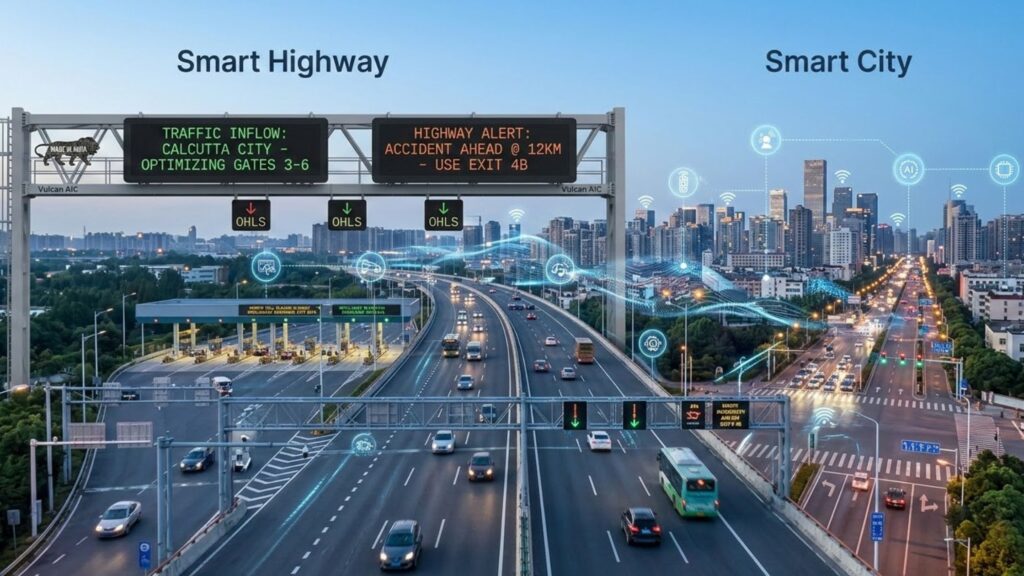
For decades, cities and highways were designed as separate systems.
Cities focused on traffic lights, public transport, and urban mobility. Highways focused on long-distance travel, tolling, and vehicle flow between regions. But today, that separation no longer works.
India is entering a new era of intelligent infrastructure, where data, automation, and real-time communication are becoming the backbone of transportation. In this environment, smart cities and smart highways cannot operate independently anymore. They must communicate with each other.
Because traffic does not start or end on a highway. It starts in cities. And every vehicle that enters a highway eventually returns to a city.
What Is a Smart City?
A smart city uses technology and data to improve urban life. This includes systems such as:
- Intelligent traffic lights
- Real-time public transport updates
- Smart parking systems
- Urban surveillance networks
- Environmental monitoring
- Digital communication infrastructure
These systems help cities manage congestion, improve safety, and make everyday movement more efficient. But even the most advanced smart city system faces a limitation. Traffic does not stop at the city border.
What Is a Smart Highway?
Smart highways extend intelligence beyond urban areas. They include technologies like:
- Variable Message Signs (VMS)
- Overhead Lane Signals (OHLS)
- AI-based traffic monitoring systems
- Tunnel safety signage
- Hybrid toll displays
- Real-time weather alerts
- Solar-powered infrastructure systems
These systems help highways respond dynamically to conditions such as:
- accidents
- traffic congestion
- fog or extreme weather
- lane closures
- construction zones
But highways face a similar limitation. They cannot predict what is happening inside the city they are connected to.
The Problem When Systems Don’t Talk
When smart cities and smart highways operate separately, several problems occur.
1. Traffic congestion spreads faster
A city might release thousands of vehicles onto a highway during rush hour, but the highway system may not be prepared. Without communication between systems, congestion becomes inevitable.
2. Delayed emergency response
If an accident happens on a highway and city traffic systems are not informed, emergency vehicles can face delays while navigating city streets.
3. Inefficient toll and lane management
Smart toll systems can work faster when city traffic data predicts incoming vehicle volume. Without that data, toll systems react instead of prepare.
4. Poor driver communication
Drivers receive fragmented information:
- city traffic updates from one system
- highway alerts from another
A connected infrastructure ecosystem would deliver a single, seamless flow of information.
Why Integrated Infrastructure Matters
When smart cities and smart highways communicate, the entire transportation ecosystem becomes more efficient.
Real-time traffic prediction
City traffic data can predict how many vehicles will enter highways in the next hour. Highway systems can then:
- adjust lane signals
- update digital signage
- optimize toll processing
Faster incident management
If a highway accident occurs, city traffic systems can immediately redirect vehicles before they reach the highway entrance.
Better driver information
Drivers receive coordinated messages across:
- city displays
- highway variable message signs
- toll systems
The journey becomes smoother and safer.
AI Is Making This Connection Possible
Artificial Intelligence is becoming the bridge between cities and highways. AI systems can analyze:
- traffic density
- vehicle speed patterns
- weather conditions
- historical congestion data
Using this information, infrastructure systems can automatically adjust signals, signage, and traffic flow. Instead of reacting after a problem occurs, AI allows systems to predict and prevent disruptions.
This is the future of mobility.
The Role of Intelligent Display Systems
Communication is the backbone of connected infrastructure. Drivers must receive information instantly and clearly. This is where intelligent display systems become essential. Technologies such as:
- Variable Message Signs
- Lane control signals
- smart toll displays
- tunnel safety signage
act as real-time communication channels between infrastructure and drivers. When integrated with city data and AI systems, these displays become part of a nationwide intelligent network.
India’s Opportunity in Connected Infrastructure
India is currently building one of the largest transportation networks in the world. With thousands of kilometers of highways and dozens of developing smart cities, the opportunity is enormous. But building infrastructure is only the first step.
Connecting that infrastructure is the real challenge. When smart cities and smart highways operate as one integrated system, the benefits include:
- safer roads
- faster travel
- lower congestion
- improved emergency response
- more efficient logistics
This is the direction modern infrastructure must take.
Humanizing the Technology
Behind every intelligent highway system and smart city display is a team of engineers, designers, and infrastructure specialists. Their goal is simple.
- To make travel safer.
- To make communication clearer.
- To make infrastructure smarter.
Because technology is not just about machines and sensors. It is about people who rely on these systems every day.
- Every commuter.
- Every driver.
- Every emergency responder.
The Road Ahead
The future of infrastructure will not be defined by isolated technologies. It will be defined by connected ecosystems.
- Smart cities must talk to highways.
- Highways must talk to toll systems.
- Toll systems must communicate with traffic management centers.
Only then will transportation truly become intelligent.
A Quiet Force Behind Intelligent Infrastructure
Across India and beyond, intelligent display systems, highway automation technologies, and AI-powered traffic solutions are already shaping this future. Many of the systems drivers see on highways today-digital traffic boards, lane signals, tunnel displays, and smart toll communication-are part of this growing intelligent infrastructure network. Behind many of these systems is a team of engineers and innovators working to make roads smarter and safer.
That team is Vulcan Advance Intelligence Computing Pvt. Ltd. (Vulcan AIC).
Headquartered in Noida, Vulcan AIC specializes in intelligent LED displays, highway automation systems, and AI-powered traffic solutions deployed across India and international projects.
Our focus is simple.
- Build infrastructure that communicates.
- Design systems that improve safety.
- And help create a future where cities and highways finally speak the same language.
Because connected infrastructure is not just a vision. It is already being built.

