
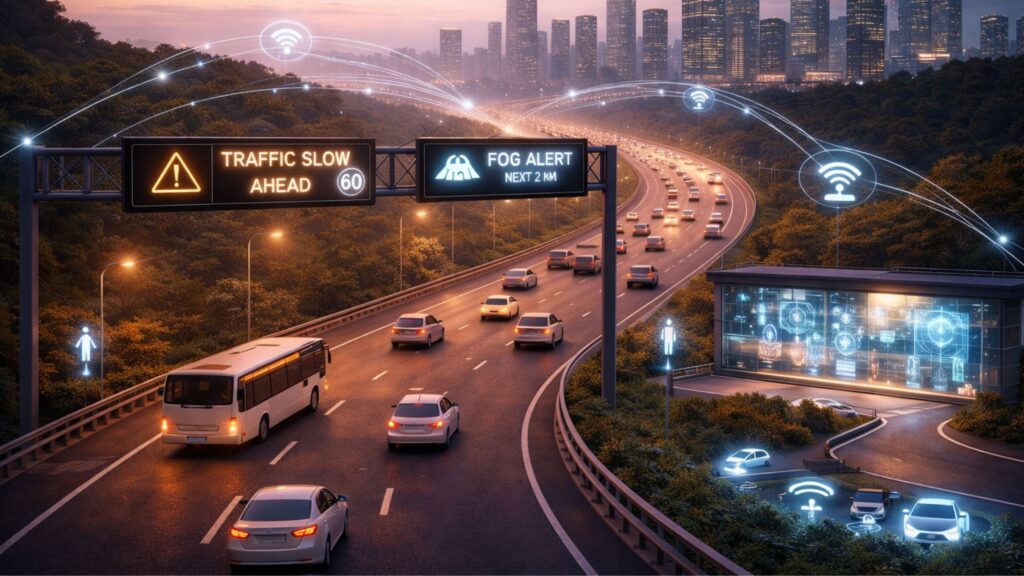
For decades, infrastructure was judged by how strong it was. Wide roads, heavy concrete, durable structures – strength meant reliability.
That definition is no longer enough.
Today, highways and cities operate in an environment of constant change. Traffic patterns shift by the hour. Weather conditions turn unpredictable. Emergencies demand instant response. Citizens expect clarity, safety, and efficiency – all at once.
In this new reality, the future belongs to intelligent infrastructure.
Not infrastructure that is merely connected or automated, but systems that can sense, understand, and respond in real time.
The Shift From Static to Adaptive Infrastructure
Traditional infrastructure is static by design. It assumes predictable behaviour and fixed conditions.
But modern cities are dynamic:
- Traffic density fluctuates continuously
- Weather impacts visibility and safety
- Urban populations grow unevenly
- Mobility patterns change with events, seasons, and time
Static systems struggle in such environments because they react after problems appear. Intelligent infrastructure changes this model.
It allows highways and cities to:
- Detect issues early
- Adapt before disruption escalates
- Communicate clearly with users
- Support faster, data-backed decisions
This shift from reaction to anticipation is what defines the next generation of infrastructure.
What Makes Infrastructure “Intelligent”?
Intelligence in infrastructure is not about adding more screens or sensors. It is about how systems behave.
An intelligent infrastructure system typically:
- Collects real-time data (traffic, environment, movement)
- Interprets patterns rather than raw numbers
- Responds automatically or with guided human input
- Learns from past events to improve future outcomes
In simple terms:
Traditional infrastructure follows instructions.
Intelligent infrastructure understands situations.
This distinction is critical for highways and smart cities alike.
Why Highways Need Intelligence, Not Just Expansion
Highway development has long focused on expansion – more lanes, longer corridors, higher speeds.
But many safety and congestion issues are not caused by lack of space. They are caused by lack of timely information.
Intelligent highway systems help by:
- Warning drivers before congestion or accidents
- Adjusting communication based on weather or visibility
- Reducing sudden braking and confusion
- Supporting faster emergency response
Instead of forcing drivers to react under pressure, intelligent systems guide them calmly and early. This improves safety without increasing enforcement or stress.
Smart Cities Depend on Clear Communication
At the heart of every smart city is a simple promise: make urban life easier and safer for citizens.
That promise cannot be fulfilled without clear, real-time communication.
Intelligent infrastructure enables cities to:
- Share live information with commuters
- Coordinate across departments using shared data
- Reduce operational delays
- Build trust through predictability and transparency
When citizens understand what’s happening around them, cities function more smoothly.
Technology becomes supportive, not intrusive.
The Role of AI in Modern Infrastructure
Artificial intelligence plays a key role in making infrastructure truly intelligent.
AI allows systems to:
- Analyse large volumes of live data
- Identify risk patterns
- Predict congestion or incidents
- Improve responses over time
Importantly, AI in infrastructure is not about replacing human decision-makers. It is about supporting better decisions, faster.
This balance between automation and human control is essential for public systems.
Policy Perspective: Why Intelligence Matters for Governance
From a policy standpoint, intelligent infrastructure delivers measurable value:
- Faster decision-making
- Better inter-department coordination
- Smarter use of public resources
- Improved public safety outcomes
- Long-term planning based on real data
Governments no longer need to rely only on reports or delayed inputs. They can manage cities and highways as live systems.
This capability is becoming central to modern governance models worldwide.
Human-Centric Design Is the Real Success Metric
Infrastructure ultimately exists for people.
If a system:
- Reduces confusion
- Lowers stress
- Improves safety
- Works quietly in the background
then it is doing its job well.
Intelligent infrastructure is successful not when citizens notice it – but when they don’t have to worry because it’s working.
This human-centric outcome is what separates meaningful innovation from technical complexity.
India’s Moment in Intelligent Infrastructure
India is at a critical point in its infrastructure journey.
With expanding highways, smart city initiatives, and digital governance, the focus is shifting from imported, one-size-fits-all solutions to locally designed, context-aware intelligence.
Organizations working in this space, Vulcan AIC, are contributing to this transition by building systems that understand Indian roads, Indian conditions, and Indian behaviour.
The emphasis is not on flashy technology, but on reliability, clarity, and adaptability.
The Future Is Infrastructure That Understands
The future of highways and smart cities will not be defined by how much concrete we pour or how fast vehicles move.
It will be defined by how well infrastructure:
- Understands its environment
- Communicates with people
- Adapts to change
- Learns over time
Intelligent infrastructure represents a fundamental shift – from building structures to building systems that think responsibly. As cities and highways evolve, intelligence will no longer be optional. It will be the foundation of safety, efficiency, and trust.
Because infrastructure that understands is infrastructure that truly lasts.

