
Let me ask you something simple.
Have you ever been on a highway that technically looked perfect – smooth surface, wide lanes, fresh markings – and yet something felt… off?
And then, on another journey, you felt completely at ease – even at high speed – because everything around you seemed organised, visible, and predictable?
Safety on highways is not just about engineering. It’s about feeling. And that feeling comes from a mix of visible and invisible elements working together. So what actually makes a highway feel safe?
Let’s talk about it like travelers, not just planners.
Is It the Lighting?
Drive on a well-lit expressway at night and you immediately notice the difference.
- The road edges are clear.
- Lane markings glow.
- Shadows don’t hide surprises.
- Lighting reduces uncertainty.
In many parts of India, night driving can feel unpredictable. Dark patches, sudden curves, and limited visibility increase stress levels. Good lighting doesn’t just help you see – it reduces mental fatigue.
When visibility improves, your shoulders relax. Your grip on the steering wheel loosens. Your confidence rises. Lighting is one of the most basic yet powerful highway safety measures in India today.
It turns anxiety into awareness.
Is It the Presence of Patrol Vehicles?
There’s something reassuring about seeing a highway patrol vehicle parked at intervals. Not because you expect trouble. But because you know someone is watching. Patrol vehicles add a psychological layer of safety. They signal order. They signal response readiness. If something goes wrong – a breakdown, a medical emergency, an accident – help is not too far away.
Modern highway infrastructure increasingly includes dedicated emergency response systems, towing units, and patrol networks. And even if you never need them, their presence makes the road feel structured.
Safe roads aren’t just built. They’re monitored.
Or Is It Clear Communication?
Let’s be honest.
Few things feel more unsettling than driving at full speed and suddenly encountering stopped traffic without warning. Or entering a fog patch without prior alert. Or discovering a diversion too late. Clear communication transforms that experience.
When you see:
- Speed advisories
- Accident alerts
- Weather warnings
- Lane closures
You adjust gradually. You prepare mentally. That preparation creates calm.
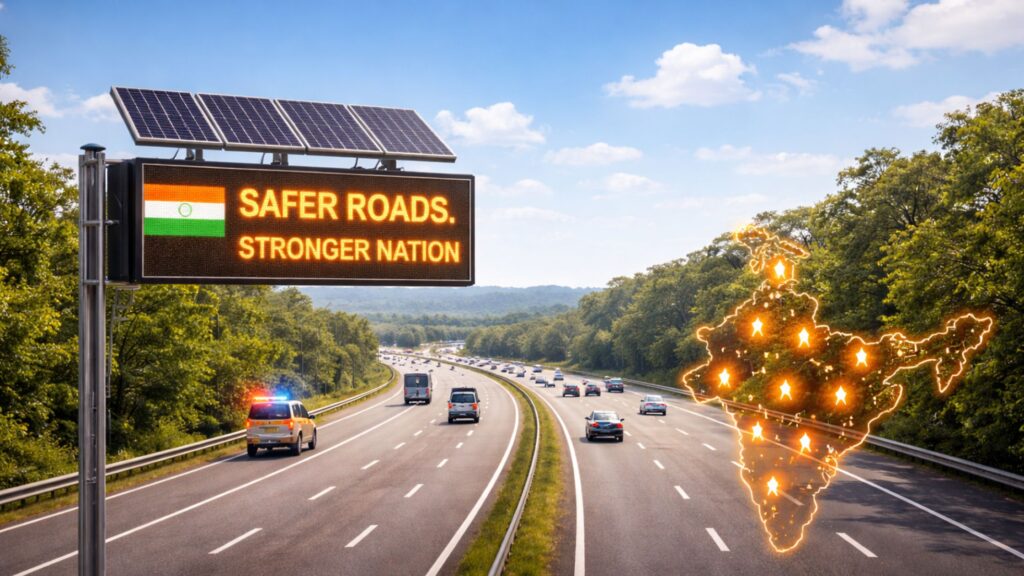
Modern highway infrastructure in India increasingly integrates digital communication systems – Variable Message Signs, speed displays, dynamic alerts. These aren’t just signs. They’re conversations between the road and the driver. And when that conversation is clear, drivers feel informed instead of surprised.
Safety Is a Combination, Not a Single Feature
A safe highway isn’t defined by one element. It’s the combination of:
- Good lighting
- Visible markings
- Reliable patrol presence
- Smooth road design
- Clear, real-time communication
Remove one layer, and the sense of safety weakens. Add all layers together, and something changes. The highway stops feeling like a risk. It starts feeling organised.
The Emotional Side of Highway Safety
Here’s something we rarely discuss in technical conversations.
Highways carry emotions.
- Families going on vacation.
- Truck drivers covering long distances.
- Parents driving back home late at night.
- Ambulances racing against time.
When a road feels safe, journeys feel lighter. When it doesn’t, even a short distance feels long. That emotional layer is just as important as structural design. Modern highway infrastructure must think beyond physical construction. It must consider how drivers feel. Because perception influences behaviour. And calm drivers make better decisions.
India’s Highway Evolution
Highway safety measures in India have improved significantly in recent years.
- Wider expressways.
- Better lane discipline enforcement.
- Integrated toll systems.
- Emergency response corridors.
- Digital messaging systems.
But growth is ongoing. As expressways expand and traffic volume increases, the role of intelligent communication becomes even more critical.
The future of modern highway infrastructure lies not just in faster roads – but in smarter ones.
- Roads that respond.
- Roads that inform.
- Roads that anticipate.
So, What Really Makes a Highway Feel Safe?
If you think about your own journeys, the answer might be this:
It’s not just one thing. It’s the moment when everything works together.
- The lights guide you.
- The signage informs you.
- The patrol presence reassures you.
- The road surface supports you.
And above all – nothing surprises you. Predictability is comfort. And comfort is safety.
Where Vulcan AIC Fits Into This Conversation
At Vulcan AIC, we believe communication is one of the strongest emotional pillars of highway safety. Our Variable Message Signs and intelligent display systems are designed to deliver timely, clear information – whether it’s a speed advisory, fog warning, accident alert, or lane instruction.
Across multiple Indian highways, these systems quietly support safer journeys. Not by controlling drivers. But by keeping them informed. Because when a highway speaks clearly, drivers feel prepared. And when drivers feel prepared, roads feel safe. That feeling matters.
And in the story of India’s modern highway infrastructure, communication will continue to play a defining role.

