
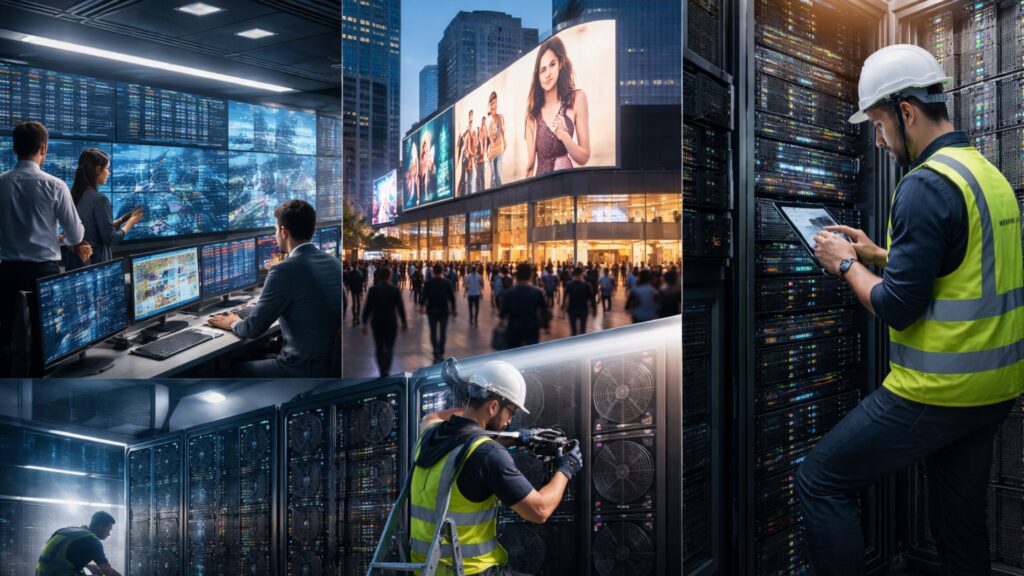
In every metro station, shopping mall, stadium, bus terminal, or highway control room, digital screens have become part of daily life. People check arrival times, watch ads, follow match scores, or look for directions.
However, during peak traffic hours, these same display systems often freeze, lag, go blank, or restart unexpectedly.
Most people think, “It’s just a technical glitch.” But behind that glitch lies a serious infrastructure problem.
Let’s break down the real reasons public display systems crash during high-traffic periods – and more importantly, how they can be prevented.
1. Server Overload During Data Spikes
During rush hours in metro stations or bus depots, thousands of real-time updates happen simultaneously:
- Arrival updates
- Route changes
- Emergency notifications
- Advertisement switches
If the backend server infrastructure is not built for peak load handling, the system becomes slow or crashes.
Problem: Poor load balancing and insufficient server capacity.
Impact: Screens freeze or show outdated information.
2. Power Fluctuations and Voltage Instability
Public spaces often experience voltage drops or sudden spikes, especially during high electricity demand hours.
LED panels and video walls are sensitive electronic systems.
Problem: Inconsistent power supply.
Impact: Sudden blackouts, flickering, or permanent damage to display modules.
3. Overheating of LED Modules
Outdoor displays in India face:
- Direct sunlight
- High humidity
- Dust accumulation
During peak hours, brightness increases, processors work harder, and internal heat rises.
Without proper thermal management:
- Panels shut down automatically
- Internal chips degrade faster
- Pixels burn out
Overheating is one of the most underestimated causes of display crashes.
4. Network Congestion
Many public display systems rely on centralized CMS (Content Management Systems).
During peak hours:
- Data packets increase
- Live feeds stream
- Emergency alerts trigger
If the network bandwidth is not optimized, latency increases.
Result: Delayed updates or complete system freeze.
5. Low-Quality Hardware Components
Budget installations often use:
- Substandard LED drivers
- Low-grade power supplies
- Weak control cards
These components perform fine under light load. However, during peak usage, they fail. This is why some screens work smoothly in the morning but crash in the evening.
6. Poor Installation and Calibration
Large video walls require:
- Precise alignment
- Proper ventilation spacing
- Secure wiring
If installation shortcuts are taken:
- Heat pockets form
- Signal interference increases
- Modules disconnect randomly
In high-traffic hours, when systems operate continuously, these flaws become visible.
7. Lack of Preventive Maintenance
Public display systems are often installed and forgotten.
Dust, loose cables, outdated firmware, and aging components reduce performance over time.
During peak hours, when demand is highest, the weakest part of the system fails first.
Why This Matters More Than Ever
From metro stations to shopping malls, from concerts to stadiums, digital displays are no longer decorative.
They are:
- Information infrastructure
- Revenue-generating platforms
- Public communication tools
- Emergency response systems
When they crash, trust breaks.
And in critical environments, delayed information can create panic.
The Real Solution: Engineering for Peak, Not Average
Most systems are designed for average usage. However, public environments require systems built for worst-case scenarios.
To prevent crashes, a display ecosystem must include:
- Scalable server architecture
- Stable and regulated power systems
- Advanced heat dissipation technology
- Optimized network bandwidth
- Industrial-grade components
- Professional installation standards
- Scheduled preventive maintenance
This is where integrated display engineering becomes important.
Across India’s evolving infrastructure – whether it’s metro networks, retail hubs, transport systems, stadiums, or smart city command centers – there is a growing need for display solutions designed for reliability, performance, and long-term durability.
Companies that understand large-format visual ecosystems focus not just on brightness and resolution, but on backend stability, thermal science, structural balance, and system redundancy.
Because in high-traffic hours, performance is not optional – it is expected.
Vulcan AIC
Everyone sees public display systems every day.
We see metro boards updating arrival times.
We see massive LED screens in malls.
We watch concerts amplified on giant video walls.
We rely on highway displays for safety alerts.
However, most people never think about what keeps these systems running during the busiest hours.
Behind every stable screen is engineering discipline – load-tested servers, calibrated modules, thermal management systems, network optimization, and structured installation practices.
At Vulcan AIC, we believe public display systems should not just look impressive – they should perform under pressure.
We design and integrate large-scale display ecosystems built for peak-hour reliability, environmental resilience, and long-term operational stability. Because in transport hubs, retail environments, stadiums, and smart infrastructure, downtime is not just inconvenient – it affects experience, trust, and safety.
Our focus is simple: Build display systems that stay stable when demand rises.
As cities grow smarter and digital communication becomes essential infrastructure, we at Vulcan AIC are committed to engineering visual systems that perform when it matters most.

