
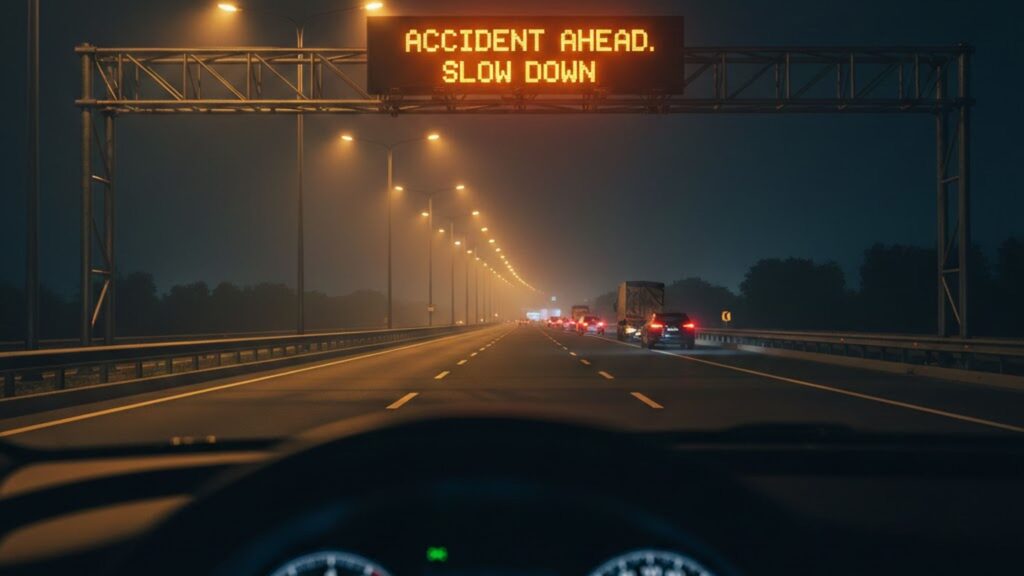
It’s 10:45 PM. The highway looks calm. Almost peaceful. Streetlights stretch ahead in a straight golden line. Your music is playing softly. The road feels open. Predictable. Safe. Then suddenly – up ahead – you see it. A bright warning message flashes across a digital board:
“Accident Ahead. Slow Down.”
You instinctively ease your foot off the accelerator. Seven seconds later, you see tail lights glowing red in the distance. Traffic has slowed. A truck is stopped across one lane. And that’s when it hits you. If you hadn’t slowed down when you did, you might have been braking too late.
Seven seconds. That’s all it took to change the outcome.
The Power of a Few Seconds
When we talk about highway safety in India, we often talk about infrastructure – better roads, wider lanes, stronger bridges. But safety is not just about concrete and asphalt.
It’s about timing.
On Indian highways, where thousands of vehicles move every hour, reaction time is everything. A driver traveling at 90 km/h covers almost 25 meters per second. Even a small delay in receiving information can make the difference between a smooth slowdown and a sudden collision.
Real-time alerts on roads are not just digital messages. They are moments. Decisions. Interventions.
They buy drivers time. And time, on a highway, is priceless.
Why Road Accidents Often Happen Too Fast
Let’s be honest. Most highway accidents don’t happen because someone wanted to be reckless. They happen because of:
- Sudden lane changes
- Poor visibility due to fog
- Unexpected congestion
- Breakdown vehicles ahead
- Construction diversions
Night Driving: When Seconds Feel Shorter
Driving at night feels different. Depth perception changes. Visibility reduces. Fatigue increases. A study of road behaviour shows that reaction time can slow by up to 20% during night hours. Now imagine receiving a warning just a few seconds late in those conditions.
That small delay becomes critical.
Clear, bright, real-time highway alerts act like a second pair of eyes on the road. They see what you cannot yet see.
Fog ahead.
Vehicle breakdown.
Speed restrictions.
Emergency diversion.
When the message reaches before the obstacle does, the journey remains safe.
Technology Is Not Replacing Drivers – It’s Supporting Them
There’s a misconception that technology removes human responsibility. In reality, it strengthens it. Drivers still make decisions. But better information helps them make better decisions.
Think about it: Would you rather suddenly encounter stopped traffic at full speed? Or slow down gradually because you were informed 500 meters earlier?
The answer is obvious. Highway safety in India is improving. Roads are becoming smoother. Expressways are expanding. But real safety doesn’t just come from speed.
It comes from communication.
The Invisible Infrastructure That Saves Lives
Most people don’t think about the digital boards they pass on highways. They glance. They read. They adjust speed. And then they forget. But behind that single line of flashing text is a system designed to respond in real time.
Weather inputs.
Traffic updates.
Emergency triggers.
Remote control centers.
When all of that works seamlessly, drivers never notice. And that’s the point. The best safety systems are invisible when they succeed.
A Simple Truth About Prevention
Road accident prevention is not dramatic. It doesn’t always look heroic.
Sometimes, it looks like a driver slowing down quietly.
Or changing lanes early.
Or avoiding a fog zone safely.
The impact is invisible because the accident never happened. But that prevention started somewhere. Often, it started with a message.
Why Those 7 Seconds Matter More Than We Think
Let’s go back to that night drive.
You saw the alert.
You slowed down.
You avoided danger.
Seven seconds gave you awareness.
Awareness gave you control.
Control gave you safety.
On India’s highways – where millions travel every day – those small moments multiply.
Multiply them across cities. Across states. Across expressways. And suddenly, those seven seconds become a nationwide impact.
Keeping India Moving – Safely and Smartly
As India builds faster highways and stronger infrastructure, intelligent communication must grow alongside it. Because a smart road is not just one that is wide and smooth.
It is one that speaks.
One that warns.
One that informs.
One that gives drivers the time they need.
At Vulcan AIC, this belief drives everything we build.
Across multiple Indian states, our Variable Message Signs and intelligent display systems are designed with one purpose – delivering clear, real-time information when it matters most.
Not for visibility alone. But for safety. Because on a highway, sometimes all it takes is seven seconds to change everything.

