
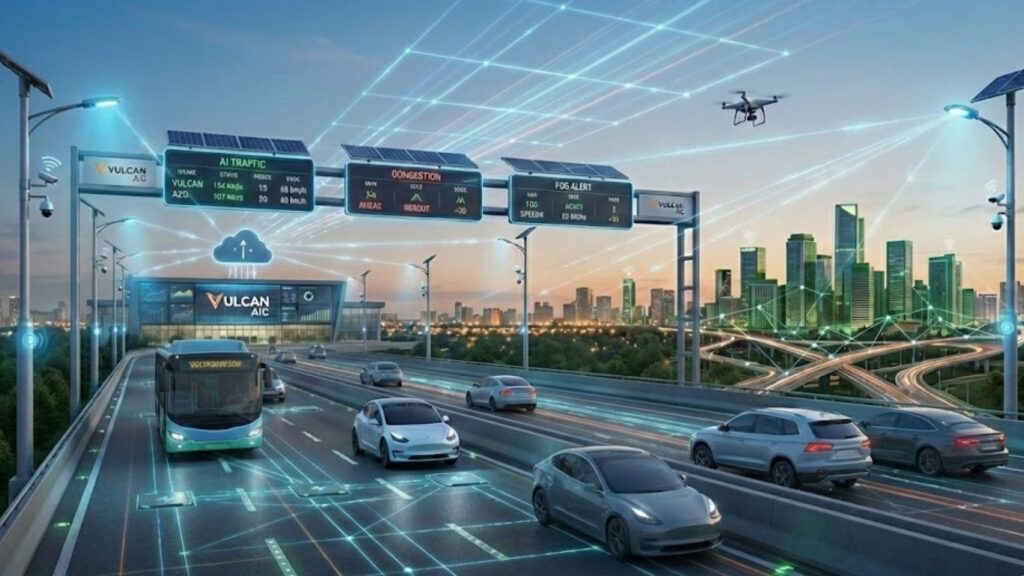
India’s roads are no longer just physical connectors between cities. They are becoming intelligent networks.
As urbanization accelerates and vehicle density increases, traditional infrastructure models are struggling to keep pace. Congestion, delayed emergency response, unpredictable traffic flow, and safety risks demand more than wider highways.
They demand smarter systems.
This is where AI (Artificial Intelligence) and IoT (Internet of Things) are transforming road infrastructure across India.
The Shift From Static Roads to Intelligent Networks
For decades, road infrastructure focused on durability and expansion. Today, the focus is shifting toward real-time responsiveness and data-driven control.
Smart mobility is built on systems that can:
- Monitor traffic flow continuously
- Detect incidents instantly
- Adjust signals dynamically
- Communicate with road users in real time
- Optimize traffic movement based on patterns
Instead of reacting after problems occur, intelligent infrastructure anticipates and adapts.
What Smart Mobility Really Means
Smart mobility is not just about electric vehicles or app-based navigation. It is about integrating AI, IoT sensors, communication networks, and intelligent display systems into road infrastructure.
At its core, smart mobility includes:
- Connected traffic management systems
- AI-enabled variable message displays
- IoT-based traffic and weather sensors
- Centralized control rooms
- Data analytics platforms
Together, these technologies create roads that can sense, think, and respond.
How AI Is Improving Road Infrastructure
Artificial Intelligence allows infrastructure to move beyond manual control.
1. Predictive Traffic Management
AI analyzes:
- Traffic density patterns
- Peak congestion hours
- Historical accident data
- Weather conditions
This enables authorities to predict congestion before it escalates and take preventive measures.
2. Real-Time Incident Detection
AI-powered systems can detect:
- Sudden traffic slowdowns
- Accidents
- Lane blockages
- Abnormal vehicle behavior
Immediate alerts reduce response time and improve safety outcomes.
3. Dynamic Information Display
Intelligent display systems powered by AI can:
- Change speed limits based on real-time conditions
- Warn drivers about fog, construction, or accidents
- Redirect traffic before bottlenecks form
Clear, timely communication significantly reduces panic-driven accidents.
The Role of IoT in Connected Highways
If AI is the brain, IoT is the nervous system.
IoT devices installed across highways and urban roads collect:
- Traffic speed data
- Environmental conditions
- Vehicle counts
- Infrastructure performance metrics
This data flows to centralized platforms where AI processes and interprets it.
The result: faster, more accurate decision-making.
Benefits for Government and Public Authorities
Smart mobility supports government priorities such as:
- Improved road safety
- Reduced congestion
- Lower carbon emissions
- Faster emergency response
- Efficient infrastructure utilization
It also enhances transparency and accountability by enabling measurable performance tracking.
For national highway authorities and smart city missions, intelligent infrastructure is no longer experimental—it is essential.
Smart Cities and Integrated Mobility
India’s Smart City initiatives emphasize:
- Data-driven governance
- Energy-efficient systems
- Sustainable urban growth
- Intelligent transport networks
AI and IoT-enabled road infrastructure fits naturally into this vision.
When traffic systems, public transport, emergency services, and communication platforms are interconnected, cities become more efficient and resilient.
Sustainability and Smart Mobility
Smart mobility also contributes to environmental goals.
AI-driven systems help:
- Reduce idle time in traffic
- Optimize fuel consumption
- Lower emissions
- Support integration with renewable-powered infrastructure
When combined with solar-powered intelligent systems, road infrastructure becomes both smart and sustainable.
From Highways to Urban Corridors
The transformation is visible across:
- National highways
- Expressways
- Metro corridors
- Urban intersections
- Event and public gathering zones
Organizations working in intelligent infrastructure, including Vulcan AIC, operate within this evolving ecosystem-designing systems that combine display technology, AI integration, and resilient engineering suited for Indian conditions.
The focus is not just on innovation, but on practical deployment at scale.
The Human Impact of Smart Roads
Technology matters only if it improves everyday life.
Smarter road infrastructure leads to:
- Reduced travel stress
- Safer journeys
- Shorter commute times
- More reliable public systems
- Better urban experiences
When roads communicate clearly and adapt quickly, drivers and pedestrians benefit directly.
The Road Ahead
India’s mobility future is not just electric. It is intelligent.
As AI and IoT continue to mature, infrastructure will increasingly shift from static systems to adaptive networks that learn continuously.
Smart mobility represents a long-term transformation-not a temporary upgrade.
Because in the next phase of development, the real measure of infrastructure will not be how far it stretches, but how intelligently it operates.

