
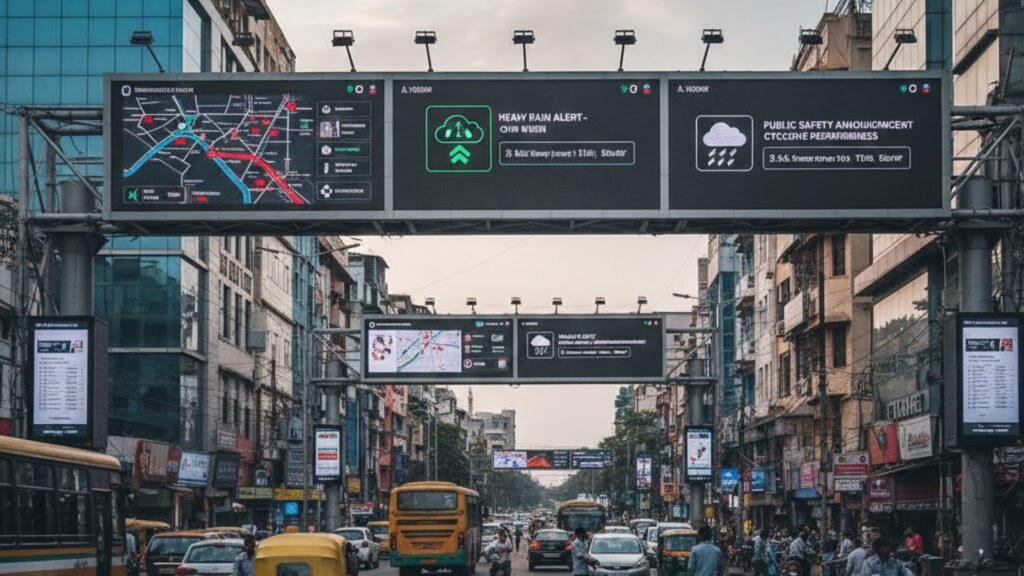
India’s Smart City Mission was never just about building new roads or installing modern equipment. At its core, the mission is about making cities easier to live in-safer, more efficient, and more responsive to citizens’ needs.
As cities grow and urban movement becomes more complex, one requirement stands out clearly:
cities must communicate better with people.
This is where intelligent display systems play a quiet but powerful role.
The Communication Gap in Urban Infrastructure
In many cities, information reaches citizens late-or not at all.
Common challenges include:
- Sudden traffic diversions without advance notice
- Congestion building up before authorities can react
- Confusion during emergencies or weather events
- Static signboards that don’t reflect real conditions
When information is delayed, even well-planned infrastructure struggles to perform.
Smart cities need systems that can inform, guide, and adapt in real time.
What Are Intelligent Display Systems?
Intelligent display systems are digital information boards connected to live data sources.
They integrate with:
- Traffic sensors and cameras
- Command and control centres
- Weather and environmental systems
- City-wide data platforms
Instead of showing fixed messages, these displays change content automatically based on what is happening on the ground.
In simple terms:
They help cities speak clearly, at the right moment, to the right people.
Why Intelligent Displays Matter in Smart City Missions
1. Real-Time Information for Citizens
Smart cities aim to reduce uncertainty in daily life.
Intelligent displays provide:
- Live traffic updates
- Route diversions and congestion alerts
- Weather-related warnings
- Event and emergency notifications
When citizens know what lies ahead, they make better decisions—and cities function more smoothly.
2. Support for Faster Administrative Decisions
For city authorities and PSUs, real-time visibility is critical.
Intelligent displays are often linked to:
- Integrated Command and Control Centres (ICCCs)
- Traffic management systems
- Emergency response units
This allows officials to:
- Respond faster to incidents
- Coordinate between departments
- Update public messaging instantly
Better information leads to faster, more confident governance decisions.
3. Improved Road Safety and Urban Mobility
One of the key goals of smart cities is safer movement.
Intelligent displays help by:
- Warning drivers before dangerous zones
- Managing speed during peak hours or poor visibility
- Reducing sudden braking and confusion
This proactive communication lowers accident risk and improves overall mobility.
4. Reduced Operational Load on City Teams
Manual communication requires:
- Field teams
- Repeated updates
- Multiple coordination points
Automated display systems reduce this burden by:
- Updating messages automatically
- Operating continuously
- Minimising human error
This allows city teams to focus on planning and response, rather than constant monitoring.
5. Data That Strengthens Long-Term Planning
Every message displayed creates data.
Over time, intelligent systems help cities understand:
- Traffic patterns
- High-risk locations
- Peak congestion periods
- Citizen response behaviour
This data supports:
- Better urban planning
- Smarter policy decisions
- More targeted infrastructure investments
Smart cities are not just connected-they are learning systems.
Fit With India’s Smart City Vision
India’s Smart City Mission focuses on:
- Technology-enabled governance
- Citizen-centric services
- Sustainable and scalable solutions
Intelligent display systems align perfectly with these goals because they:
- Are visible to citizens
- Deliver immediate value
- Integrate easily with existing city platforms
- Scale across zones, corridors, and departments
They are not add-ons-they are foundational communication tools.
The Importance of Context-Aware Design
Indian cities are diverse.
A solution that works in one region may not work in another due to:
- Climate differences
- Traffic behaviour
- Density and road conditions
This is why locally designed intelligent infrastructure matters.
Organizations working in this space, including Vulcan AIC, focus on systems that perform reliably under real Indian urban conditions, not just ideal environments.
Smart Cities Must Speak Clearly
A smart city is not defined only by sensors or software. It is defined by how clearly it communicates with its people.
Intelligent display systems:
- Reduce confusion
- Improve safety
- Support faster governance
- Build public trust
As India’s smart cities continue to evolve, these systems will play a growing role in ensuring that technology remains visible where it matters and invisible where it doesn’t.
Because when cities communicate better, urban life becomes calmer, safer, and more efficient.

