
For a long time, infrastructure was judged by how strong it looked. Thicker roads, bigger structures, brighter lights. That thinking made sense in the past. But today, infrastructure faces a very different world.
Cities are expanding faster than ever. Traffic patterns change by the hour. Weather conditions are unpredictable. And decisions often need to be made in seconds, not days. In this new reality, three ideas matter more than anything else: Balance. Intelligence. Infinity.
These are not marketing words. They describe how modern infrastructure must actually behave in the real world.
What Does “Balanced” Infrastructure Really Mean?
Balance in infrastructure does not mean doing everything equally. It means doing the right thing at the right time.
A balanced system knows:
- When to automate
- When to alert humans
- When to stay quiet
- When to intervene
For example, flooding drivers with constant warnings creates confusion. Silence during dangerous conditions creates risk.
Balanced infrastructure sits calmly in between.
It:
- Shares only relevant information
- Avoids unnecessary noise
- Supports decision-making without overwhelming people
In real infrastructure systems, balance is what keeps roads calm, predictable, and safe-even during uncertainty.
Intelligence: Beyond Automation
Many people confuse automation with intelligence. They are not the same.
Automation follows rules. Intelligence understands situations.
An intelligent infrastructure system:
- Reads real-time data
- Understands changing conditions
- Chooses the most appropriate response
- Improves with experience
For example:
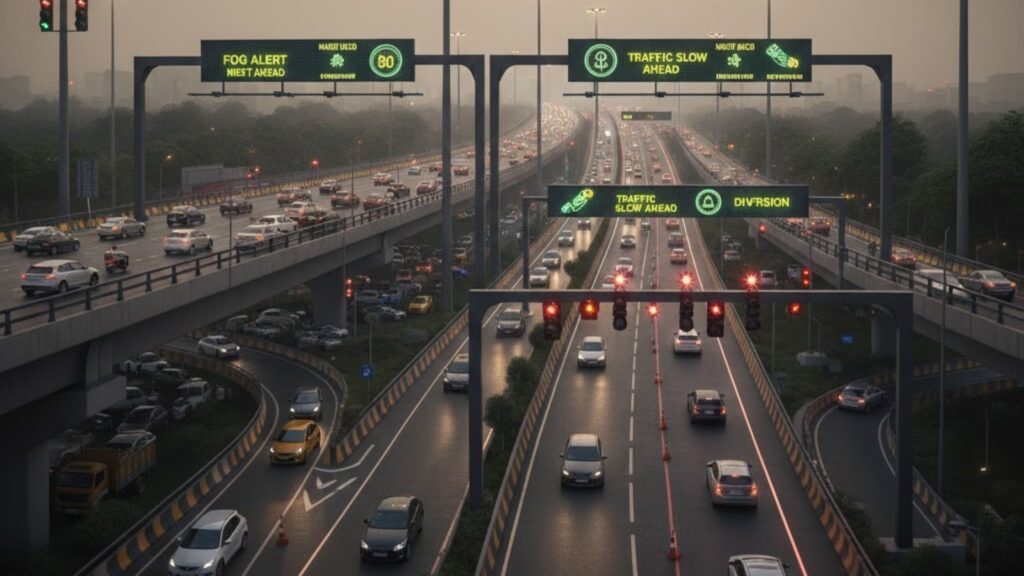
A static sign always shows the same message. An intelligent display changes its message based on fog, traffic density, accidents, or emergencies.
This ability to sense, decide, and respond is what separates old infrastructure from modern systems.
Intelligence turns roads from passive structures into aware systems.
Infinite: Systems That Never Stop Learning
Traditional infrastructure is built once and expected to last decades without change.
Modern infrastructure doesn’t work that way.
- Traffic patterns evolve.
- Cities grow.
- New risks appear.
That’s where infinity comes in.
Infinite systems are not endless in size-they are endless in learning.
They:
- Collect data continuously
- Learn from patterns
- Adapt over time
- Improve without needing constant redesign
Instead of becoming outdated, these systems become smarter with use.
This is how infrastructure stays relevant-not by rebuilding everything, but by learning continuously.
Why These Three Ideas Must Work Together
Balance, intelligence, and infinity cannot exist in isolation.
- Intelligence without balance becomes chaotic
- Balance without intelligence becomes slow
- Intelligence without learning becomes outdated
When all three work together, infrastructure becomes:
- Calm under pressure
- Responsive in real time
- Reliable over the long term
This is what real, future-ready infrastructure looks like.
What This Means on Real Roads
On highways and urban roads, these principles translate into systems that:
- Warn drivers before danger appears
- Adjust communication based on conditions
- Reduce human error
- Support faster emergency response
- Lower stress for everyday commuters
Drivers don’t need more technology.
They need clear guidance at the right moment.
That’s the difference thoughtful infrastructure makes.
The Human Side of Intelligent Infrastructure
At its core, infrastructure exists for people.
- Balanced systems reduce confusion.
- Intelligent systems reduce accidents.
- Learning systems reduce long-term risk.
When infrastructure works quietly in the background:
- Journeys feel smoother
- Decisions feel easier
- Roads feel safer
This human experience is the true measure of success—not how advanced the technology looks.
India’s Shift Toward Thoughtful Infrastructure
Across India, there is a clear shift underway:
from static structures → adaptive systems
from imported solutions → locally designed intelligence
Organizations working in this space, including Vulcan AIC, are part of a broader movement focused on building infrastructure that understands Indian roads, Indian conditions, and Indian behaviour.
The goal is not to make infrastructure louder or more complex-but more aware and more dependable.
Infrastructure That Understands
The future of infrastructure is not defined by concrete or steel. It is defined by understanding.
Balanced systems keep things calm. Intelligent systems respond wisely. Infinite systems continue to improve.
When infrastructure understands its environment, cities move better.
When systems adapt responsibly, people feel safer.
And when technology is guided by care, progress becomes meaningful.
That is what Balanced. Intelligent. Infinite. looks like in the real world

