Driving through a tunnel is different from driving on an open road.
Visibility can change within seconds. Natural light disappears, lanes become confined, and there may be limited space for drivers to react to accidents, breakdowns, congestion, or emergency situations.
This is where tunnel lane control signs become extremely important.
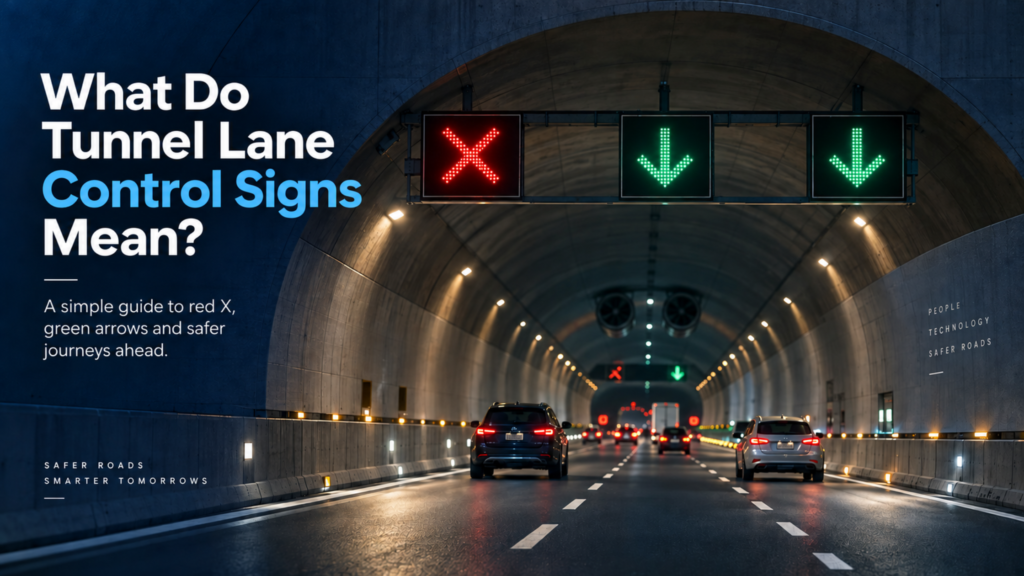
You may have noticed a green arrow, red X, or other illuminated symbol above a lane while travelling through a tunnel. These aren’t simply decorative LED displays. They are part of an intelligent traffic management system designed to communicate the status of individual lanes to drivers.
A green arrow generally indicates that a lane is available for traffic, while a red X indicates that the lane is closed and should not be entered. Depending on the system and operating environment, additional indications can warn drivers about an upcoming lane closure or changing traffic conditions.
In modern tunnels, tunnel lane control signs help operators communicate directly with drivers without relying only on conventional roadside signs.
So, what exactly do these signs mean?
And how do tunnel lane control signs contribute to safer and smarter tunnel operations?
1. What Are Tunnel Lane Control Signs?
Tunnel lane control signs are illuminated traffic control displays installed above or alongside individual lanes inside tunnels.
Their primary purpose is simple:
Tell drivers whether a particular lane is open, closing, or closed.
Instead of displaying a permanent message, these systems can change their indication according to the current traffic situation.
For example:
- 🟢 Green Arrow: Lane is open for traffic.
- 🔴 Red X: Lane is closed.
- 🟡 Yellow X: Lane may be closing or drivers may need to leave the lane, depending on the system.
- ➡️ Directional indications: Can provide lane guidance in certain traffic-management applications.
The important point is that the signal corresponds to the specific lane beneath it.
This makes tunnel lane control signs particularly useful when tunnel operators need to temporarily change how traffic moves.
Imagine a three-lane tunnel.
Under normal conditions, all three lanes may be available. But if an incident occurs in the middle lane, the operator may need to close that lane while keeping the other two lanes operational.
Instead of shutting the entire tunnel, tunnel lane control signs can communicate the lane-level restriction directly to approaching drivers.
That makes traffic management more flexible.
2. What Does a Green Arrow Mean?
A green downward arrow above a lane generally means that the lane is open and available for traffic.
It gives the driver a clear visual indication that the lane can be used.
In a tunnel environment, this becomes especially valuable because drivers have fewer opportunities to interpret traditional signs placed far away from the roadway.
A well-positioned green arrow provides information exactly where the driver needs it: above the lane itself.
This is one reason why tunnel lane control signs are designed around simple, recognizable symbols rather than lengthy messages.
The driver doesn’t need to read a paragraph.
The driver needs to understand the lane condition quickly.
Why use a green arrow?
A green arrow can help:
- Indicate an active traffic lane
- Reduce uncertainty
- Improve lane awareness
- Support dynamic traffic management
- Guide drivers through changing tunnel conditions
In a properly designed system, the indication should be visible from an appropriate distance and positioned so that drivers can associate the signal with the lane it controls.
3. What Does a Red X Mean?
The red X is one of the most important symbols used in tunnel lane management.
A red X generally means: The lane is closed. Do not enter or continue using that lane.
This can happen for several reasons.
For example:
- Vehicle breakdown
- Traffic accident
- Road maintenance
- Obstruction
- Emergency response
- Fire or smoke
- Lane maintenance
- Temporary traffic management
- Other operational requirements
This is where tunnel lane control signs become more than simple information displays.
They can become an active part of the tunnel’s safety system.
Consider a vehicle that has stopped in a tunnel lane.
If the lane remains visually available, approaching drivers may continue entering it. That can increase the possibility of secondary incidents.
A red X provides an immediate visual warning that the lane should not be used.
Drivers should respond to the lane closure according to the applicable traffic rules and other signs or instructions provided by the tunnel operator.
4. Why Are Tunnel Lane Control Signs Important?
The biggest advantage of tunnel lane control signs is that they provide dynamic information.
Traditional road signs are generally static.
They tell drivers something that remains true until the sign changes.
But tunnel conditions can change rapidly.
A lane that is open at 10:00 AM could become unavailable at 10:05 AM because of an incident.
A static sign cannot communicate that change instantly.
Dynamic tunnel lane control signs, however, can change their indication based on the traffic-management requirements.
This makes them particularly useful in environments where operators need to control individual lanes.
Faster communication
A symbol can communicate a lane condition almost instantly.
Better lane-level guidance
Instead of giving a general instruction, the system can identify the specific lane affected.
Support during incidents
When an accident or obstruction occurs, operators can use lane-control systems to restrict access to the affected lane.
Improved driver awareness
Bright, high-visibility indications can attract attention in the tunnel environment.
Flexible traffic management
Operators can change lane availability without necessarily closing the entire tunnel.
Better integration
Modern tunnel lane control signs can form part of a broader intelligent tunnel-management ecosystem.
Support for safer operations
By clearly communicating lane status, the system can help reduce confusion when tunnel conditions change.
5. How Tunnel Lane Control Signs Support Traffic Management
A modern tunnel isn’t just a passage through a mountain, under a city, or beneath a structure.
It can be a highly controlled transportation environment.
Traffic-management systems can monitor conditions and provide operators with information about what’s happening inside the tunnel.
When a situation requires intervention, tunnel lane control signs can help communicate the resulting instruction to drivers.
For example:
Normal condition
Lane 1 → Green Arrow
Lane 2 → Green Arrow
Lane 3 → Green Arrow
All lanes are available.
Now imagine an obstruction in Lane 2.
The configuration could become:
Lane 1 → Green Arrow
Lane 2 → Red X
Lane 3 → Green Arrow
The message is immediately understandable:
Lane 2 is closed.
This lane-by-lane approach is one of the key benefits of intelligent tunnel traffic management.
Instead of communicating only with a general message board, the system communicates with drivers at the exact point where their lane decision needs to be made.
6. What Happens During a Tunnel Emergency?
Emergency situations inside tunnels require particularly careful traffic management.
A tunnel has physical constraints that an open highway doesn’t.
There may be:
- Limited escape routes
- Restricted visibility
- Confined road space
- Heavy traffic
- Smoke or fire
- Emergency vehicles
- Limited opportunities to turn around
Because of this, communicating the correct instruction quickly can be critical.
During an incident, tunnel lane control signs can help operators communicate lane closures or changes in traffic movement.
For example, if an incident blocks one lane, that lane can be indicated as closed while unaffected lanes remain available when conditions permit.
If a larger emergency affects tunnel operations, lane-control indications can work alongside other systems such as:
- Variable message signs
- Traffic signals
- Emergency lighting
- CCTV
- Traffic monitoring systems
- Public address systems
- Tunnel control systems
- Fire and life-safety systems
The important idea is that tunnel lane control signs are one component of a larger intelligent infrastructure system.
They don’t replace emergency management.
They support it by giving drivers clear visual information.
7. Tunnel Lane Control Signs vs Static Road Signs
What’s the difference between a traditional road sign and tunnel lane control signs?
The biggest difference is dynamic control.
A conventional sign might permanently display:
SPEED LIMIT 60
A lane-control display can change according to the current operating condition.
For example:
GREEN ARROW → Lane Open
Then later:
RED X → Lane Closed
This makes lane-control displays useful in environments where traffic conditions aren’t always predictable.
| Feature | Static Sign | Tunnel Lane Control Signs |
|---|---|---|
| Information | Fixed | Dynamic |
| Lane-specific control | Limited | Yes |
| Can change indication | No | Yes |
| Incident response | Limited | Stronger |
| Real-time communication | No | Possible |
| Visibility | Depends on sign | Illuminated display |
| Traffic management | Basic | Intelligent/dynamic |
This doesn’t mean static signs are unnecessary. Both technologies serve different purposes. Static signs communicate permanent or predictable information, while tunnel lane control signs are especially useful when lane conditions can change.
8. Why Are Red X and Green Arrows So Effective?
One reason these symbols work well is their simplicity.
Imagine you’re driving through a tunnel at highway speed. You don’t have time to stop and read a long paragraph. You need to understand the instruction quickly.
That’s why tunnel lane control signs typically rely on highly recognizable visual symbols.
Green Arrow
Think: GO / OPEN
The lane is available for traffic.
Red X
Think: STOP / CLOSED
The lane should not be entered or used.
This visual language allows information to be communicated with minimal reading effort.
The effectiveness of these indications still depends on proper design, visibility, positioning, maintenance, and driver understanding.
That’s why the engineering behind tunnel lane control signs matters just as much as the symbols themselves.
9. What Makes a Good Tunnel Lane Control System?
Not every LED display automatically becomes an effective traffic-management system. A properly designed lane-control solution needs to consider the environment in which it will operate.
High visibility
The indication should remain clearly visible to approaching drivers.
Correct positioning
The display should be positioned so drivers can easily associate it with the corresponding lane.
Reliable operation
Traffic infrastructure needs dependable electronics and control systems because failures can affect road operations.
Appropriate brightness
Displays need to remain visible without creating unnecessary glare.
Clear symbols
Drivers should be able to understand the indication quickly.
Environmental durability
Tunnel infrastructure can experience dust, humidity, vibration, temperature variations, and continuous operation.
Easy maintenance
Access for inspection and maintenance is an important part of infrastructure planning.
A combination of these factors determines how effectively tunnel lane control signs perform in real-world conditions.
10. Where Are Tunnel Lane Control Signs Used?
Tunnel lane control signs can be used in different types of tunnel environments where dynamic lane management is required.
Examples include:
Road tunnels
Highway and urban road tunnels can use lane-control displays to manage changing traffic conditions.
Urban tunnels
Busy city tunnels may require dynamic lane management during congestion, maintenance, or incidents.
Long tunnels
Long tunnels can benefit from clear lane-level indications because drivers may have limited opportunities to see conventional roadside information.
Multi-lane tunnels
The more lanes a tunnel has, the more useful individual lane indications can become.
Intelligent transportation systems
Lane-control displays can form part of broader Intelligent Transportation System infrastructure. In each application, the exact configuration depends on the tunnel’s design, traffic-management strategy, local standards, and operational requirements.
11. How Intelligent Displays Make Tunnels Smarter
The evolution of road infrastructure is moving from static information to connected, intelligent systems.
Instead of simply putting signs on roads, modern infrastructure increasingly uses sensors, cameras, controllers, communication systems, and dynamic displays to manage transportation environments.
Tunnel lane control signs fit into this transition.
They provide the visual communication layer between the traffic-management system and the driver.
Think of it this way:
Sensors and monitoring systems → detect or identify conditions
Traffic-management system → processes the situation
Operator/control logic → determines the appropriate response
Tunnel lane control signs → communicate the lane instruction
Driver → responds to the information
This creates a communication loop between infrastructure and road users.
That’s one of the fundamental ideas behind intelligent transportation infrastructure.
12. The Role of LCS in Tunnel Infrastructure
LCS stands for Lane Control System.
A tunnel LCS can use lane-specific displays to communicate whether individual lanes are open or closed. This makes LCS an important component of intelligent tunnel traffic management. For manufacturers and infrastructure developers, the goal isn’t simply to build an LED board. The goal is to build a reliable system capable of performing in a demanding infrastructure environment.
At Vulcan AIC, tunnel infrastructure is part of a broader intelligent-display ecosystem that includes solutions such as Lane Control Signs, Variable Speed Limit Signs, traffic signals, and other intelligent display systems.
The focus is on engineering and manufacturing infrastructure technology that helps road operators communicate with drivers more effectively.
13. Why Visibility Matters Inside a Tunnel
A tunnel creates a completely different visual environment compared with an open road.
Lighting conditions can change, There may be reflections. Vehicles may create visual clutter. Drivers may be travelling at high speeds. The display therefore needs to be designed with visibility in mind.
This includes considerations such as:
- LED performance
- Optical visibility
- Brightness control
- Viewing distance
- Symbol size
- Display positioning
- Contrast
- Environmental protection
For tunnel lane control signs, visibility isn’t simply about making the LEDs bright.
The information needs to be clear, recognizable, and appropriately visible.
A brighter display isn’t automatically a better display.
The engineering has to balance visibility with the tunnel environment.
14. Red X vs Green Arrow: A Simple Guide
If you’re driving through a tunnel and see these indications, remember the basic difference:
| Symbol | General Meaning | Driver Response |
|---|---|---|
| 🟢 Green Arrow | Lane open | Lane may be used |
| 🔴 Red X | Lane closed | Do not enter/use lane |
| 🟡 Yellow X | Lane closing/warning in applicable systems | Prepare to leave lane |
The exact meaning and operational rules can vary depending on the traffic-control system and applicable local regulations. However, the principle behind tunnel lane control signs remains straightforward: The display communicates the current status of the lane. When a lane shows a red X, drivers should never treat it as an ordinary decorative display.
It is a traffic-control indication.
15. The Future of Tunnel Traffic Management
As transportation infrastructure becomes more connected, tunnel management is also becoming more intelligent.
Future systems may increasingly combine:
- AI-based video analytics
- Automatic incident detection
- Traffic monitoring
- Variable message signs
- Lane control systems
- Variable speed displays
- Connected traffic systems
- Centralized command centres
- Real-time data
- Smart infrastructure platforms
In such environments, tunnel lane control signs can become part of a much larger network of intelligent infrastructure.
Imagine a system where an incident is detected automatically.
The system identifies the affected lane.
Traffic-management logic evaluates the situation.
The affected lane is closed.
The corresponding tunnel lane control signs change from green to red.
Drivers approaching the location see the updated instruction.
This is the direction in which intelligent transportation infrastructure is moving: faster communication between the road, the system, and the driver.
Frequently Asked Questions
What are tunnel lane control signs?
Tunnel lane control signs are illuminated displays used to communicate the status of individual traffic lanes inside a tunnel. They commonly use symbols such as green arrows and red Xs to indicate whether lanes are open or closed.
What does a green arrow mean in a tunnel?
A green downward arrow generally indicates that the lane beneath the signal is open for traffic.
What does a red X mean inside a tunnel?
A red X generally indicates that the corresponding lane is closed. Drivers should not enter or continue using that lane.
Why are tunnel lane control signs important?
Tunnel lane control signs provide dynamic lane-level information. They can help communicate changing traffic conditions, lane closures, incidents, maintenance requirements, and other operational instructions.
Are tunnel lane control signs part of ITS?
Yes. Tunnel lane control signs can form part of an Intelligent Transportation System (ITS), working alongside traffic monitoring, CCTV, variable message signs, traffic signals, and other intelligent infrastructure.
Can tunnel lane control signs help during emergencies?
Yes. During incidents or emergencies, tunnel lane control signs can communicate lane closures and changing traffic conditions to drivers, subject to the tunnel’s traffic-management strategy.
Are red X and green arrow signs only used inside tunnels?
No. Similar lane-use control signals can also be used on highways, managed lanes, bridges, and other transportation environments where dynamic lane control is required.
Who manufactures tunnel lane control systems?
Specialized intelligent-infrastructure manufacturers such as Vulcan AIC engineer and manufacture display and traffic-management solutions for highway and tunnel applications.
Conclusion
A tunnel may look like a simple road through a structure. But behind that road is a complex combination of lighting, monitoring, communication, safety, and traffic-management technology.
Tunnel lane control signs play an important role in this ecosystem by giving drivers one of the most important pieces of information they need: Is this lane open or closed?
A green arrow can indicate an available lane.
A red X can indicate a closed lane.
And when conditions change, dynamic displays can help communicate those changes directly to drivers.
As cities expand, highways become more intelligent, and transportation networks become increasingly connected, technologies such as tunnel lane control signs will continue to play an important role in smart infrastructure.
Because sometimes, a simple symbol above a lane isn’t just a sign.
It’s the infrastructure communicating with the driver.

