
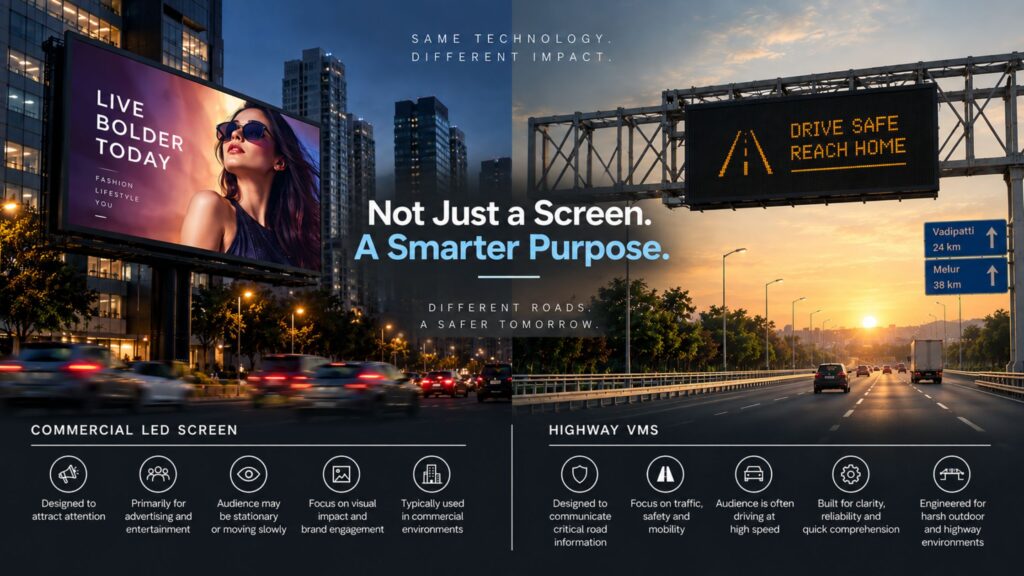
A large LED display installed beside or above a road can look similar to a commercial LED screen.
Both use LED technology.
Both display text and graphics.
Both can be remotely controlled.
And both are visible from a distance.
But this visual similarity often creates a major misunderstanding.
A Highway VMS is not simply a commercial LED screen installed on a highway.
The difference lies in the purpose, engineering, reliability and operating environment behind the display.
A commercial screen is primarily designed to attract attention and deliver visual content. A Highway VMS, or Variable Message Sign, is designed to communicate important road information to people who are driving-often at high speeds and in changing environmental conditions.
That distinction changes almost everything about how the system must perform.
On a highway, a display may need to communicate:
- A traffic diversion ahead
- A lane closure
- An accident or incident alert
- Changing traffic conditions
- Travel time information
- Weather warnings
- Emergency instructions
- Road safety messages
- Route updates
The driver must be able to understand that information quickly and safely.
There may be no second opportunity.
This is why a Highway VMS should be evaluated as an intelligent transportation system rather than simply as an LED display.
Official highway specifications also reflect this distinction. In NHAI technical specifications for an ITS project, VMS designs, components and enclosures primarily designed for commercial, advertising, billboard or other display purposes are explicitly stated as unacceptable for that VMS application.
The difference, therefore, is not just about what appears on the screen.
It is about what the system is designed to do when it matters.
What Is a Highway VMS?
A Highway VMS is a Variable Message Sign designed to provide dynamic information to road users.
Unlike conventional static signboards, the displayed content can be changed according to the situation on the road.
For example, the same display may communicate normal travel information during one part of the day and immediately display an emergency message when an incident occurs.
A modern Highway VMS can become part of a larger intelligent transportation ecosystem.
Depending on the project requirements and system configuration, it may support:
- Dynamic message display
- Traffic updates
- Incident alerts
- Diversion information
- Lane closure messages
- Travel time estimation
- Weather information
- Emergency messaging
- Road safety campaigns
- Remote monitoring
- Centralized control
- Message scheduling
- Brightness management
- Integration with traffic management systems
The objective is straightforward. Deliver the right information to the right road user at the right time. That is very different from the objective of a commercial display.
Commercial LED Screen vs Highway VMS
Before looking at the engineering differences, it helps to understand the fundamental distinction.
| Commercial LED Screen | Highway VMS |
|---|---|
| Designed primarily for visual engagement | Designed primarily for road communication |
| Often focuses on advertising or entertainment | Focuses on traffic, safety and mobility information |
| Audience may be stationary or moving slowly | Audience is often driving at high speed |
| Visual impact is a major objective | Fast comprehension is a major objective |
| Commercial operating environment | Harsh roadside environment |
| Content may be promotional and visually complex | Messages need to be clear and quickly understood |
| General display control | Integrated transportation and control capabilities may be required |
| Downtime affects commercial communication | Failure can affect road information availability |
This comparison does not mean one technology is better than the other.
They are designed for different purposes.
A premium commercial LED display can be highly advanced. But an advanced commercial display does not automatically become a Highway VMS simply because it is installed beside a road.
The application determines the engineering requirements.
1. Highway VMS Is Designed for a Different Purpose
The first and most important difference is purpose.
A commercial LED screen is generally designed to capture attention. A Highway VMS is designed to communicate information that supports safer and more informed decisions.
That changes the way content is approached.
An advertisement can encourage the viewer to spend several seconds looking at an image, product or campaign.
A highway message cannot depend on that amount of attention.
A driver may only have a limited amount of time to:
- Notice the display.
- Read the information.
- Understand the message.
- Decide what action may be required.
This is why highway communication needs to prioritize clarity.
Consider the difference between these two objectives.
Commercial communication:
Look at this.
Highway communication:
Understand this quickly.
That difference may appear small.
In reality, it influences display design, content strategy, brightness, visibility, control systems and operational reliability. A Highway VMS is therefore part of the communication layer of road infrastructure.
It is not simply an electronic billboard.
2. Highway VMS Must Operate in Harsh Environmental Conditions
Indoor commercial displays operate in relatively controlled environments.
Even outdoor commercial displays may be designed around different operational expectations than highway infrastructure.
A Highway VMS, however, may operate continuously in conditions involving:
- Extreme heat
- High humidity
- Heavy rainfall
- Dust
- Pollution
- Wind
- Direct sunlight
- Night-time darkness
- Temperature variations
These conditions can affect electronic components, power systems, display performance and enclosure durability.
The system must therefore be engineered with the installation environment in mind.
NHAI specifications for VMS projects specifically require LED components suitable for severe environmental conditions, including testing expectations related to high temperature and high moisture conditions.
The challenge is not simply getting the display to work.
The challenge is ensuring that it continues to perform consistently over time.
A display that looks excellent during installation but becomes difficult to read or maintain under real roadside conditions is not fulfilling the same role as a properly engineered Highway VMS.
For infrastructure applications, long-term performance matters.
3. Readability Is More Important Than Visual Attraction
One of the biggest differences between a commercial LED screen and a Highway VMS is how the content is consumed.
A commercial display can use:
- Large images
- Animation
- Brand colours
- Product visuals
- Complex layouts
- Promotional messaging
The objective is often engagement.
Road users are different.
Drivers should not be required to study the screen.
The information must be easy to understand while the vehicle is moving.
This creates several important requirements.
Message hierarchy
The most important information should be immediately noticeable.
Character readability
Text must be clear at the required viewing distance.
Appropriate content density
Too much information can increase the time required to understand the message.
Contrast
The displayed information must remain distinguishable from its visual background.
Consistent communication
Drivers should be able to quickly recognise the type and importance of information being displayed.
Indian road specifications also consider where a VMS is installed and how far in advance drivers need to receive information. For example, the referenced IRC specification discusses placement before decision points and visibility requirements for VMS on expressways and National Highways.
The purpose is not simply visibility.
It is useful visibility.
A Highway VMS should communicate information early enough for drivers to process it and respond appropriately.
4. Brightness Management Is Critical for Highway VMS
Brightness is often misunderstood as a simple question of how bright a display can become.
For a Highway VMS, brightness management is more complex.
The display may need to remain readable during:
- Bright afternoon sunlight
- Cloudy conditions
- Heavy rain
- Sunrise
- Sunset
- Night-time operation
Maximum brightness alone does not solve the problem.
A display that is excessively bright at night can create unnecessary glare. A display that is insufficiently bright during daylight may become difficult to read. This is why intelligent brightness control is important.
NHAI ATMS specifications include adaptive display brightness to help maintain readability as outdoor environmental conditions change. A properly engineered Highway VMS therefore considers the changing relationship between:
Ambient light → Display brightness → Driver readability
The goal is not to make the display brighter than everything around it.
The goal is to ensure that the message remains appropriately readable
5. Control Systems Make a Highway VMS More Than a Display
A major difference between conventional display systems and a modern Highway VMS is what happens behind the screen.
The visible display is only one part of the system.
The intelligence often lies in the control infrastructure.
A modern VMS environment may include centralized capabilities for:
- Device monitoring
- Screen status monitoring
- Connectivity monitoring
- Message scheduling
- Dynamic content updates
- Brightness control
- User access management
- Emergency message override
- Operational logging
This allows authorized users to manage roadside communication without physically visiting every display.
For example, an authority may need to update multiple locations when:
- Traffic congestion develops
- An accident occurs
- A lane is closed
- Weather conditions deteriorate
- A diversion is activated
- An emergency occurs
A Highway VMS can therefore become part of a centralized communication network.
NHAI’s ATMS specifications describe VMS control software capable of managing large numbers of VMS boards, supporting device configuration and integration with other traffic and roadside systems.
This is an important distinction.
The display shows the message.
The control system manages the communication.
6. Reliability and Redundancy Matter Differently on a Highway
Every electronic system can experience faults.
The question is how the system responds when something goes wrong.
For commercial advertising, a temporary display failure may result in:
- Lost visibility
- Missed advertising time
- Revenue impact
For road communication infrastructure, failure can have a different operational consequence.
The display may be required to communicate important information to drivers.
This is why reliability is an important consideration in Highway VMS applications.
Depending on the design and project requirements, systems may incorporate approaches related to:
- Modular display construction
- Fault monitoring
- Device diagnostics
- Communication monitoring
- Replaceable components
- Error reporting
- Controlled system recovery
NHAI project specifications state that malfunction of an individual LED, pixel or display unit should not affect the normal operation of other LEDs, pixels and display units within the specified VMS system.
This reflects a broader infrastructure principle.
A localized fault should not unnecessarily become a system-wide communication failure.
For a Highway VMS, reliability is not simply a product feature.
It is part of the operational responsibility of the system.
7. Maintenance Is About More Than Replacing a Screen
Every roadside electronic system will eventually require maintenance. The real question is how easily the system can be inspected, diagnosed and serviced. A commercial installation may be located in a controlled environment. A highway installation introduces additional considerations.
Maintenance teams may need to consider:
- Roadside access
- Working height
- Traffic conditions
- Safety procedures
- Weather conditions
- Component accessibility
- Remote fault identification
A properly designed Highway VMS should support efficient maintenance through engineering that considers serviceability. Remote monitoring can also help authorities or operators identify potential issues before sending maintenance teams to the location.
For example, monitoring can provide visibility into:
- Device connectivity
- Screen status
- Operational condition
- Power-related issues
- Communication status
This can reduce unnecessary physical inspections and improve maintenance planning. The display is therefore not treated as an isolated electronic product. It becomes part of a managed infrastructure system.
Highway VMS Must Integrate With the Road Environment
Road integration is another major difference.
A Highway VMS must be considered as part of the physical and operational road environment.
This includes:
- Location
- Viewing angle
- Driver approach
- Decision points
- Lane configuration
- Road geometry
- Gantry or support structure
- Safety considerations
The information displayed must also make sense within the larger road ecosystem.
A message about a diversion should reach drivers before they need to make the relevant decision.
A lane closure alert should provide meaningful information before the affected section.
An emergency message should be prioritized appropriately.
This is why VMS placement is not simply a matter of finding an empty roadside location. The system must communicate at the right place as well as at the right time.
Why a Commercial LED Screen Cannot Simply Replace a Highway VMS
This is the key point.
The question should not be: Can an LED screen display traffic information?
The answer is obviously yes.
The more important question is:
Was the system engineered and configured for highway communication?
A commercial LED screen may be capable of displaying:
- Text
- Graphics
- Images
- Video
But highway communication involves additional expectations.
A Highway VMS may need to provide:
- Outdoor readability
- Dynamic brightness management
- Reliable remote communication
- Device health monitoring
- Centralized control
- Emergency message handling
- Traffic system integration
- Road-specific placement and operation
- Long-term environmental performance
This is why choosing a display based only on pixel pitch, screen size or brightness specifications can be misleading.
Those factors are important.
But they are not the complete definition of a highway communication system.
A Highway VMS should be evaluated based on the complete application.
The Intelligence Behind a Highway VMS
The future of road communication is moving beyond static information.
Infrastructure is becoming more connected.
Traffic conditions can change quickly.
Weather can change quickly.
Incidents can happen without warning.
Road authorities increasingly need systems that help communicate those changes efficiently.
A Smart VMS can support communication related to:
Traffic Information
Congestion updates, route information, diversions and lane closures.
Incident Management
Information related to accidents or unexpected road conditions.
Travel Time Information
Helping commuters understand estimated journey conditions.
Weather Communication
Displaying relevant weather information and alerts where required.
Emergency Messaging
Prioritizing critical communication when urgent situations occur.
Road Safety Campaigns
Delivering reminders and awareness messages directly within the road environment.
The intelligence of a Highway VMS is therefore not limited to the LED technology.
It comes from the combination of:
Display + Software + Connectivity + Monitoring + Control + Road Integration
That combination transforms a screen into an infrastructure communication system.
Highway VMS and Intelligent Transportation Systems
Modern road infrastructure increasingly includes multiple connected technologies.
These may include:
- CCTV systems
- Traffic management systems
- Speed monitoring
- Incident detection
- Environmental monitoring
- Communication networks
- Command and control centres
A Highway VMS can act as one of the visible communication outputs of this ecosystem.
Data may be collected through different systems.
The VMS can help communicate relevant information to road users.
For example:
Traffic system detects congestion → Authority reviews the situation → Relevant message is issued → Drivers receive information before reaching the affected location.
This is a simple example.
But it demonstrates the role of communication within intelligent mobility.
Technology does not improve infrastructure simply by collecting more data.
The information must eventually help someone make a better decision.
A Highway VMS helps bring that information closer to the people using the road.
Commercial Attention vs Road Communication
Perhaps the easiest way to understand the difference is this:
A commercial LED screen asks:
How can we attract attention?
A Highway VMS asks:
How can we communicate clearly?
Both questions require good technology.
But the answers are different.
A commercial display may intentionally use motion, colour and visual complexity to create interest.
A Highway VMS should prioritize information that can be understood efficiently. One is designed around engagement. The other is designed around communication and mobility. This is why the two applications should not be treated as interchangeable.
Why This Difference Matters for India’s Road Infrastructure
India’s road infrastructure is becoming increasingly connected.
New expressways, highways, urban corridors and smart mobility projects are creating greater demand for intelligent communication systems. As infrastructure evolves, the expectations placed on roadside technology also evolve.
The conversation can no longer be limited to:
How big is the screen?
Or:
How bright is the display?
The more important questions include:
- Can the system be centrally monitored?
- Can messages be updated remotely?
- Can it support dynamic road communication?
- Can it operate reliably in demanding environmental conditions?
- Can it integrate with traffic management systems?
- Can authorities manage multiple devices efficiently?
- Can critical messages receive priority?
These are infrastructure questions.
And they require infrastructure-focused solutions.
A Highway VMS should therefore be considered as part of the larger intelligent transportation ecosystem.
What Should Authorities and Project Teams Look for in a Highway VMS?
When evaluating a VMS solution, the display itself is important—but it should not be the only consideration.
Project teams should evaluate the complete system.
1. Application Suitability
Is the product specifically designed for the intended road environment?
2. Readability
Can drivers understand the information at the required viewing distance and operating conditions?
3. Environmental Performance
Can the system operate reliably in the expected local environment?
4. Brightness Management
Can readability be maintained across changing day and night conditions?
5. Remote Monitoring
Can operators monitor device health, status and connectivity?
6. Control Capabilities
Can authorized users update and manage messages efficiently?
7. Integration
Can the system work with broader traffic management or smart infrastructure platforms?
8. Maintenance
Are components accessible and is the system designed for practical servicing?
9. Reliability
How does the system manage faults and operational issues?
10. Long-Term Infrastructure Value
Is the solution designed as a long-term road communication system?
These questions help move the discussion beyond simply buying an LED display.
The Future of Highway VMS in India
The role of the Highway VMS will continue to expand as transportation systems become more connected.
Future road communication may increasingly involve:
- Real-time traffic information
- Predictive traffic management
- AI-supported analytics
- Weather-responsive messaging
- Incident communication
- Connected mobility platforms
- Smart city integration
- Centralized command and control
- Data-driven infrastructure management
The display will remain important.
But the real value will increasingly come from what the system can do beyond the screen.
At Vulcan AIC, this is how we see the evolution of intelligent road communication. A VMS is not simply a display installed on a gantry.
It is a communication point within the larger infrastructure ecosystem.
It can help authorities communicate faster.
It can help operators manage information more efficiently.
And it can help road users receive important updates before they reach the situation ahead.
That is the real difference between a conventional display and a Highway VMS designed for intelligent mobility.
Frequently Asked Questions
Is a Highway VMS the same as an LED screen?
No. While both may use LED technology, a Highway VMS is designed specifically for dynamic road communication, including requirements related to readability, environmental performance, control, monitoring and integration.
Can a commercial LED screen be used as a Highway VMS?
The ability to display text or graphics alone does not make a commercial screen suitable for highway VMS applications. The system should be evaluated against the requirements of the specific road project and applicable specifications. NHAI technical specifications for at least one ITS project explicitly state that VMS designs and components primarily intended for commercial, advertising, billboard or other display purposes are not accepted for that application.
What information can a Highway VMS display?
Depending on system capabilities and project requirements, it can display traffic updates, lane closures, diversions, incidents, travel information, weather alerts, emergency messages and road safety communication.
Why is brightness control important?
Road environments change significantly between daylight and night-time. Adaptive brightness management helps maintain readability while reducing the risk of inappropriate glare.
Can a Highway VMS be controlled remotely?
Modern systems can support centralized control and remote management, allowing authorized operators to monitor and update multiple VMS installations from a control environment.
Can Highway VMS integrate with traffic management systems?
Yes. Depending on the project architecture, VMS can be integrated with traffic management and other intelligent transportation systems. NHAI ATMS specifications describe integration and coexistence with systems such as CCTV, speed displays and roadside communication infrastructure.
Conclusion: A Highway VMS Is an Infrastructure System
A commercial LED screen and a Highway VMS may share similar display technology.
But their purpose is fundamentally different.
One is primarily designed to attract attention.
The other is designed to communicate information that can influence decisions on the road.
That difference affects:
- Engineering
- Environmental performance
- Readability
- Brightness management
- Control systems
- Monitoring
- Reliability
- Maintenance
- Integration
The future of road infrastructure will require more than larger screens.
It will require systems that can communicate intelligently, respond dynamically and integrate with the wider mobility ecosystem.
A Highway VMS is not just a screen.
It is an intelligent communication system designed for the road.
And as India’s infrastructure continues to become smarter and more connected, the importance of reliable, high-performance road communication will only continue to grow.

