
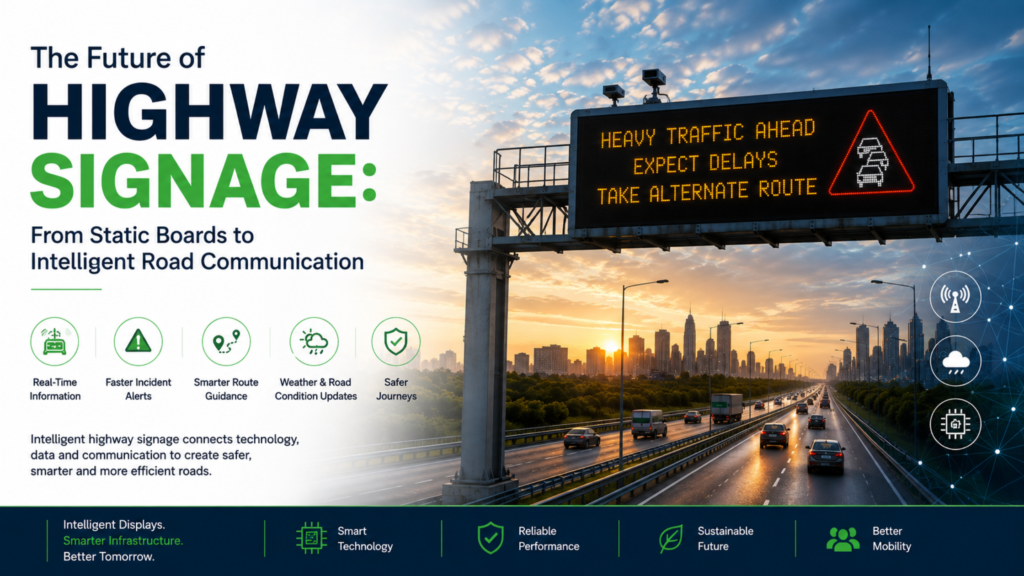
Intelligent highway signage is changing the way information moves between road infrastructure and the people using it.
For decades, highway signage was largely static.
A destination name was printed on a board.
A speed limit remained fixed.
A warning sign communicated a permanent condition.
Drivers received information based primarily on what was physically installed along the road. But modern highways are becoming more connected. Traffic conditions change continuously. Weather can affect visibility. Accidents can create unexpected congestion. Construction can alter lanes. Travel times can vary significantly throughout the day.
A static sign cannot respond to these changes.
Intelligent highway signage can.
Modern highway communication is moving toward systems that can receive information, process it and communicate relevant messages to road users in near real time. This transformation is closely connected to the development of Intelligent Transportation Systems (ITS), where technology, communications, traffic monitoring and infrastructure work together to improve how transportation networks operate.
For Vulcan AIC, this transformation represents an important part of what we build.
Our work across Variable Message Signs (VMS), highway displays, traffic systems, tunnel signage and intelligent infrastructure reflects a broader shift in transportation:
Roads are no longer just physical infrastructure.
They are becoming information infrastructure.
From Static Signs to Intelligent Highway Signage
Imagine driving on a highway ten years ago.
You might see a sign saying: DELHI → 80 KM
That information is useful. But what happens if there is an accident 20 kilometres ahead?
The sign cannot tell you.
What happens if a lane is temporarily closed?
The sign cannot change.
What happens if severe weather affects the road?
The static board remains exactly the same.
Now imagine the same highway equipped with intelligent highway signage.
A Variable Message Sign could communicate:
ACCIDENT AHEAD
USE CAUTION
Or:
LANE CLOSED
KEEP RIGHT
Or:
HEAVY TRAFFIC AHEAD
EXPECT DELAYS
The difference is significant. The sign has moved from simply identifying the road to communicating with road users. This is one of the most important changes taking place in highway infrastructure.
What Is Intelligent Highway Signage?
Intelligent highway signage refers to digital and connected road signage systems capable of displaying changing information based on current traffic, road or operational conditions.
These systems can include:
- Variable Message Signs
- Dynamic Message Signs
- Overhead Lane Signals
- Vehicle Actuated Speed Displays
- Tunnel information displays
- Highway LED displays
- Traffic information boards
- Connected roadside displays
The technology behind the display is only one part of the system.
The bigger picture involves: Data → Processing → Decision → Communication → Driver Response
For example:
A traffic monitoring system identifies congestion.
↓
The traffic management system processes the information.
↓
An operator or automated system determines an appropriate message.
↓
The information is sent to a roadside display.
↓
The driver receives the information before reaching the affected area.
That is the fundamental concept behind intelligent highway signage.
FHWA describes dynamic message signs as programmable systems used to provide current information to travellers, including traffic conditions, incidents and route information.
Why Highway Communication Is Changing
Modern road networks are becoming more complex.
Urban populations are growing.
Highways are carrying more vehicles.
Travel patterns are changing.
Expressways are becoming longer and more technologically integrated.
At the same time, road users expect information faster than ever. People are accustomed to real-time information on their smartphones.
They can see:
- Traffic
- Estimated arrival times
- Road closures
- Alternative routes
- Weather
- Delays
The expectation is increasingly moving from personal devices to infrastructure itself. Why should a driver have to discover a road disruption only after reaching it? This is where intelligent highway signage becomes valuable.
The highway can become another source of real-time information.
1. Intelligent Highway Signage for Real-Time Traffic Information
Traffic conditions are rarely static. A highway that is moving smoothly at 10:00 AM can experience congestion thirty minutes later.
Intelligent displays can communicate information such as:
TRAVEL TIME
CITY CENTRE – 32 MIN
or:
HEAVY CONGESTION
NEXT 10 KM
This information gives drivers additional context before they reach a difficult section.
FHWA notes that displaying travel-time information on dynamic message signs can help travellers plan routes and can contribute to congestion management.
For road operators, this creates another channel for communicating what is happening on the network.
For drivers, it creates better awareness.
And that is an important distinction.
The purpose of intelligent highway signage is not simply to display more information. It is to display useful information at the right point in the journey.
2. Faster Incident Communication
Road incidents can develop quickly.
An accident.
A stalled vehicle.
A sudden obstruction.
A lane closure.
A security situation.
A major event.
Without effective communication, drivers may discover the problem only when they reach it. By then, their ability to respond may be limited. Intelligent highway signage can help communicate relevant warnings upstream.
For example:
INCIDENT AHEAD
SLOW DOWN
or:
ACCIDENT 5 KM AHEAD
EXPECT DELAYS
or:
LEFT LANE CLOSED
MERGE RIGHT
FHWA identifies dynamic message signs as useful for providing information about unusual conditions, diversion guidance and advance warnings.
This is where highway displays become more than information boards.
They become part of the incident communication layer of the road network.
3. Smarter Route Guidance
One of the biggest advantages of intelligent highway signage is the ability to communicate route-related information. Suppose a major highway experiences congestion. A road operator may want to encourage drivers to consider an alternative route. Instead of relying entirely on navigation applications, road infrastructure can provide information directly to drivers.
For example:
CONGESTION AHEAD
ALTERNATE ROUTE →
EXPECT 25 MIN DELAY
The objective is not necessarily to tell every driver exactly where to go.
It is to provide enough relevant information for better decisions.
NHAI’s own documentation describes VMS as systems intended to provide road and traffic-condition information and notes that information during congestion can help commuters decide whether to take a detour or make another travel decision.
This is a powerful example of how intelligent highway signage can support the relationship between infrastructure and road users.
4. Weather and Road Condition Updates
Road conditions can change because of weather.
Heavy rain.
Fog.
Strong winds.
Flooding.
Poor visibility.
Extreme temperatures.
In these situations, information can be critical.
A highway display may communicate:
FOG AHEAD
REDUCE SPEED
or:
HEAVY RAIN
DRIVE CAREFULLY
or:
WATERLOGGING AHEAD
USE CAUTION
The value of this information depends heavily on timing. A warning displayed too late may not provide enough time for the driver to respond.
This is why intelligent highway signage must be considered as part of the road’s overall information architecture.
It is not just about having a screen.
It is about where the screen is placed, what it displays and when it displays it.
5. Work-Zone and Lane Communication
Road construction is a normal part of infrastructure development. But construction can introduce temporary changes to traffic movement. A lane that normally carries traffic may be closed.
Traffic may be diverted.
A temporary speed restriction may apply.
An exit may become unavailable.
Static signage can communicate some of these conditions.
But digital signage offers greater flexibility.
A Variable Message Sign can be updated as work progresses.
For example:
ROAD WORK AHEAD
5 KM
Later:
LEFT LANE CLOSED
MERGE RIGHT
And after the work is completed, the message can be removed.
FHWA guidance specifically identifies dynamic message signs as useful for communicating work-zone information, traffic delays and safety messages.
This flexibility makes intelligent highway signage particularly useful in environments where road conditions are temporary or changing.
6. Intelligent Highway Signage and Safer Driving Decisions
Good road communication is ultimately about helping people make better decisions.
A driver does not have time to read a paragraph while travelling at highway speed.
Messages need to be:
- Clear
- Short
- Relevant
- Visible
- Timely
- Easy to understand
This is why message design is as important as display technology. A technically advanced display can still be ineffective if the message is poorly designed.
FHWA research and guidance on changeable-message signs emphasises the importance of effective message design and appropriate information for road users.
For intelligent highway signage, communication quality is therefore a combination of:
Hardware + Software + Data + Message Design + Placement
All five matter.
7. Connecting Highways With Traffic Management Centres
The biggest transformation occurs when roadside displays become connected to a central traffic management system.
A modern highway can include multiple technologies working together:
- Traffic cameras
- Vehicle detection
- Speed detection
- ANPR
- Weather monitoring
- Traffic counting
- Travel-time estimation
- Variable Message Signs
- Traffic Management Centres
Information from these systems can be processed centrally. The resulting information can then be communicated through roadside displays.
FHWA describes DMS systems as including the sign, controller and communication architecture, with software capable of communicating with signs from a central location such as a Traffic Management Center.
This is what makes the word “intelligent” meaningful.
The display itself is only one part.
The intelligence comes from the system surrounding it.
The Role of Variable Message Signs
Variable Message Signs, commonly known as VMS, are one of the most visible forms of intelligent highway signage. Unlike a conventional road sign, a VMS can display different messages according to operational requirements.
Typical information can include:
- Traffic conditions
- Travel times
- Incidents
- Detours
- Lane restrictions
- Road closures
- Safety messages
- Weather warnings
- Work-zone information
NHAI technical documentation describes VMS as LED displays intended to provide road and traffic-condition information to commuters.
This makes VMS a critical interface between highway management systems and road users.
Beyond the Traditional VMS
The future of intelligent highway signage is not limited to traditional VMS. Road infrastructure is becoming more diverse. Different environments require different visual communication systems.
For example:
Highway VMS
Communicates traffic and road information.
Overhead Lane Signals
Communicate lane status and traffic movement information.
Vehicle Actuated Speed Displays
Provide real-time speed feedback.
Tunnel Displays
Communicate information within enclosed road environments.
Toll Displays
Provide operational and lane-related information.
Highway LED Displays
Support larger-format information requirements.
Together, these technologies create a broader visual communication network.
This is where the transition from “road signs” to “intelligent road communication” becomes clear.
What Makes Highway Signage Intelligent?
A digital display does not automatically make a highway intelligent.
There are several layers involved.
1. Data
The system needs relevant information.
This can come from traffic sensors, cameras, weather systems, incident reports and other infrastructure.
2. Processing
Raw data needs to become useful information.
For example:
Vehicle count increases → congestion detected
3. Decision Making
The system or operator determines what action or message is appropriate.
4. Communication
The information is transmitted to the relevant roadside display.
5. Visualisation
The message must be displayed clearly.
6. Driver Interaction
The ultimate objective is for the road user to understand the information and respond appropriately.
That complete chain is what makes intelligent highway signage meaningful.
The Technology Behind Intelligent Highway Signage
Modern highway displays depend on more than LED modules.
A complete system may include:
- LED display modules
- Controllers
- Communication interfaces
- Power systems
- Monitoring systems
- Enclosures
- Structural support
- Remote management
- Environmental protection
- Centralised software
For highway deployment, durability is also important. Displays operate outdoors.
They face:
- Heat
- Rain
- Dust
- Wind
- Vibration
- Temperature variations
- Long operating hours
This makes engineering and environmental protection critical parts of highway display design.
NHAI specifications for VMS include requirements around environmental protection and standards such as EN 12966 and IP-rated protection for relevant components.
The lesson is simple:
Highway displays need to be designed for the road, not simply adapted to it.
Intelligent Highway Signage and Smart Cities
The evolution of highway communication is closely connected with the development of smart cities. A smart city is not simply a city with more technology. It is a city where infrastructure can communicate, respond and adapt more effectively.
Roads are a major part of that ecosystem.
Imagine a connected urban transportation network where:
Cameras detect traffic.
↓
Sensors measure movement.
↓
Traffic systems analyse conditions.
↓
A Traffic Management Centre receives the information.
↓
Intelligent highway signage communicates relevant instructions.
↓
Drivers respond.
↓
Traffic conditions change.
↓
The system updates again.
This creates a feedback loop.
The road network becomes more responsive.
India’s Shift Toward Intelligent Road Infrastructure
India’s highway infrastructure is undergoing significant technological development. Advanced Traffic Management Systems are being incorporated into highway projects to support functions including traffic monitoring, incident detection, speed detection, travel-time measurement and Variable Message Signs.
NHAI documentation for ATMS projects lists systems including traffic monitoring cameras, video incident detection, VMS, vehicle-speed detection and traffic management centres.
This reflects a broader direction: Highway infrastructure is becoming increasingly data-driven.
As India’s expressway and highway network expands, communication infrastructure will become increasingly important.
A road can be physically excellent.
But if road users do not receive the right information at the right time, the infrastructure cannot operate at its full potential.
How Vulcan AIC Contributes to Intelligent Highway Infrastructure
At Vulcan AIC, intelligent display technology is at the centre of our work.
Our experience spans applications including:
- Smart VMS
- Highway displays
- Overhead Lane Signals
- Vehicle Actuated Speed Displays
- Tunnel displays
- Toll displays
- Traffic signal systems
- HD LED displays
- Intelligent traffic infrastructure
Our perspective is therefore broader than simply manufacturing LED display hardware. We look at how visual information becomes part of the transportation environment.
A highway display has a specific job.
It needs to communicate information clearly.
It needs to operate reliably.
It needs to integrate with the larger infrastructure.
And it needs to be designed around the people using the road. That application-first approach is what drives our work in intelligent highway signage.
Designing the Right Message for the Road
One of the most overlooked aspects of intelligent highway signage is message design.
A driver has only a limited amount of time to interpret information.
A message such as:
ACCIDENT AHEAD
SLOW DOWN
may be more useful than a long explanation.
Similarly:
LEFT LANE CLOSED
MERGE RIGHT
communicates an action immediately.
Good road messaging should answer a simple question: What does the driver need to know right now?
This is why display engineering and communication design need to work together. The best hardware cannot compensate for poor information.
The Future of Intelligent Highway Signage
The next stage of intelligent highway signage will likely involve deeper integration between roadside infrastructure and connected transportation systems.
Future highway environments may increasingly connect:
- Roadside displays
- Traffic cameras
- Vehicle detection
- AI-based analytics
- Connected vehicles
- Navigation platforms
- Weather systems
- Traffic Management Centres
- Emergency response systems
This could create more contextual communication. Instead of displaying only: TRAFFIC AHEAD
a connected system could potentially provide more useful information based on real-time conditions:
12 MIN DELAY AHEAD
ALTERNATE ROUTE AVAILABLE
The important development is not simply larger displays.
It is better information.
From Information Boards to Intelligent Road Communication
The transformation of highway signage represents a much larger shift in infrastructure thinking. Static signs communicate fixed information. Digital displays communicate changing information. Connected intelligent displays can become part of a larger transportation information system.
That is the journey from:
Static Signage
to
Digital Signage
to
Dynamic Message Signs
to
Connected Intelligent Highway Signage
to
Intelligent Road Communication
Each stage makes the road more responsive. And ultimately, the goal is not technology for technology’s sake. The goal is a transportation environment where road users receive meaningful information when they need it.
Why Intelligent Highway Signage Matters for the Future
Consider the highway of the future.
A driver enters an expressway. Traffic conditions are being monitored continuously. A system detects congestion ahead.
The information is processed.
The appropriate message is sent to a roadside display.
The driver sees:
CONGESTION AHEAD
EXPECT 18 MIN DELAY
The driver can make a decision. A few kilometres later, conditions change. The system updates. The message changes. This is a highway that communicates. And that is the real promise of intelligent highway signage. It transforms the road from a passive structure into an active information environment.
Conclusion
The future of highway signage is not about replacing every static road sign with a digital screen. It is about understanding where dynamic information can create genuine value. Static signage will continue to have an important role.
But where road conditions change frequently, where incidents need to be communicated quickly and where traffic management depends on real-time information, intelligent displays can become an essential part of the infrastructure. Intelligent highway signage brings together display technology, data, communication systems, traffic management and human decision-making.
For Vulcan AIC, this evolution represents the direction in which intelligent infrastructure is moving.
From VMS to traffic systems.
From highway displays to connected infrastructure.
From information boards to intelligent road communication.
The highway of tomorrow will not simply carry vehicles.
It will communicate with them.
And the displays along the road will be an important part of that conversation.

