
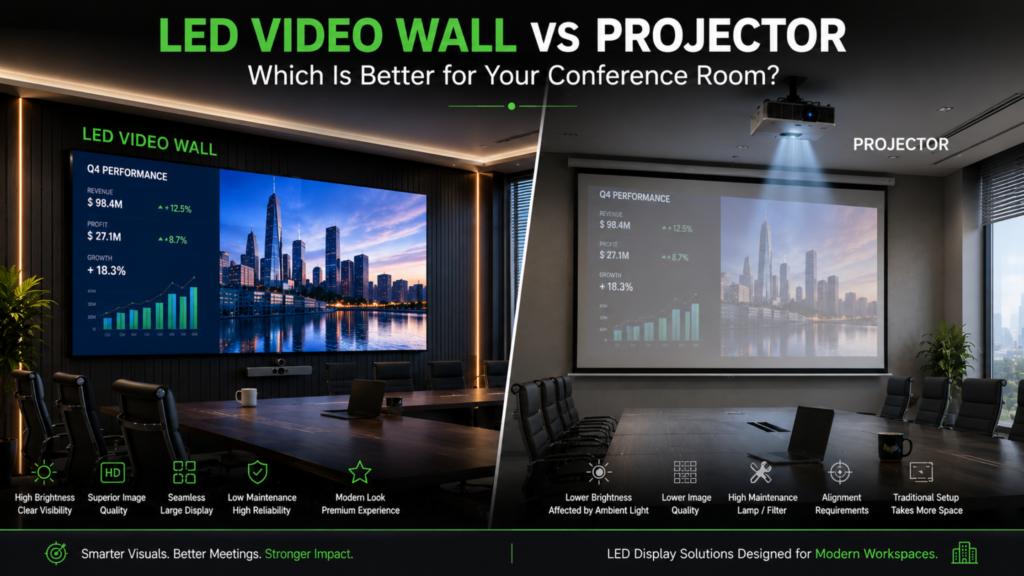
LED video wall vs projector is becoming an important question for businesses designing modern conference rooms, boardrooms, training spaces and corporate meeting environments. A conference room is no longer just a room with a table, chairs and a screen.
Today’s corporate spaces are expected to support in-person meetings, hybrid collaboration, presentations, video conferencing, training sessions, product demonstrations and executive communication.
That makes the visual display one of the most important elements in the room.
For years, projectors were the obvious choice for large-format presentations. They offered the ability to create very large images without requiring a huge physical display. But commercial LED technology has changed the conversation. Today, businesses can choose between a traditional projection setup and a direct-view LED video wall designed specifically for professional environments.
So, when comparing an LED video wall vs projector, which one makes more sense?
The answer depends on the room, viewing distance, content, lighting, budget and intended use.
However, for businesses looking for a premium, high-impact and flexible visual communication environment, LED video walls can offer several advantages. For Vulcan AIC, this comparison is particularly relevant as commercial LED displays become an increasingly important part of our display solutions portfolio.
Our approach is not simply about manufacturing a screen.
It is about understanding how display technology fits into the environment where it is being used — whether that environment is a corporate boardroom, training room, retail space, airport, educational institution or large commercial facility.
Why the LED Video Wall vs Projector Debate Matters
Choosing a display technology is not simply a matter of selecting the biggest screen available. A conference room is an environment where people need to see, understand, discuss and respond to information.
If a presentation is difficult to see, the meeting becomes less effective.
If small text becomes unclear, participants may struggle to follow the discussion.
If the room has significant ambient light, projected content can lose visual impact.
And if the technology requires complicated setup every time a meeting begins, it can become a source of frustration. This is why the LED video wall vs projector decision should be based on the actual requirements of the room. AVIXA’s conference-room guidance also highlights the importance of sightlines, lighting, content sharing and display quality when designing modern collaboration spaces.
The right display should therefore be evaluated as part of the complete meeting environment.
What Is an LED Video Wall?
An LED video wall is a large-format display made by combining multiple LED modules or cabinets into one seamless visual surface. Unlike a projector, an LED video wall generates its own light.
There is no separate projection screen.
There is no projector mounted at the back of the room.
There is no projected image travelling through the room before reaching the viewing surface.
Instead, the LED modules themselves create the image. This allows businesses to create large displays in different shapes and sizes depending on the application. For example, a conference room may use a wide-format LED video wall for presentations and video conferencing.
A larger boardroom may use a high-resolution fine-pitch LED wall.
A corporate auditorium may require a significantly larger display.
This modular approach gives commercial LED technology considerable flexibility.
How Does a Projector Work?
A projector creates an image by projecting light onto a separate surface, usually a dedicated projection screen or wall. The projector must be positioned at an appropriate distance from the screen. This distance is commonly referred to as the throw distance. The room therefore needs to accommodate both the screen and the projector.
Projectors can still be an effective solution, particularly where extremely large images are required or where the room has been designed specifically around projection.
However, the performance of projection can be influenced by factors such as:
- Ambient light
- Projector brightness
- Throw distance
- Screen quality
- Room layout
- Lens selection
- Maintenance
AVIXA’s setup guidance notes that projector placement and throw distance are important considerations when installing projection systems.
LED Video Wall vs Projector: The Key Differences
| Factor | LED Video Wall | Projector |
|---|---|---|
| Brightness | High and consistent | Depends on projector and room lighting |
| Image source | Direct-view LED | Projected image |
| Screen required | No separate screen | Yes |
| Ambient light | Generally performs well | Can reduce perceived image quality |
| Maintenance | Modular maintenance | Projector/lens/filter or system maintenance |
| Installation | Wall-mounted/modular | Requires projector + screen positioning |
| Large formats | Highly scalable | Highly scalable |
| Visual impact | Premium, seamless appearance | Traditional presentation setup |
| Space requirement | Primarily wall space | Screen + projector space |
| Content flexibility | Excellent | Excellent |
| Corporate aesthetics | Modern | Traditional/projection-oriented |
The best choice depends on the application.
But for many modern corporate environments, LED video walls are becoming increasingly attractive.
1. LED Video Wall vs Projector: Brightness and Visibility
One of the biggest differences between an LED video wall and a projector is how they produce light.
An LED video wall is a direct-view display. Each LED module produces light directly towards the viewer. This means the display can maintain strong visual impact even when the room has ambient lighting.
Conference rooms often have windows, glass walls and overhead lighting. That can create challenges for projection. A projector may need the room lighting to be controlled to achieve the best image quality.
This is not always practical.
A modern boardroom may need to remain bright enough for people to take notes, interact with colleagues and participate in video calls.
An LED video wall can therefore be useful when businesses want high visibility without turning the conference room into a dark presentation theatre.
2. LED Video Wall vs Projector: Image Quality and Clarity
Content displayed in conference rooms is becoming increasingly detailed.
A presentation may include:
- Financial dashboards
- Product designs
- Engineering drawings
- Data visualisations
- Spreadsheets
- Video content
- Remote participants
- Small text
- High-resolution images
Clarity matters.
An LED video wall provides a direct-view image with no projection surface between the viewer and the image source. Fine-pitch LED technology can be designed for closer viewing distances, making it particularly relevant for corporate meeting spaces. This is one reason direct-view LED is increasingly appearing in boardrooms and collaboration environments.
AVIXA’s recent conference-room guidance identifies LED video walls as an option for high-impact, large-space applications and notes the importance of display quality in supporting effective communication.
3. LED Video Wall vs Projector: Creating a Large Visual Experience
Projectors have traditionally been strong when it comes to large images. That remains one of their advantages. However, LED video walls have changed what businesses can expect from large-format displays.
Because LED walls are modular, manufacturers and integrators can create different sizes and aspect ratios.
This makes them suitable for:
- Executive boardrooms
- Large conference rooms
- Corporate auditoriums
- Training centres
- Experience centres
- Command rooms
- Hospitality venues
A large LED wall can become a visual focal point of the room. It can display a presentation during a meeting, video participants during a hybrid call and branded content when the room is not being used.
That versatility is increasingly valuable in modern corporate environments.
4. LED Video Wall vs Projector: Maintenance and Reliability
Maintenance is another important factor in the LED video wall vs projector comparison.
A projector-based setup includes several components that need to work together:
- Projector
- Lens
- Projection surface
- Mounting system
- Cabling
- Signal equipment
Depending on the projector technology, maintenance requirements may also include filters or other service considerations. LED video walls are modular systems. If a specific module requires service, the system can be designed so that individual components can be accessed and replaced without necessarily replacing the entire display.
This makes serviceability an important consideration for businesses planning long-term commercial display installations. For a corporate environment where meeting rooms may be used every day, reliability and ease of service can matter just as much as image quality.
5. LED Video Wall vs Projector: Installation and Space
Space is often overlooked when selecting conference room technology. A projector requires appropriate positioning. The projector must have enough throw distance to create the desired image size. That can influence ceiling design, room layout and sightlines.
An LED video wall, on the other hand, is primarily installed on the wall itself.
This can create a cleaner visual environment.
There is no projector occupying ceiling space.
There is no projection beam passing through the room.
And there is no need to reserve a large area behind participants for projector placement. For modern corporate interiors where aesthetics matter, this can be an important advantage.
6. LED Video Wall vs Projector for Collaboration
Today’s meetings are increasingly visual.
Teams may switch between: PowerPoint → Teams → dashboards → videos → spreadsheets → product designs
The display needs to handle these different types of content effectively. LED video walls can support this kind of content-rich environment.
A corporate display system can also be integrated with:
- Video conferencing
- Wireless presentation
- HDMI/DisplayPort sources
- Collaboration platforms
- Room control systems
- Digital signage
- Content management systems
This allows the display to become part of the room’s broader technology ecosystem. The objective is not simply to show a presentation. It is to create an environment where people can communicate and collaborate more naturally.
7. LED Video Wall vs Projector: Professional Aesthetics
A conference room also communicates something about the organisation.
Boardrooms are often used for:
- Client meetings
- Investor presentations
- Leadership meetings
- Training
- Product demonstrations
- Partner discussions
The technology becomes part of the room’s visual identity. A seamless LED video wall can provide a clean, contemporary appearance. When integrated correctly into the architecture, it can look less like a piece of equipment and more like a part of the room itself.
This is particularly relevant for companies designing premium corporate offices.
LED Video Wall vs Projector for Different Conference Rooms
There is no universal answer.
Different rooms require different display strategies.
Small Meeting Rooms
For smaller rooms, a conventional professional display may be more appropriate than either a large LED wall or projector.
AVIXA’s guidance for small conference rooms notes that wall-mounted displays can often be preferable to traditional projector/screen setups in space-constrained environments.
Medium Conference Rooms
For medium-sized rooms, the choice depends on viewing distance, room lighting and required screen size. An LED video wall can make sense when the organization wants a premium, high-impact display.
Large Boardrooms
Large executive rooms can benefit from the scale and visual clarity of a fine-pitch LED video wall.
Training Rooms
Training environments often need large, clear visuals that remain visible from different seating positions. LED can be particularly useful where the room has significant ambient light.
Corporate Auditoriums
For large corporate spaces, both high-end projection and LED video walls can be considered. The choice should be based on viewing distance, screen size, content and room design.
When a Projector Still Makes Sense
A balanced comparison should recognize that projectors are not obsolete. There are situations where projection remains a practical solution.
A projector may make sense when:
- Extremely large image sizes are required
- The room can control ambient light
- A projection setup already exists
- The application is occasional rather than continuous
- Budget constraints favour projection
- The architecture is already designed around projection
- A specific projection format is required
The goal is not to claim that LED technology is always better.
The goal is to choose the technology that best fits the application.
That is also how commercial display decisions should be approached at Vulcan AIC.
How Vulcan AIC Approaches Commercial LED Displays
For Vulcan AIC, the LED video wall vs projector discussion is part of a much larger shift happening in the commercial display industry. Vulcan AIC has experience developing intelligent display solutions for demanding environments, including highway and infrastructure applications.
Our broader display portfolio includes solutions across areas such as:
- Variable Message Signs
- Highway displays
- Tunnel displays
- Toll displays
- Traffic-related displays
- HD LED displays
- Commercial LED displays
- Video walls
This experience has shaped an important principle:
A display should be designed around its application.
A highway VMS has completely different requirements from a corporate boardroom.
An airport passenger-information display has different requirements from a retail video wall.
A corporate conference room requires a different visual experience again.
But the fundamental question remains the same: What does the user need the display to do?
From LED Screen to Commercial Visual Infrastructure
This is where Vulcan AIC’s commercial display strategy goes beyond the traditional concept of an LED screen manufacturer. A corporate LED video wall can become part of a larger visual infrastructure. It can connect with the company’s communication ecosystem.
For example, a boardroom display may be used for:
9:00 AM – Leadership Meeting
11:00 AM – Client Presentation
2:00 PM – Product Review
4:00 PM – Hybrid Team Meeting
The same display can support different experiences throughout the day.
This makes commercial LED technology more than a static installation.
It becomes an active visual communication platform.
What Businesses Should Consider Before Choosing
Before making an LED video wall vs projector decision, businesses should ask several practical questions.
1. How large does the image need to be?
Screen size should be based on viewing distance and room dimensions.
2. How much ambient light does the room have?
If the room has large windows or bright lighting, display visibility becomes important.
3. What content will be displayed?
Small text, spreadsheets and detailed graphics may have different requirements from basic presentations.
4. How frequently will the system be used?
Daily corporate use can justify a different investment than occasional presentations.
5. What is the room’s design?
Consider ceiling height, wall space, sightlines and overall aesthetics.
6. Will the display support hybrid meetings?
Modern conference rooms increasingly need to accommodate remote participants.
7. How will maintenance be handled?
Think beyond installation.
Consider long-term serviceability and support.
8. What is the expected lifecycle?
The right solution should be evaluated as a long-term infrastructure investment rather than only an initial purchase.
The Future of Corporate Conference Rooms
The modern conference room is becoming increasingly connected.
Displays are working alongside:
- Video conferencing
- Wireless presentation
- AI-powered meeting tools
- Cameras
- Smart microphones
- Room booking systems
- Digital collaboration platforms
- Centralised room control
This means the display is becoming one component of a larger collaboration environment.
AVIXA’s current conference-room guidance reflects this broader approach, with emphasis on lighting, acoustics, room layout, remote participation, content sharing and technology integration-not simply the display device itself.
The future conference room will therefore be less about a projector or television sitting at the front of the room.
It will be about creating a connected visual environment.
LED Video Wall vs Projector: Which Is Better?
So, after comparing the two technologies, which one should a business choose? There is no universal answer. A projector can still be a strong option for certain large-format applications and environments designed around projection.
But for organisations looking for:
- High brightness
- Strong visual clarity
- Premium aesthetics
- Large-format digital communication
- Flexible content
- Seamless visual experiences
- Long-term commercial display infrastructure
an LED video wall can be a compelling option.
The decision should ultimately be based on the room, content, users and intended experience.
Why This Matters for Vulcan AIC
The growth of commercial LED technology is creating a broader opportunity for companies that understand both display engineering and real-world applications.
At Vulcan AIC, our experience across intelligent displays and infrastructure provides a foundation for approaching commercial visual environments with an application-first mindset.
From roads and tunnels to corporate environments, the requirement is different—but the purpose remains connected:
Make information visible.
Make communication clearer.
Make technology work within the environment.
That is the direction in which commercial display technology is moving.
And for businesses designing the next generation of conference rooms, the question may no longer simply be:
“LED video wall or projector?”
It may be:
“What visual environment will help our people communicate better?”
That is a much more useful question.
Conclusion
The LED video wall vs projector debate is ultimately about more than two display technologies. It is about how businesses want people to experience information. Projectors remain useful in the right environment.
But LED video walls offer a combination of brightness, clarity, scalability, modern aesthetics and continuous visual performance that makes them increasingly relevant to corporate conference rooms.
For businesses investing in premium meeting spaces, boardrooms, training centres and corporate collaboration environments, the display should be considered part of the overall room design-not an afterthought.
And as commercial display technology continues to evolve, the opportunity extends beyond simply putting an LED screen on a wall.
It is about creating purpose-built visual infrastructure for the way people work, communicate and collaborate.
That is where Vulcan AIC sees the future of commercial LED displays.
Not just bigger screens.
Better visual experiences.
Smarter commercial spaces.

