
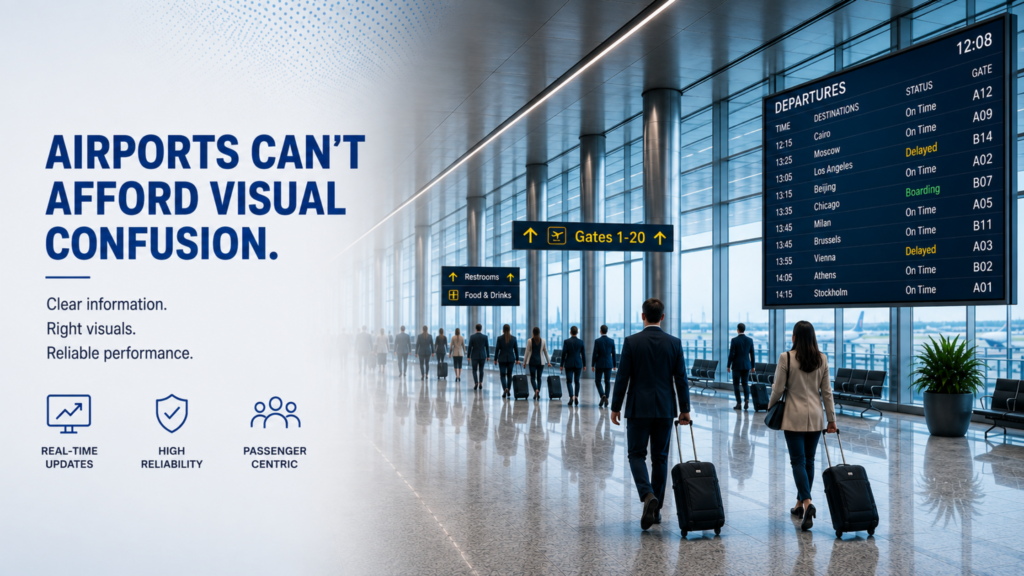
Airport passenger communication has become increasingly important as airports handle larger passenger volumes, more complex terminal layouts and constantly changing flight information.
For a passenger, an airport can be overwhelming.
There are check-in counters, security checkpoints, boarding gates, baggage claim areas, lounges, retail spaces, parking zones and multiple terminal sections to navigate. At the same time, passengers need to keep track of flight schedules, gate changes, boarding announcements, delays and other important information.
This is where LED displays can play an important role.
Modern airport display systems are no longer simply large digital screens placed around a terminal. When planned as part of a broader visual communication infrastructure, they can help airports deliver information at the right location, at the right time and in a format passengers can quickly understand.
For airports, this means better information delivery.
For passengers, it can mean less confusion and a smoother journey.
And for technology providers, it represents a shift from simply manufacturing LED screens to developing commercial visual infrastructure designed around real-world environments and user experiences.
This article explores how LED displays can improve airport passenger communication and why they are becoming an important part of modern airport environments.
What Is Airport Passenger Communication?
Airport passenger communication refers to the systems, technologies and communication methods airports use to provide passengers with relevant information throughout their journey.
This information can include:
- Flight arrival and departure information
- Boarding announcements
- Gate changes
- Baggage information
- Terminal directions
- Security instructions
- Emergency announcements
- Airport services
- Transportation information
- Parking information
- Public announcements
- Operational updates
Traditionally, airports relied heavily on printed signs, static boards and public-address announcements.
While these methods continue to have their place, modern airports require communication systems that can respond quickly to changing circumstances.
A flight can be delayed.
A boarding gate can change.
A baggage carousel can be reassigned.
A terminal route can temporarily close.
An emergency instruction may need to reach thousands of passengers within minutes.
Digital display infrastructure provides airports with a flexible way to communicate these changes visually.
Why Communication Matters in Airports
Airports are highly dynamic environments. Unlike many commercial buildings, airport conditions can change continuously throughout the day. Hundreds or thousands of passengers may be moving through the same space while following different journeys.
One passenger may be looking for a boarding gate.
Another may be searching for baggage claim.
Someone else may need directions to a lounge or airport exit.
This creates a major communication challenge.
Information must be: Visible. Relevant. Timely. Easy to understand.
A passenger should not have to stop repeatedly to figure out where to go next.
Effective airport passenger communication can therefore contribute to:
- Reduced passenger confusion
- Better wayfinding
- Faster information delivery
- Improved operational communication
- Better passenger experience
- More efficient use of terminal spaces
LED displays can support these requirements by creating flexible visual communication points throughout the airport.
10 Ways LED Displays Improve Airport Passenger Communication
1. Real-Time Flight Information
One of the most important applications of digital displays in airports is flight information.
Passengers regularly need to know:
- Departure times
- Arrival times
- Flight numbers
- Gate numbers
- Boarding status
- Delays
- Cancellations
- Terminal information
A digital display can update this information as airport operations change.
Instead of replacing printed material every time information changes, digital systems can update the content electronically. This is particularly useful in high-traffic areas such as departure halls and boarding zones.
The key advantage is not simply that the screen is digital. It is the ability to deliver changing information dynamically.
2. Better Wayfinding
Finding your way through a large airport can be challenging, particularly for first-time passengers. Large terminals can include multiple floors, gates, corridors, security areas and connecting facilities.
LED displays can support wayfinding by displaying clear directional information.
For example:
Gates →
Security Check →
Baggage Claim ←
Terminal 2 →
Airport Exit ↓
When combined with appropriate symbols, arrows and multilingual information, digital displays can make navigation easier. Strategically positioned displays can act as visual checkpoints throughout the passenger journey.
Rather than relying on one large information point, airports can create a network of communication touchpoints.
3. Gate and Boarding Communication
Gate areas are among the most information-sensitive locations in an airport. Passengers need to know when boarding begins, whether the gate has changed and whether the flight is ready for boarding. LED displays positioned around boarding areas can reinforce this information visually.
For example, displays can communicate:
BOARDING
FINAL CALL
GATE CHANGED
BOARDING CLOSED
This becomes particularly valuable when information changes quickly. Visual communication can also complement public announcements. Instead of passengers depending entirely on audio announcements, important information can be presented simultaneously on screens.
This creates a more accessible communication environment.
4. Baggage Claim Information
The passenger journey does not end when the aircraft lands. Baggage collection is another important communication stage. Passengers need to know which carousel is assigned to their flight and whether their baggage is available.
Digital displays in baggage claim areas can communicate:
- Flight number
- Arrival information
- Carousel number
- Baggage status
- Directional information
- Service announcements
This can help reduce uncertainty in busy baggage halls. For airports handling multiple flights simultaneously, dynamically updated information can be especially useful.
5. Emergency and Safety Communication
Airport communication is not limited to normal operations. There can be situations where passengers need immediate instructions.
For example:
- Emergency procedures
- Evacuation directions
- Security instructions
- Temporary access restrictions
- Severe weather information
- Operational disruptions
Digital displays can become an additional communication channel during such situations. Instead of displaying normal promotional or informational content, a network of displays can be used to communicate urgent instructions.
This highlights an important aspect of commercial visual infrastructure: A display can serve different communication purposes depending on what the environment requires.
For airports, flexibility can be just as important as screen size or brightness.
6. Multilingual Communication
International airports serve passengers from different regions and countries.
Language can therefore become an important part of passenger communication.
Digital displays can support multiple languages depending on the airport’s requirements.
Information may be presented through:
- English
- Hindi
- Regional languages
- International languages
- Universal symbols
For example, a directional message can combine text with universally recognisable icons.
This can help make airport information more accessible to international travellers.
Multilingual communication also demonstrates why airport display systems should be designed as communication platforms, rather than simply screens.
7. Supporting Accessibility
Passenger communication should be designed for diverse users.
Some passengers may have difficulty hearing public announcements.
Others may have difficulty reading small text from a distance.
Digital displays can complement other communication systems by providing visual information that passengers can reference independently.
Clear typography, appropriate viewing distances, sufficient brightness and well-designed content can all contribute to accessibility.
The objective should not simply be to make a display brighter.
It should be to make the information easier to perceive.
8. Reducing Information Overload
More information does not necessarily mean better communication.
Airports contain enormous amounts of information.
If everything is displayed simultaneously, passengers may struggle to identify what is important.
Modern display networks therefore need thoughtful content design.
A good airport display should prioritise information based on passenger needs.
For example:
Primary information
FLIGHT 6E 204 — GATE 18 — BOARDING
Secondary information
Boarding begins at 10:20 AM.
Supporting information
Security screening → 5 min walk
This hierarchy makes the information easier to scan.
LED technology provides the visual platform, but effective content strategy and information design determine how useful that platform becomes.
9. Creating a Consistent Passenger Journey
Airports often contain many different communication systems.
There may be flight information displays, directional signs, advertising screens, information kiosks and public announcements.
Without consistency, the passenger experience can feel fragmented.
A well-planned digital display network can help create a consistent visual language throughout the airport.
For example, the same:
- Typography
- Icons
- Colour conventions
- Information hierarchy
- Screen layouts
- Directional symbols
can be used across different areas.
This can make information easier to recognise.
The passenger begins to understand:
“This is where I look for information.”
That familiarity can be valuable in a complex environment.
10. Improving the Overall Passenger Experience
Ultimately, airport passenger communication is about more than information.
It is about experience.
A passenger who knows where to go, when to board and where to collect baggage is likely to feel more confident than someone constantly searching for information.
This is particularly important in large airports.
Technology can help remove some of the friction from the passenger journey.
LED displays can contribute by making important information:
Visible. Dynamic. Timely. Contextual.
And that is where commercial visual infrastructure becomes more than a hardware requirement.
It becomes part of the passenger experience.
Where Can LED Displays Be Used in an Airport?
LED displays can support communication across multiple airport environments.
Terminal Entrances
Large displays can welcome passengers and provide high-level information about terminals, services and directions.
Check-In Areas
Screens can provide operational information, queue guidance and airline-related communication.
Security Areas
Displays can communicate instructions, directions and important passenger reminders.
Departure Lounges
Flight information and boarding updates can be presented throughout passenger waiting areas.
Boarding Gates
Gate-specific information can be displayed prominently for passengers waiting to board.
Baggage Claim
Digital displays can communicate carousel assignments and arrival information.
Arrival Areas
Screens can provide directions towards exits, transportation, parking and other airport facilities.
Parking Areas
Displays can help communicate parking information and directions.
Retail and Commercial Zones
Large-format LED displays can also contribute to visual experiences within airport retail and hospitality areas.
Why LED Displays Need to Be Designed for Airports
An airport is not the same as a shopping mall, office or showroom.
The display requirements can be significantly different.
Airport environments may involve:
- Long viewing distances
- High ambient lighting
- Continuous operation
- Large passenger volumes
- Strict operational requirements
- Different viewing angles
- Real-time information
- High reliability expectations
This means selecting an LED display should involve more than asking:
“How big should the screen be?”
Other factors need to be considered.
Pixel Pitch
Pixel pitch influences how clearly content can be viewed from different distances.
A display installed in a large terminal hall may have different requirements from one positioned close to a boarding gate.
Choosing the right pixel pitch should therefore be based on:
- Viewing distance
- Screen size
- Content type
- Installation environment
- Passenger movement patterns
Brightness
Airports can have large glass façades and significant natural lighting.
A display needs sufficient brightness to remain visible without compromising the viewing experience.
The right brightness level depends on the installation environment.
Viewing Angle
Passengers rarely stand directly in front of a display.
People may approach from different directions while walking through the terminal.
Wide viewing angles can therefore become important when selecting display technology.
Reliability
Airport displays may operate for long periods every day.
A display failure in an important passenger communication zone can have operational consequences.
Reliability, serviceability and maintenance planning should therefore be part of the system design.
Airport LED Displays as Commercial Visual Infrastructure
The growing role of digital displays in airports demonstrates a broader shift in the commercial display industry.
LED displays are increasingly becoming part of the architecture and operational infrastructure of commercial spaces.
They can serve multiple purposes:
Communication
Providing information passengers need.
Navigation
Helping people understand where to go.
Experience
Creating visually engaging environments.
Branding
Supporting the visual identity of airports, airlines and commercial partners.
Operations
Communicating changing information across large spaces.
This is why the industry is moving beyond the traditional concept of an “LED screen.”
The bigger opportunity lies in designing complete visual communication environments.
Integrating LED Displays With Digital Systems
A display becomes significantly more useful when it can receive and present relevant information.
Airport display systems can be connected with operational and content-management platforms.
Depending on the implementation, this can enable information to be updated across multiple screens.
For example:
A flight gate changes from Gate 12 to Gate 18.
Instead of manually changing physical signage, the updated information can be distributed through the digital display system.
Similarly, multiple screens can be managed from a central platform while displaying different information according to their locations.
This creates a more scalable communication environment.
What Airports Should Consider Before Installing LED Displays
Before selecting a display solution, airport operators and project consultants should consider the complete environment.
1. What information will the display communicate?
Flight information and advertising have very different requirements.
2. Where will passengers view it from?
Viewing distance should influence display specifications.
3. What are the lighting conditions?
Indoor terminal environments can still have significant daylight exposure.
4. How will content be managed?
The display should work with an appropriate content-management workflow.
5. What happens when information changes?
Real-time communication should be considered during system planning.
6. How will the system be maintained?
Accessibility for service and maintenance can influence the installation design.
7. How will the display integrate with the architecture?
The screen should complement the terminal rather than appear disconnected from the surrounding environment.
The Future of Airport Passenger Communication
Airport passenger communication is likely to become increasingly digital, connected and context-aware.
Future airport environments may combine:
- Large-format LED displays
- Interactive kiosks
- Digital wayfinding
- Mobile applications
- AI-powered information systems
- Real-time operational data
- Connected passenger services
- Automated content management
The display itself will remain important, but it will increasingly become one part of a broader digital ecosystem.
Imagine arriving at an airport and receiving information that is relevant to your journey at every stage.
Your terminal.
Your gate.
Your boarding status.
Your baggage carousel.
Your route to the exit.
The technology required to create such experiences involves multiple systems working together.
LED displays can become one of the most visible components of that infrastructure.
Why This Matters for Commercial Display Manufacturers
For companies working in the commercial display sector, airports represent an important example of how display technology is evolving.
The opportunity is no longer limited to producing a high-quality screen.
It is about understanding:
- The environment
- The user
- The information
- The infrastructure
- The application
- The operational requirement
That shift requires closer collaboration between manufacturers, AV integrators, system integrators, consultants, architects and infrastructure developers.
For a company such as Vulcan AIC, this broader approach creates an opportunity to participate in the development of visual communication infrastructure across complex commercial environments.
The objective is not simply to put a screen on a wall.
It is to understand what that screen needs to accomplish within the space.
Conclusion
Airport passenger communication is becoming an increasingly important part of modern airport infrastructure.
Passengers expect information to be available quickly, clearly and consistently throughout their journey.
LED displays can support this requirement by providing dynamic flight information, wayfinding, boarding updates, baggage information, safety communication and commercial experiences.
But the future is not simply about installing larger screens.
It is about creating smarter visual communication infrastructure that works naturally within the environment.
For Vulcan AIC, this is an important part of our evolution from an intelligent display and infrastructure manufacturer into a broader commercial visual infrastructure solutions provider.
Whether the environment is a highway, tunnel, airport, corporate office, retail space or commercial venue, the principle remains the same:
Technology should not simply occupy space.
It should make the space work better.
And that is where the real potential of commercial LED display technology lies.

