
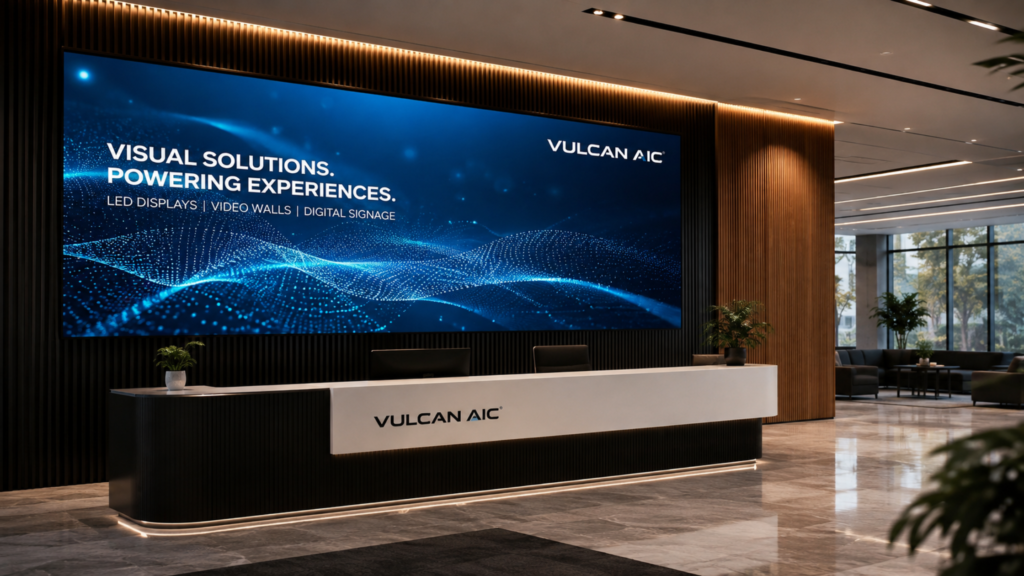
Corporate reception LED displays are changing the way businesses design and experience their front-office spaces. A reception area used to have a relatively simple purpose: welcome visitors, provide directions and create a professional first impression.
Today, that role is expanding. Walk into a modern corporate office and the reception area may include architectural lighting, digital signage, interactive technology, branded environments and large-format displays. The reception is no longer simply the place where visitors wait.
It has become part of the company’s identity.
This is where corporate reception LED displays are becoming increasingly relevant.
A large LED display can turn an otherwise ordinary wall into a dynamic communication surface. It can showcase a company’s brand story, introduce products, communicate achievements, welcome visitors, support events and change the atmosphere of a space throughout the day. But the real opportunity isn’t simply putting an LED screen behind a reception desk.
The display needs to work with the architecture, brand identity, content strategy, visitor journey and practical requirements of the workplace.
For architects, interior designers, AV consultants, system integrators and corporate decision-makers, understanding these factors is essential when planning a modern reception environment.
Why Corporate Reception Areas Are Changing
The modern workplace has changed significantly. Companies increasingly think about their offices as extensions of their brand. The design of a headquarters can communicate how an organisation wants to be perceived.
A technology company may want an innovative and futuristic environment.
A financial organisation may prefer a sophisticated and trustworthy appearance.
A manufacturing company may want to showcase its scale, engineering capabilities and projects.
A creative company may use bold visuals and dynamic environments.
In each case, the reception becomes an important part of the visitor experience.
A logo on a wall can communicate the company’s name.
A well-designed digital display can communicate the company’s story.
That distinction is important.
What Are Corporate Reception LED Displays?
Corporate reception LED displays are direct-view LED display systems designed for reception areas, lobbies and other corporate entrance environments. Unlike conventional televisions, LED displays are built from modular LED panels or cabinets. This allows businesses to create large display surfaces in different sizes and configurations.
Depending on the project, an LED display can be:
- Wall-mounted
- Recessed into an architectural wall
- Freestanding
- Integrated behind a reception desk
- Used as a branded feature wall
- Designed around specific architectural dimensions
The display can show a wide range of content, including:
- Brand videos
- Corporate films
- Product demonstrations
- Company milestones
- Project showcases
- Welcome messages
- Sustainability initiatives
- Employee stories
- Event content
- Digital artwork
- Live information
This flexibility makes LED particularly interesting for modern corporate interiors.
Why Businesses Are Using LED Displays in Reception Areas
The biggest reason isn’t technology for technology’s sake.
It is experience.
A reception area is one of the few parts of an office that almost every visitor experiences.
That could include:
- Customers
- Business partners
- Investors
- Job candidates
- Vendors
- Government representatives
- Employees
- International visitors
The same display can communicate differently to each audience.
A potential customer might see the company’s products.
A candidate might see the organisation’s culture.
A business partner might see major projects.
An investor might see milestones.
The screen becomes a flexible communication layer.
1. Creating a Stronger First Impression
You never get a second chance to make a first impression. This old idea is particularly relevant to corporate spaces.
A visitor walking into a modern headquarters immediately begins forming an opinion about the organisation. The architecture, lighting, reception desk, staff interaction and visual communication all contribute to that perception. A carefully designed LED display can become the visual anchor of the space.
Imagine entering a corporate headquarters and seeing a large, high-resolution display showing: Who We Are
followed by:
What We Build
then:
Where We Are Going
Instead of simply seeing a company logo, visitors immediately receive context.
The technology supports storytelling. However, the display should complement the space rather than overpower it. This is where professional display planning becomes important.
2. Turning Brand Identity Into a Visual Experience
Branding is traditionally associated with:
- Logos
- Colours
- Typography
- Packaging
- Advertising
But in a physical office, branding becomes environmental.
The reception area can become a physical expression of the company’s identity. Corporate reception LED displays allow brands to continuously adapt that environment. For example, a company launching a new product can temporarily transform the reception display into a product showcase.
During a corporate anniversary, the same display can present company milestones.
During a major event, it can become an event backdrop.
During normal working days, it can showcase corporate content.
The physical space stays the same.
The experience changes.
That is one of the strongest advantages of digital displays.
3. Making Reception Areas More Dynamic
Static walls don’t change.
Digital displays can.
This doesn’t mean the screen should constantly show flashy animations.
In fact, excessive motion can make a corporate environment feel distracting.
The better approach is controlled, purposeful content.
For example:
Morning
A subtle corporate welcome visual.
Business Hours
Brand films, company information and project content.
Client Visit
A customised welcome message.
Corporate Event
Event branding and presentation visuals.
Evening
A visually engaging brand animation. The display becomes adaptable without requiring the physical space to be redesigned.
4. Improving Visitor Communication
Reception displays can also provide useful information.
Instead of relying entirely on printed signs, businesses can use digital content to communicate:
- Visitor instructions
- Meeting information
- Event schedules
- Wayfinding
- Safety messages
- Corporate announcements
- Building information
For large corporate campuses, this can become particularly useful.
A visitor attending a conference could see: Welcome to the Annual Leadership Summit
followed by:
Registration → Conference Hall → Level 2
After the event, the same display can return to regular corporate branding.
This makes the display both aesthetic and functional.
5. Supporting Corporate Events and Presentations
A reception LED wall doesn’t necessarily have to remain a reception display. It can become part of the company’s event infrastructure.
During:
- Product launches
- Press conferences
- Annual meetings
- Leadership events
- Town halls
- Award ceremonies
- Investor meetings
the display can become a large-format visual backdrop.
This can eliminate the need for separate temporary visual setups in certain environments. A properly designed installation can therefore serve multiple purposes throughout the year. This is especially useful for organizations that frequently host events at their own headquarters.
6. Making Better Use of Large Wall Spaces
Corporate reception areas often contain large blank surfaces.
Traditional design may fill these spaces with:
- Logos
- Metal lettering
- Artwork
- Printed graphics
- Photographs
These can look excellent, but they remain static.
An LED display creates another possibility. Instead of decorating the wall once, businesses can make the wall programmable. The same physical area can communicate different messages throughout the year. This can be especially powerful in large headquarters where the reception wall is visible from a considerable distance.
7. Creating a Future-Ready Corporate Environment
The workplace is becoming increasingly digital.
Meetings now involve remote participants.
Companies operate across multiple locations.
Corporate events often involve live content.
Employee communication is becoming more digital.
Data is increasingly visual.
A reception display can become part of this larger digital workplace ecosystem.
It can connect with:
- Content management systems
- Media players
- Presentation systems
- Corporate networks
- Event systems
- Video sources
- Digital signage platforms
This makes the display more than a decorative feature. It becomes part of the company’s communication infrastructure.
Where Should an LED Display Be Installed?
The ideal position depends on the architecture.
Common options include:
Behind the Reception Desk
This is probably the most recognizable configuration. The display becomes the visual background behind the reception team.
Opposite the Entrance
This creates an immediate visual impact as visitors enter.
Feature Wall
The LED display can become part of a larger architectural feature.
Waiting Area
The display can provide brand content or information while visitors wait.
Corridor or Transition Area
Large offices can use displays to guide visitors between spaces. The important thing is to consider the visitor’s natural line of sight. A technically excellent screen placed in the wrong location can have limited impact.
Choosing the Right Pixel Pitch
Pixel pitch is one of the most important technical specifications for corporate reception LED displays. It refers to the distance between individual LED pixels. A smaller pixel pitch generally provides greater pixel density and supports sharper images at closer viewing distances. This matters because reception areas often have visitors standing relatively close to the screen. Fine-pitch LED solutions may therefore be appropriate for premium corporate lobbies.
But smaller is not automatically better.
The right pixel pitch depends on:
- Viewing distance
- Screen dimensions
- Content
- Room size
- Camera usage
- Budget
- Required visual detail
An experienced manufacturer or AV consultant should calculate the appropriate specification rather than simply recommending the smallest available pitch.
Brightness and Viewing Comfort
Reception areas are usually indoor environments. However, indoor does not automatically mean dark.
Modern offices can contain:
- Large glass windows
- Skylights
- Strong architectural lighting
- Spotlights
- Bright reception lighting
The LED display therefore needs appropriate brightness.
Too little brightness can make content appear dull.
Too much brightness can create glare and make the environment uncomfortable.
The objective should be balanced visibility.
The display should remain clear without dominating the room unnecessarily.
Content Matters as Much as the Display
A beautiful LED display can still look poor if the content is badly designed. This is an important point for businesses investing in commercial displays.
Content should be created specifically for the display’s:
- Resolution
- Aspect ratio
- Viewing distance
- Screen dimensions
- Brightness
- Environment
Large text and simple visual hierarchy often work better than trying to put too much information on one screen. A reception display should not look like a PowerPoint slide. It should feel like part of the architecture.
Good content might include:
A powerful image
↓
A short message
↓
A subtle brand element
↓
A clear transition
The goal is not to fill every pixel. The goal is to create an experience.
LED Display vs Traditional Reception Signage
Traditional signage still has value. A physical logo can be elegant, timeless and low-maintenance. However, it cannot change.
An LED display provides much greater content flexibility.
| Feature | LED Display | Static Signage |
|---|---|---|
| Dynamic content | Yes | No |
| Video | Yes | No |
| Brand storytelling | High | Limited |
| Content updates | Easy | Requires redesign |
| Event branding | Excellent | Limited |
| Long-term flexibility | High | Low |
| Visual impact | High | Depends on design |
The best solution may even combine both. For example, a physical company logo could sit beside or above a large LED display. This can create a premium architectural balance between permanent branding and dynamic content.
LED Display vs LCD Video Wall
LCD video walls are another common option for corporate environments. An LCD video wall uses multiple LCD panels assembled into a larger display. LED technology uses LED modules or cabinets to create the visual surface.
The appropriate choice depends on the project.
| Consideration | LED | LCD |
|---|---|---|
| Large seamless surface | Excellent | Bezel lines possible |
| Custom dimensions | Highly flexible | More limited |
| Brightness | High | Generally lower |
| Large-scale installations | Excellent | Suitable |
| Close viewing | Fine-pitch options available | Excellent |
| Maintenance | Modular | Panel-based |
| Architectural integration | Highly flexible | More standardized |
For a large feature wall where seamless visual continuity is important, LED can be particularly attractive.
What Businesses Should Consider Before Installation
Before choosing corporate reception LED displays, businesses should evaluate more than the display specification.
1. Architecture
Will the display complement the interior design?
2. Viewing Distance
How close will visitors stand?
3. Ambient Light
How much natural and artificial light reaches the screen?
4. Content
What will the display actually show?
5. Screen Size
How large does the display need to be?
6. Pixel Pitch
What level of detail is appropriate?
7. Maintenance
How will components be accessed?
8. Power
What electrical infrastructure is required?
9. Processing
What sources will feed content to the display?
10. Future Requirements
Could the display later be used for events, presentations or live feeds? Answering these questions early can prevent expensive changes later.
How Vulcan AIC Approaches Commercial LED Displays
A commercial display should be treated as an engineered system rather than simply a collection of LED modules. At Vulcan AIC, commercial LED display solutions are part of a broader display and intelligent infrastructure capability.
The company works across LED display technologies and develops solutions for different professional environments, including indoor videowalls, HD LED displays and digital LED display applications. Vulcan AIC commercial display solutions
For a corporate reception project, the requirements can extend from the LED modules themselves to:
- Cabinet engineering
- Power systems
- Display processing
- Mounting
- Thermal considerations
- Content integration
- Installation
- Serviceability
This becomes particularly important when the display needs to fit a specific architectural design. A corporate reception is not a generic environment. Every building has its own dimensions, lighting, materials, viewing angles and brand requirements.
The display therefore needs to be considered as part of the overall environment.
The Role of Architects and Interior Designers
Architects and interior designers increasingly have an opportunity to integrate display technology into the original design rather than adding it later.
This can produce a much cleaner result.
Instead of asking: “Where can we fit a screen?”
the better question is: “How should the display become part of the space?”
This approach can lead to:
- Recessed displays
- Architectural feature walls
- Integrated reception backgrounds
- Curved configurations
- Custom screen dimensions
- Combined physical and digital branding
For large corporate projects, collaboration between the architect, interior designer, AV consultant, system integrator and LED manufacturer can significantly improve the final outcome.
Why Commercial Display Manufacturing Matters
The commercial LED display market contains many standard products. However, corporate environments don’t always follow standard dimensions.
A reception wall may have:
- An unusual width
- A specific ceiling height
- Columns
- Curved surfaces
- Lighting restrictions
- Limited service access
This is where manufacturing and engineering capability become important.
A manufacturer can work around project-specific requirements rather than forcing the architecture to conform to a standard screen.
For corporate buyers and system integrators, this can provide greater flexibility during project planning.
Corporate Reception LED Displays Are Becoming Part of the Brand
The biggest change isn’t technological.
It’s psychological.
Businesses are increasingly understanding that physical spaces influence how people perceive their organisation.
A visitor doesn’t separate: architecture + lighting + furniture + signage + display
into individual components.
They experience the environment as one thing.
That means a poorly integrated LED display can hurt an otherwise premium office.
But a carefully designed display can become one of the strongest visual elements in the space. The difference comes from design, engineering and content working together.
Conclusion
Corporate reception LED displays are changing the traditional idea of what a reception area can be.
The reception desk remains important.
The people welcoming visitors remain important.
But the surrounding environment now has a much bigger role to play.
A well-designed LED display can:
- Strengthen first impressions
- Communicate the brand
- Showcase products
- Welcome visitors
- Share company information
- Support events
- Transform blank walls
- Create flexible digital environments
However, the goal should never be to install a screen simply because LED technology is popular. The better approach is to begin with the experience.
What should a visitor feel?
What should they understand about the company?
What should the space be capable of doing?
Once those questions are answered, the right display technology becomes much easier to choose. For architects, consultants, AV integrators and corporate decision-makers, the opportunity is bigger than replacing static signage. It is about turning corporate spaces into living visual environments.
And as workplaces continue to evolve, the reception area may become one of the most important places where digital technology and corporate identity meet.
Frequently Asked Questions
Are LED displays suitable for corporate reception areas?
Yes. Indoor LED displays can be used in reception areas to showcase branding, videos, corporate communication, visitor information and event content.
What pixel pitch is best for a reception LED display?
There is no single ideal pixel pitch. It depends on viewing distance, display size, content and room conditions. Fine-pitch LED is often considered for close-viewing corporate environments.
Can an LED reception display show videos?
Yes. Commercial LED displays can show videos, images, animations, presentations and other digital content when paired with appropriate processing and content systems.
Are LED displays better than static reception signage?
LED provides significantly more flexibility because content can change without physically replacing the signage. However, static signage can still be valuable as part of a combined architectural design.
Can corporate LED displays be customized?
Yes. Depending on the technology and manufacturer, commercial LED displays can be configured for different dimensions, pixel pitches, cabinet formats and installation requirements.
How should an LED display be integrated into a reception?
The display should be planned alongside the architecture, lighting, reception desk, viewing distance and content strategy. Early collaboration between designers, AV professionals and the display manufacturer can produce a more integrated result.
Commercial LED Displays by Vulcan AIC
At Vulcan AIC, we see commercial LED displays as more than visual hardware. They are becoming an important part of how modern businesses communicate, present their identity and create experiences within physical spaces.
Our commercial LED display solutions are designed for environments such as corporate offices, reception areas, boardrooms, retail spaces, malls, hotels, airports, educational institutions, experience centres and other commercial environments.
From display engineering and cabinet design to installation and system integration, every project needs to be considered according to its environment, viewing distance, content requirements and architectural context.
For a corporate reception, that could mean a high-resolution LED feature wall that introduces visitors to the brand.
For a boardroom, it could mean a fine-pitch display designed for presentations and collaboration.
For a retail or experience centre, the same technology can become an immersive visual communication surface.
The objective isn’t simply to put a screen on a wall.
It’s to make the display work naturally with the space, the content and the people experiencing it.
That is the approach Vulcan AIC is bringing to the commercial LED display segment.
Engineered for the space.
Designed for the experience.
Built for commercial environments.

