
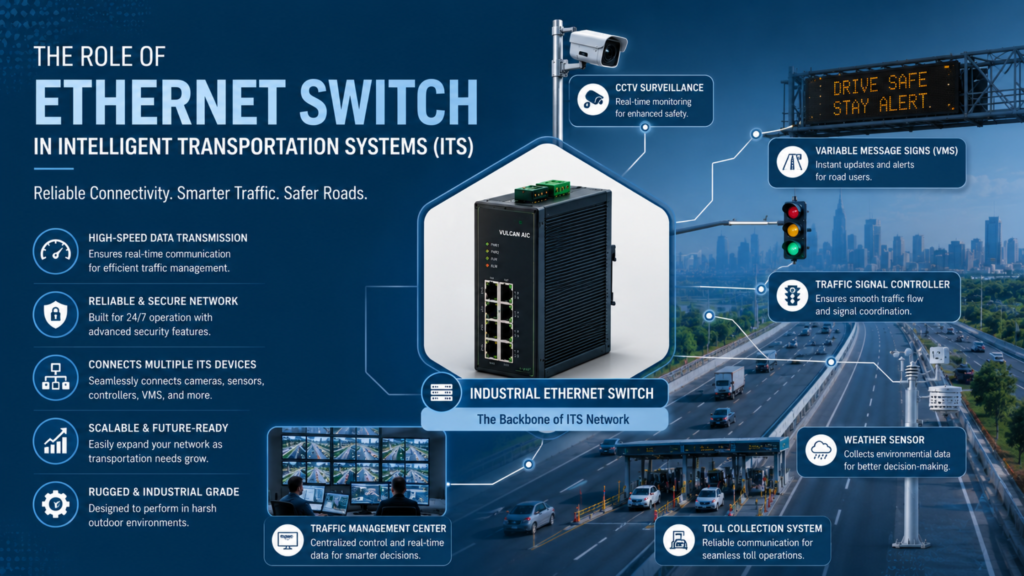
Modern cities are becoming smarter every day, and transportation systems are evolving to keep pace. From real-time traffic monitoring to connected highways and smart intersections, Intelligent Transportation Systems (ITS) rely on seamless communication between multiple devices. At the heart of this communication lies the Ethernet Switch, a critical networking component that ensures fast, secure, and reliable data transmission.
Whether it’s connecting Variable Message Signs (VMS), traffic controllers, surveillance cameras, weather sensors, or toll systems, an Ethernet Switch enables uninterrupted communication across the transportation network. Without it, modern traffic management would struggle to deliver the efficiency and safety that today’s cities demand.
In this article, we’ll explore the importance of an Ethernet Switch in ITS, its benefits, applications, and why industrial-grade switches are essential for intelligent infrastructure.
What is an Ethernet Switch?
An Ethernet Switch is a networking device that connects multiple devices within a Local Area Network (LAN). Unlike a traditional hub that broadcasts data to every connected device, an Ethernet Switch intelligently identifies the destination device and forwards data only where it is needed.
This intelligent traffic management improves network efficiency, reduces congestion, and ensures faster communication.
Industrial Ethernet Switches are specifically designed for harsh environments such as highways, tunnels, transportation control centers, and outdoor infrastructure, where reliability is essential.
Why this Matter in ITS
An Intelligent Transportation System consists of hundreds or even thousands of interconnected devices spread across large geographical areas.
These include:
- Traffic Signal Controllers
- Variable Message Signs (VMS)
- CCTV Cameras
- Speed Detection Systems
- Automatic Number Plate Recognition (ANPR)
- Weather Monitoring Stations
- Emergency Communication Systems
- Toll Collection Systems
An Ethernet Switch acts as the communication backbone that connects all these devices into one intelligent network.
Without reliable switching technology, real-time traffic monitoring and automated traffic control become difficult to achieve.
10 Powerful Benefits of Ethernet Switch in ITS
1. High-Speed Data Transmission
An Ethernet Switch supports Gigabit and even 10 Gigabit communication, enabling quick transmission of traffic data, HD surveillance footage, and emergency alerts.
Fast communication allows traffic management centers to make real-time decisions.
2. Reliable Network Communication
ITS networks operate 24/7. Industrial network Switches provide stable communication with minimal downtime, ensuring uninterrupted operation even in demanding environments.
3. Easy Device Connectivity
Modern transportation infrastructure includes hundreds of network devices.
allows seamless integration of:
- LED Displays
- Traffic Lights
- CCTV Cameras
- Sensors
- Control Cabinets
- Network Video Recorders
This centralized connectivity simplifies infrastructure management.
4. Enhanced Network Security
Cybersecurity is becoming increasingly important in transportation.
Industrial support:
- VLAN
- Access Control Lists
- Port Security
- MAC Address Filtering
- Network Authentication
These features protect transportation networks against unauthorized access.
5. Scalability for Future Expansion
Cities continuously expand their transportation infrastructure.
Network Switch makes it easy to add:
- New intersections
- Additional cameras
- Smart parking systems
- Road weather stations
- AI traffic analytics
without redesigning the existing network.
6. Low Network Latency
Traffic management relies on immediate responses.
An industrial network Switch minimizes communication delays between field devices and control centers, improving emergency response and reducing congestion.
7. Rugged Industrial Performance
Transportation equipment is exposed to:
- Dust
- Heat
- Rain
- Vibrations
- Electrical Noise
Industrial network Switches are built to withstand these harsh conditions while maintaining reliable performance.
8. Power over Ethernet (PoE) Support
Many modern Ethernet Switches provide Power over Ethernet (PoE), allowing devices like IP cameras and wireless access points to receive both power and data through a single cable.
This reduces installation costs and simplifies deployment.
9. Network Redundancy
Transportation systems cannot afford communication failures.
Industrial network Switches support redundancy protocols such as:
- Rapid Spanning Tree Protocol (RSTP)
- Media Redundancy Protocol (MRP)
- Ring Network Protection
These technologies ensure continuous communication even if one network path fails.
10. Cost-Effective Network Management
Although industrial Ethernet Switches have a higher initial cost than consumer-grade devices, they significantly reduce maintenance expenses through:
- Longer lifespan
- Lower downtime
- Simplified troubleshooting
- Remote monitoring capabilities
This leads to a lower total cost of ownership.
Applications of Ethernet Switch in Intelligent Transportation Systems
Common applications include:
Smart Highways
Connecting Variable Message Signs, traffic sensors, and emergency communication systems.
Traffic Management Centers
Enabling real-time communication between field devices and centralized software.
Tunnel Monitoring Systems
Supporting surveillance cameras, ventilation control, and emergency response systems.
Toll Collection Systems
Providing secure communication between toll booths, payment servers, and monitoring equipment.
Railway Infrastructure
Connecting signaling equipment, surveillance systems, and passenger information displays.
Smart City Projects
Integrating traffic management with IoT-based urban infrastructure.
Features to Look for in an Industrial Ethernet Switch
Essential features:
- Gigabit Ethernet Ports
- Managed Switching Capability
- Layer 2 or Layer 3 Support
- Power over Ethernet (PoE)
- Wide Operating Temperature Range
- IP-rated Rugged Design
- Redundant Power Inputs
- DIN Rail Mounting
- Network Monitoring Support (SNMP)
- Fast Recovery Protocols
These features ensure long-term reliability in mission-critical transportation applications.
Future of Ethernet Switch in Smart Mobility
As cities embrace AI, IoT, and connected transportation, the role of the Ethernet Switch will continue to grow. Emerging technologies such as autonomous vehicles, edge computing, and Vehicle-to-Infrastructure (V2I) communication require ultra-fast, secure, and reliable networking.
Future industrial Ethernet Switches will support higher bandwidth, advanced cybersecurity, predictive maintenance, and intelligent traffic analytics, making them an essential component of next-generation transportation networks.
Conclusion
Switch is much more than a networking device—it is the backbone of Intelligent Transportation Systems. From enabling real-time communication and reducing network latency to supporting secure and scalable infrastructure, it plays a vital role in creating safer, smarter, and more efficient roads.
As transportation networks continue to evolve, investing in high-quality industrial Ethernet Switches will help ensure reliable performance, easier maintenance, and future-ready connectivity. For organizations developing intelligent mobility solutions, choosing the right Ethernet Switch is a key step toward building resilient and connected transportation infrastructure.
Frequently Asked Questions
What is an Ethernet Switch?
Switch is a networking device that connects multiple devices and intelligently forwards data to the correct destination, improving network performance and efficiency.
Why is an Ethernet Switch important in ITS?
An Ethernet Switch enables reliable communication between traffic signals, surveillance cameras, Variable Message Signs, sensors, and control centers, ensuring smooth operation of Intelligent Transportation Systems.
What is the difference between a managed and unmanaged Ethernet Switch?
A managed Ethernet Switch offers advanced features such as VLANs, network monitoring, security, and redundancy, while an unmanaged switch provides basic plug-and-play connectivity.
Can Ethernet Switches operate outdoors?
Yes. Industrial Ethernet Switches are specifically designed to withstand harsh outdoor conditions, including extreme temperatures, dust, vibration, and moisture.
Which devices connect through an Ethernet Switch in ITS?
Common devices include traffic controllers, CCTV cameras, VMS displays, weather sensors, toll systems, network video recorders, and communication gateways.

