
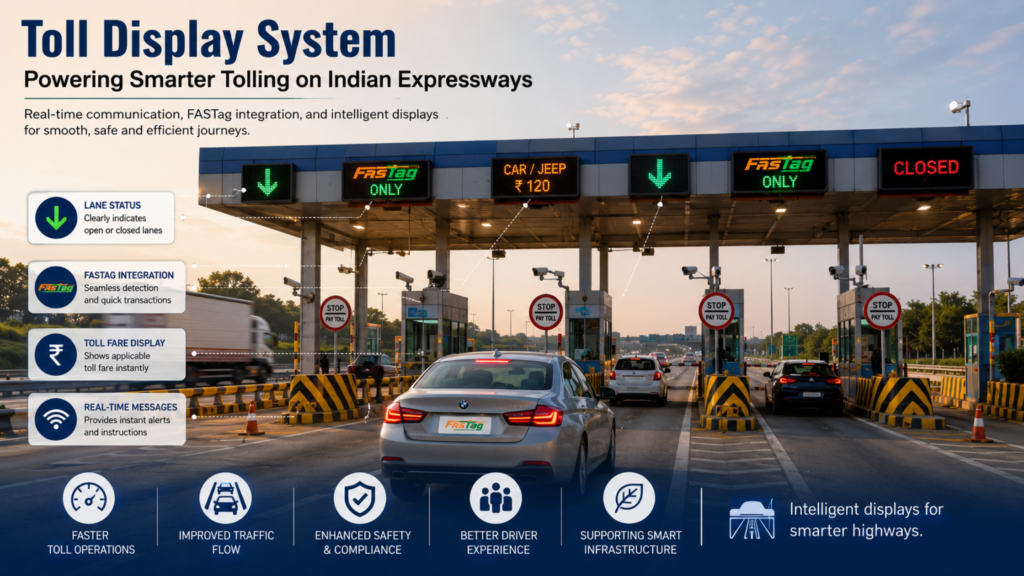
If you travel regularly on highways or expressways in India, you have probably noticed digital display boards installed above toll lanes.
Some show toll fare information.
Some display STOP or GO signals.
Others guide vehicles toward active lanes or FASTag-enabled sections.
Most people see these systems every day but rarely think about how important they actually are.
Behind the smooth movement of vehicles at toll plazas, there is a complete communication and automation system working continuously in real time. One of the most important parts of this infrastructure is the toll display system.
As Indian highways continue becoming smarter and more connected, toll display systems are playing a major role in improving traffic movement, reducing waiting time, and making expressway travel more efficient.
Understanding Toll Display System?
A toll display system is a digital visual communication system installed at toll plazas and expressway lanes to provide real-time information to drivers.
These systems are designed to display:
- Toll fare information
- Lane status
- Vehicle instructions
- FASTag notifications
- STOP/GO indicators
- Emergency alerts
- Transaction messages
The goal of a toll display system is simple:
help drivers understand lane activity quickly and clearly while maintaining smooth vehicle movement.
Modern toll systems rely heavily on instant visual communication because drivers often need to make quick decisions while approaching toll lanes.
Why Toll Display Systems Matter on Indian Expressways
India has one of the world’s largest highway networks, and traffic movement continues increasing every year.
Without proper communication systems, toll plazas can quickly become congested, confusing, and difficult to manage.
This is why toll display systems have become essential for:
- Faster toll operations
- Better traffic control
- Reduced lane confusion
- Improved safety
- Smoother FASTag transactions
- Better driver awareness
Even a few seconds of delay at toll lanes can create long queues during peak traffic hours. Clear visual communication helps reduce these delays significantly.
How toll Display Systems Work
Modern toll display systems operate through a combination of:
- LED display technology
- Lane management systems
- Toll automation software
- FASTag integration
- Vehicle detection systems
These systems are connected to toll management infrastructure and work in real time. When a vehicle approaches a toll lane, the system instantly communicates important information through digital displays.
For example:
- A green signal may indicate an active lane
- A red cross may indicate a closed lane
- Fare displays show toll charges
- FASTag messages confirm successful transactions
All this happens within seconds.
Understanding FASTag Integration
One of the biggest changes in Indian toll infrastructure has been the introduction of FASTag. FASTag is an electronic toll collection system that uses RFID technology to enable automatic toll payments without stopping vehicles.
Today, FASTag integration has become a major part of modern toll display systems.
When a vehicle equipped with FASTag enters a toll lane:
- RFID scanners detect the FASTag sticker
- The system identifies vehicle information
- Toll charges are calculated automatically
- Payment is deducted digitally
- Display systems show transaction status
This process helps vehicles pass through toll plazas much faster compared to traditional manual toll collection.
How Display Systems Support FASTag Operations
FASTag works smoothly only when drivers receive clear instructions while approaching toll lanes. This is where toll display systems become extremely important.
Display systems help by showing:
- FASTag lane indicators
- Payment confirmation
- Balance alerts
- Error notifications
- Lane guidance information
For example:
- “FASTag Accepted”
- “Low Balance”
- “Transaction Successful”
- “Use Alternate Lane”
Without proper visual communication, drivers may enter incorrect lanes or face confusion during transactions.
Hybrid User Fare Displays (HUFD)
Modern toll plazas often use Hybrid User Fare Displays (HUFD) for lane communication.
These systems combine:
- Toll fare displays
- STOP/GO indicators
- Lane operation signals
HUFD systems help improve both communication and traffic management at toll lanes.
Drivers can instantly understand:
- Which lane is active
- Whether payment was successful
- What amount is charged
- Whether they should stop or proceed
This improves overall operational efficiency.
Benefits of Toll Display Systems
Faster Traffic Movement
One of the biggest advantages is reduced congestion. Drivers receive information instantly, helping lanes move faster and more smoothly.
Better Driver Awareness
Clear digital communication reduces confusion and improves decision-making near toll lanes.
Improved Safety
Lane guidance systems help reduce sudden lane changes and vehicle conflicts near toll plazas.
Real-Time Communication
Toll operators can instantly update messages depending on traffic conditions or emergencies.
Better FASTag Efficiency
Integrated systems help improve automated toll collection and reduce transaction delays.
High Visibility Is Extremely Important
Toll display systems operate in demanding outdoor environments.
Displays must remain visible during:
- Bright sunlight
- Nighttime conditions
- Rain and fog
- High-speed vehicle movement
This is why high-brightness LED technology is widely used in toll communication systems. Drivers must be able to understand messages quickly without distraction or confusion. Visibility directly affects both efficiency and safety.
Smart Expressways Need Intelligent Communication
Indian expressways are gradually evolving into smarter transportation networks.
Modern highway infrastructure now depends heavily on:
- Real-time communication
- Automated traffic systems
- Intelligent lane management
- Connected transportation technology
Toll display systems are becoming a key part of this transformation. As traffic volumes continue growing, future toll infrastructure will become even more automated and data-driven.
Future of Toll Display System Technology in India
The future of toll communication systems will include:
- AI-based traffic monitoring
- Smart lane allocation
- Automated vehicle analytics
- Dynamic toll messaging
- Integrated highway communication systems
These technologies will help create:
- Faster toll movement
- Reduced congestion
- Better safety
- Smarter expressway management
Intelligent display systems will remain at the center of this evolution.
How Vulcan AIC Supports Smart Toll Infrastructure
At Vulcan AIC, we design and manufacture intelligent LED display systems built for modern transportation infrastructure and real-time highway communication.
Our solutions include:
- Hybrid User Fare Displays (HUFD)
- Overhead Lane Signals (OHLS)
- Variable Message Signs (VMS)
- Intelligent Traffic Display Systems
- Smart Highway Communication Solutions
With deployments across 25+ Indian states and international regions like Jamaica and Bangladesh, Vulcan AIC continues contributing to the future of intelligent transportation infrastructure.
Every solution is engineered and manufactured in India while meeting global standards including BIS, EN-12966, CE, and FCC certifications.
Building Smarter Toll Experiences
As Indian expressways continue modernizing, toll plazas are becoming more intelligent, automated, and communication-driven. Toll display systems may seem like small components, but they play a major role in improving how millions of vehicles move every day.
From FASTag integration and lane communication to safety and traffic efficiency, intelligent display systems are helping shape the future of smarter highways in India. Because better roads do not only move vehicles faster – they communicate smarter.

