
If you’ve travelled across India in the last ten years, you’ve felt it. The difference.
- Journeys that once took eight hours now take four.
- Cities that felt distant now feel connected.
- Expressways stretch where dusty two-lane roads once struggled.
India is building – and building fast.
From massive expressway expansion projects to smart cities rising from the ground up, the country is in the middle of one of the largest infrastructure transformations in its history. But here’s something most people don’t talk about. Infrastructure is not just about concrete and steel.
It’s also about communication. And without it, even the best roads fall short of their potential.
The Expressway Era
Drive on a new expressway today, and you immediately notice the scale.
- Wider lanes.
- Controlled access.
- Better lighting.
- Smoother surfaces.
India’s national highway network has expanded significantly over the past decade. New corridors are connecting economic hubs. Freight movement has become faster. Regional access has improved.
But as speed increases, responsibility increases too. On high-speed corridors, reaction time shrinks. The margin for error narrows. Information must travel faster than vehicles. This is where communication infrastructure becomes essential.
An expressway without real-time updates is like a fast car without headlights.
Speed alone is not progress. Informed speed is.
Smart Cities: More Than Smart Buildings
India’s smart city mission often highlights surveillance systems, data analytics, and digital governance. But what makes a city truly “smart” isn’t just data collection – it’s data delivery.
- Traffic congestion updates.
- Weather alerts.
- Public advisories.
- Emergency warnings.
A smart city communicates with its citizens. And it does so clearly, quickly, and reliably.
When communication systems are integrated into urban infrastructure – through digital signboards, traffic displays, and dynamic messaging – cities begin to function more smoothly.
Commuters adjust routes earlier.
Traffic builds less suddenly.
Emergency services respond faster.
Technology becomes invisible – but its impact is visible everywhere.
National Highway Projects: The Silent Communication Layer
National Highway projects are often measured in kilometres built. But behind every new stretch of road lies another critical layer – communication systems.
Modern highways now rely on:
- Variable Message Signs (VMS)
- Speed advisory displays
- Lane control systems
- Incident alert systems
These tools are not decorative. They are decision-making systems.
Imagine a highway accident during peak travel hours. Without communication, vehicles continue at speed until they encounter congestion directly. With communication, drivers are warned kilometers in advance.
Diversions are displayed.
Speed is reduced gradually.
Risk decreases.
Infrastructure growth without communication planning creates bottlenecks. Infrastructure growth with communication creates efficiency.
Growth Is Not Just Physical – It’s Informational
India’s infrastructure growth story is often told through images of bridges, tunnels, and elevated corridors. But growth is also informational. The more connected our highways become, the more interconnected our communication systems must be. A modern highway does not just carry vehicles.
It carries information:
- About weather conditions
- About traffic density
- About safety advisories
- About public awareness campaigns
The future of infrastructure lies in combining physical expansion with intelligent communication. And that shift is already underway.
Why Communication Is Central to Safety
As India’s highway network expands, vehicle volume increases too.
- More vehicles.
- Higher speeds.
- Greater complexity.
Communication systems reduce uncertainty.
- They reduce sudden braking.
- They reduce confusion during diversions.
- They reduce panic during emergencies.
When drivers feel informed, they drive differently. It’s subtle – but powerful.
The Human Side of Infrastructure
We often talk about infrastructure as if it’s mechanical. But roads are human spaces.
- They carry families.
- Truck drivers working long routes.
- Students returning home.
- Emergency vehicles racing against time.
Behind every infrastructure milestone is a human journey. Communication protects those journeys.
- It gives drivers clarity in fog.
- Direction during congestion.
- Awareness during risk.
And that is where infrastructure becomes meaningful.
India’s Opportunity
India is still in the middle of its infrastructure acceleration phase. This is an opportunity. Instead of treating communication as an afterthought, it can be embedded into planning from the beginning.
- Smart highways.
- Digitally integrated cities.
- Responsive traffic corridors.
When communication grows alongside construction, infrastructure becomes future-ready.
Where Vulcan AIC Fits Into This Growth Narrative
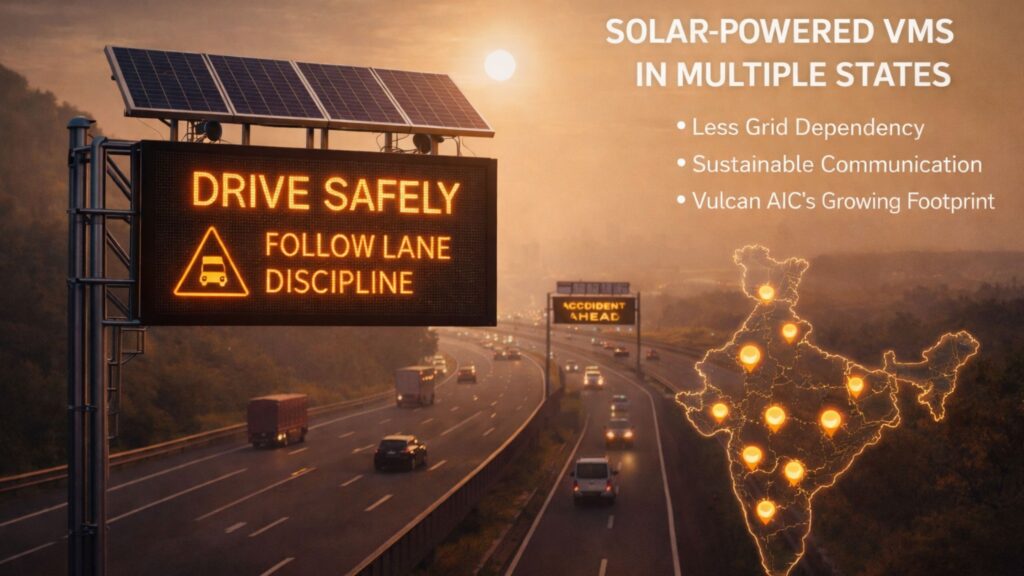
At Vulcan AIC, we see communication as the invisible backbone of India’s infrastructure transformation. Across multiple states, our Variable Message Signs and intelligent display systems support expressways, national highway projects, and urban traffic networks. We focus on delivering real-time clarity – because growth without guidance creates risk.
As India builds faster roads and smarter cities, our role is simple:
- Make sure those roads speak clearly.
- Make sure cities communicate effectively.
- Make sure information reaches before risk does.
Infrastructure connects places. Communication protects journeys. And in India’s growth story, both must move together.

