
For a long time, we believed something quietly but firmly:
- If it’s high-tech, it must consume more power.
- If it’s powerful, it must leave a bigger footprint.
Big machines. Bright lights. Massive highways. Heavy energy usage. Infrastructure and sustainability rarely appeared in the same sentence. But that assumption is slowly changing. Today, the real question isn’t whether infrastructure can be advanced. It’s whether it can be advanced responsibly.
Can highways be smart – and still be green? Can digital systems operate at scale – without draining energy?
Let’s explore that honestly.
The Old Image of Infrastructure
When most people imagine highway infrastructure, they picture:
Concrete flyovers.
Metal gantries.
Bright LED displays glowing all night.
And yes – traditional systems often consumed significant energy.
Large display systems running at full brightness 24/7. No adaptive controls. Limited power optimization. Technology was built for visibility first. Efficiency came later. But modern infrastructure cannot afford that mindset anymore. Energy costs are rising. Climate conversations are growing louder. Public accountability is stronger than ever.
High-tech infrastructure now has to answer a new question: How much energy are you consuming to operate?
Solar-Powered VMS: A Practical Shift
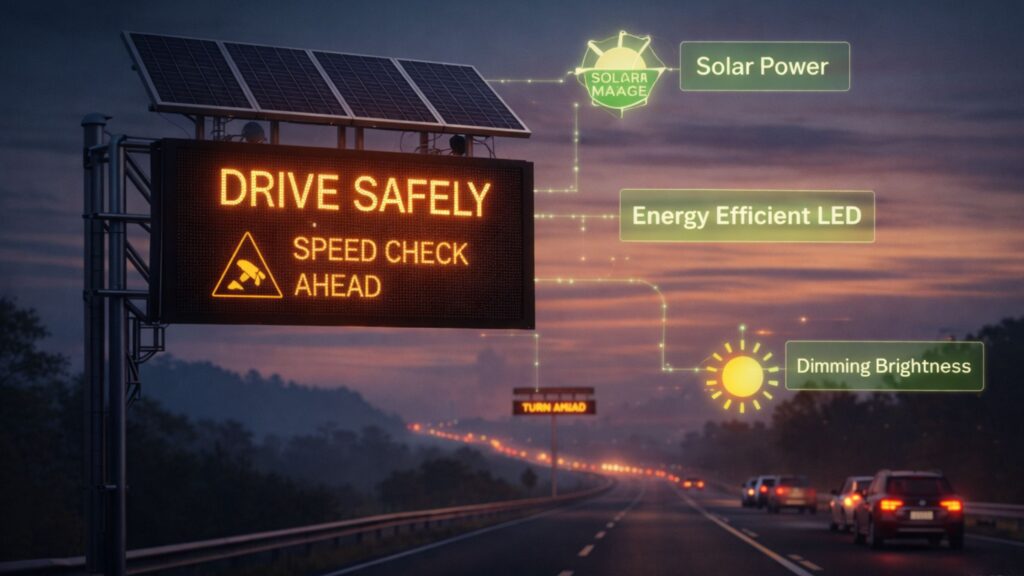
Let’s start with something practical – solar-powered Variable Message Signs (VMS). Instead of relying entirely on grid electricity, solar-powered systems use renewable energy to operate critical highway communication.
During the day, solar panels capture sunlight. Energy is stored efficiently. At night, that stored power supports display operations. It’s not just about “going green” for branding. It’s about resilience.
In remote highway locations where grid power is inconsistent, solar-powered VMS systems offer stability. They reduce dependency. They ensure communication continues even during outages.
And in a country like India – where sunlight is abundant in most regions – ignoring solar potential simply doesn’t make sense.
Energy Efficiency Is No Longer Optional
High-tech displays today are far more energy efficient than they were a decade ago. Modern LED modules consume less power while delivering higher brightness. Heat management systems reduce waste. Smart controllers optimize performance without overloading circuits. Energy efficiency is not just about reducing electricity bills. It’s about reducing long-term environmental impact.
Every watt saved across hundreds of installations adds up. Multiply that across states. Across highways. Across years. Suddenly, efficiency becomes meaningful.
Intelligent Dimming: Small Feature, Big Impact
One of the most underrated innovations in smart highway systems is intelligent dimming technology. It sounds simple. But it changes everything. During bright daylight, displays automatically increase brightness for visibility. At night, when ambient light is low, brightness reduces intelligently.
This does three important things:
- Saves energy
- Extends LED lifespan
- Reduces light pollution
It’s a quiet innovation. Most drivers won’t notice it. But the planet does. When thousands of digital boards reduce output during low-light conditions, the cumulative energy savings become significant. And importantly, visibility is never compromised.
The Balance Between Performance and Responsibility
Here’s the real challenge:
- Highways demand clarity.
- Warnings must be visible in fog.
- Speed advisories must be readable at distance.
- Emergency alerts must stand out immediately.
Safety cannot be sacrificed for sustainability. So the real achievement lies in balance. High-tech infrastructure must deliver maximum visibility with minimum energy waste. It must operate 24/7 – but intelligently. That’s where thoughtful engineering matters.
Is Sustainable Infrastructure More Expensive?
Initially, yes – in some cases. They require investment.
But long term?
- Reduced operational costs.
- Lower maintenance frequency.
- Extended system lifespan.
- Energy savings year after year.
Sustainability is not just environmental responsibility. It’s operational wisdom. Forward-thinking infrastructure planners now understand this. The future is not about building more. It’s about building smarter.
India’s Opportunity
India is expanding highways rapidly. Expressways are connecting regions at unprecedented speed. This growth phase is also an opportunity. Instead of upgrading later, sustainable design can be integrated now. When sustainability becomes part of the foundation, not an afterthought, infrastructure becomes future-ready.
And that’s where real transformation begins.
High-Tech Doesn’t Have to Mean High-Impact
For years, people assumed that advanced infrastructure would automatically increase environmental strain. But today, innovation allows a different path.
Technology can be:
- Bright without being wasteful
- Powerful without being excessive
- Intelligent without being intrusive
High-tech and sustainable are no longer opposites. They’re partners.
Where Vulcan AIC Fits Into This Vision
At Vulcan AIC, this balance between performance and responsibility is central to how we approach infrastructure. Our solar-powered VMS systems are designed to reduce grid dependency while maintaining critical visibility standards. Our intelligent dimming technology ensures displays adapt to ambient conditions – saving energy without compromising safety.
Across installations, we focus on energy efficiency not as a marketing claim, but as an engineering priority. Because smart roads should not only move people faster. They should move the country forward responsibly.
And when high-tech infrastructure supports both safety and sustainability, everyone benefits – drivers, cities, and the environment alike.

