
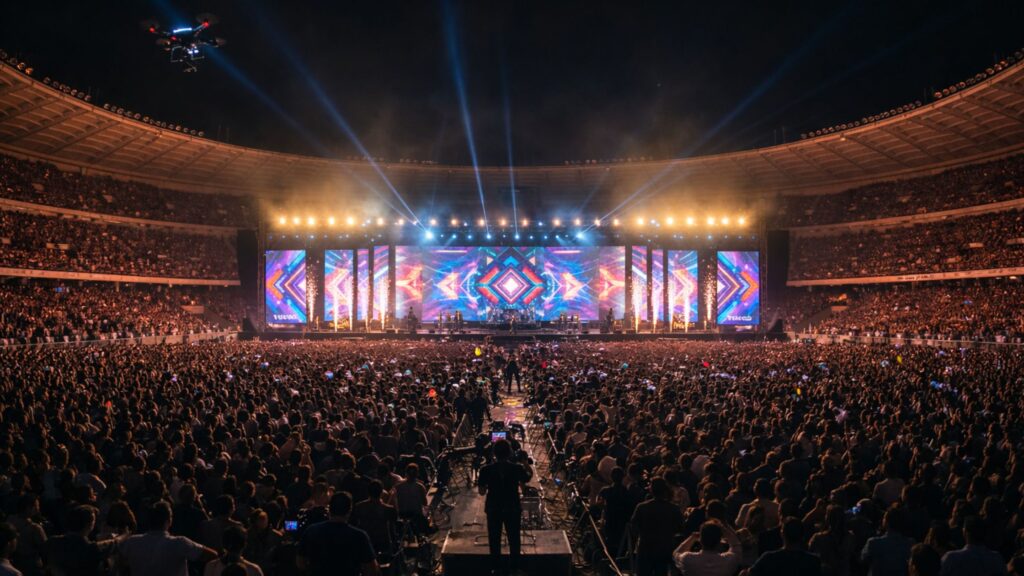
If you’ve ever watched a live concert replay and noticed strange lines moving across the giant LED screen behind the singer, you’ve witnessed something the audience inside the stadium may not have seen – flicker.
To the human eye, the screen looked perfect. To the camera, it didn’t.
In today’s event industry, that difference matters more than ever. Concerts are no longer just live experiences. They are filmed, streamed, clipped for social media, archived for OTT platforms, and replayed across millions of screens.
Which means one thing: If your LED wall fails on camera, the entire production feels compromised. So what actually makes a concert LED screen camera-friendly and flicker-free?
Let’s understand this in simple, practical terms.
First, Why Do LED Screens Flicker on Camera?
LED screens don’t emit light continuously like the sun or a bulb. They refresh rapidly – turning pixels on and off thousands of times per second.
Your eyes blend this into smooth light. But cameras operate differently.
Professional broadcast cameras use high shutter speeds. If the LED screen’s refresh timing doesn’t align with the camera’s capture rate, the result can be:
- Rolling black bars
- Horizontal lines
- Brightness pulsing
- Color distortion
- Frame tearing
In a concert with multiple camera angles, drones, crane shots, and live switching – even minor flicker becomes visible instantly. That’s why concert-grade LED is different from regular advertising LED.
1. High Refresh Rate Is the Foundation
If there’s one technical factor that defines a broadcast-ready LED screen, it’s refresh rate. Concert and stadium LED walls typically require:
- 3,840Hz refresh rate or higher
- Stable driver IC performance
- Smooth grayscale transition
A higher refresh rate ensures that when cameras shoot at fast shutter speeds, the image remains stable and clean. Anything lower increases the risk of banding or flicker – especially during close-ups.
2. Proper LED Driver & Scan Design
Not all LED panels are built the same. Lower-cost panels often use higher scan ratios, which can create uneven illumination timing. This may look fine to spectators, but cameras detect these micro-variations immediately.
Professional event LED systems use:
- Optimized scan configurations
- High-quality driver IC chips
- Precision signal timing
This keeps brightness consistent across the entire wall – even during slow-motion capture.
3. Camera Shutter Synchronization
Concert productions use different types of cameras:
- Broadcast cinema cameras
- Mirrorless rigs
- Steadicams
- Drone cameras
- OB van systems
Each camera may operate at different shutter angles. Advanced LED processing systems allow synchronization with camera shutter speeds. When timing aligns correctly, flicker disappears. Without sync, even the best screen can appear unstable.
This is where backend processing becomes just as important as the LED panels themselves.
4. Balanced Brightness for Stage Lighting
Concert environments are visually intense.
You have:
- Moving head lights
- Laser beams
- Smoke machines
- Pyrotechnics
- Color-changing spotlights
LED walls must remain visible without overpowering the stage. Excessive brightness causes blooming on camera. Insufficient brightness makes the screen look dull.
Camera-friendly LED systems provide:
- Controlled brightness levels
- Uniform light distribution
- Smooth dimming curves
It’s not about being the brightest. It’s about being controllable.
5. Accurate Color Calibration
In live concerts, LED screens often display:
- Live close-ups of artists
- Background visuals
- Brand logos
- Sponsor content
If color calibration is inconsistent, cameras may capture:
- Skin tones that look unnatural
- Reds that oversaturate
- Blacks that look grey
- Color shifts between panels
Professional-grade LED systems use factory calibration and real-time color correction to maintain uniformity across modules. Because once the camera zooms in, there’s nowhere to hide.
6. Seamless Modular Construction
Concert LED walls are built using modular cabinets. If alignment is poor, you may see:
- Visible seams
- Slight brightness variation
- Panel misalignment
From the audience far away, this may not be noticeable. From a 4K broadcast zoom shot, it is obvious. Precision cabinet engineering and proper installation reduce visible panel gaps and ensure a seamless image.
7. Stable Signal Processing Under Load
Concert visuals are dynamic:
- High-motion graphics
- Rapid cuts
- Live switching
- Multi-camera feeds
- Real-time overlays
All of this runs through LED processors. If the processing system cannot handle the bandwidth, you may experience:
- Micro stutters
- Frame drops
- Signal delay
- Sync issues
Broadcast-ready LED systems require robust controllers that maintain stability under extreme load.
8. Outdoor Environmental Stability
In India, many concerts and stadium events are outdoors. That means LED screens face:
- Heat
- Humidity
- Dust
- Power fluctuations
Environmental instability can affect driver performance and brightness consistency. High-performance event LED systems are engineered to maintain output stability even under weather stress. Because live events do not pause for technical resets.
Why This Matters for Event Organizers & Stadium Authorities
A flicker issue is not just technical. It impacts:
- Broadcast quality
- Sponsor perception
- Brand credibility
- Social media visibility
- Audience experience
In high-budget events, production quality reflects directly on organizers. And in today’s digital world, every live event becomes recorded content. Which means LED performance must meet broadcast standards – not just stage standards.
The Evolution of Concert LED Standards
Earlier, LED walls were designed mainly for crowd visibility. Today, they must serve:
- Live audience
- Television broadcast
- OTT streaming
- Digital marketing clips
- High-resolution replay
This shift demands higher engineering standards. Refresh rate, signal timing, calibration, and processing are no longer optional upgrades. They are baseline requirements.
Building Flicker-Free Live Experiences
Across India’s expanding entertainment ecosystem – from music festivals to stadium sports events – LED screens are central to storytelling. But the real magic is not just size. It’s stability. Behind every flawless concert broadcast is a combination of:
- High refresh rate panels
- Precision driver architecture
- Broadcast-ready processors
- Accurate calibration
- Professional installation
Companies that understand these technical nuances quietly shape how live events are experienced – both in the stadium and on screen. Because in modern concerts, the performance doesn’t end at the stage. It lives forever on camera. And camera-friendly LED technology ensures it looks exactly as powerful as it felt in the moment

