
Walk into a metro station in Delhi.
Drive past a highway in Rajasthan.
Visit a mall in Mumbai.
You will see LED screens everywhere – showing ads, announcements, safety alerts, transport schedules, brand campaigns, and live updates.
Now here’s something most people don’t think about: How are 1,000+ screens updated at the same time – in different cities – within seconds?
It’s not manual.
It’s not random.
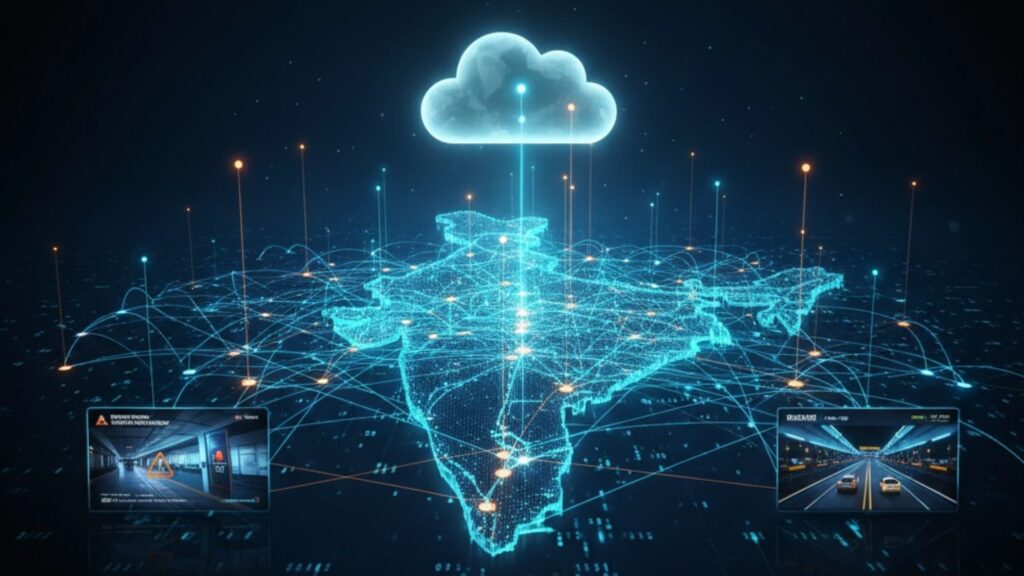
It’s powered by a cloud-based Content Management System (CMS).
Let’s understand how it works – and why it has become essential for large-scale digital display networks in India.
What Is a Cloud-Based CMS for Digital Screens?
A cloud-based CMS is a centralized software platform that allows operators to:
- Upload content
- Schedule campaigns
- Monitor screen health
- Push emergency alerts
- Track performance
All from a single dashboard. Instead of physically visiting each location, teams control every screen remotely using the internet. Whether there are 10 screens or 10,000 screens – the control panel remains one.
That’s the power of cloud architecture.
The Real Challenge: Managing Screens at Scale
Managing a few screens inside one building is easy.
But managing:
- 1,000+ outdoor billboards
- Metro display networks
- Airport screens
- Mall video walls
- Highway VMS boards
… across multiple states? That requires serious backend coordination.
Without cloud CMS, the problems multiply:
- Delayed content updates
- Inconsistent messaging
- Manual errors
- No visibility into screen status
- High operational costs
Scale demands automation.
1. Instant Content Deployment Across Locations
Imagine a brand launching a nationwide campaign at 10:00 AM. With cloud CMS:
- The creative is uploaded once.
- Screens in different cities receive it instantly.
- Playback begins as scheduled.
No USB drives. No on-site visits. No regional confusion.
This level of synchronization is only possible through centralized cloud control.
2. Real-Time Monitoring of Screen Health
When you operate 1,000+ screens, downtime is expensive.
A cloud-based CMS provides:
- Online/offline status
- Temperature alerts
- Power failure notifications
- Brightness monitoring
- Playback confirmation
Instead of waiting for a client complaint, the system alerts operators instantly. Preventive maintenance becomes possible.
3. Smart Scheduling and Zoning
Different cities.
Different audiences.
Different peak hours.
Cloud CMS allows:
- City-wise content scheduling
- Time-based campaign rotation
- Zone-based targeting
- Daypart advertising
For example:
Morning – traffic updates
Afternoon – retail ads
Evening – entertainment promotions
One network. Multiple strategies.
4. Emergency Communication in Seconds
In public infrastructure, speed matters. Cloud CMS enables operators to override all content and display:
- Weather alerts
- Traffic warnings
- Safety messages
- Public announcements
Within seconds, every connected screen can display the same urgent information. This capability is critical for smart cities and transport systems.
5. Data & Analytics for Performance Tracking
Modern cloud systems do more than just display content.
They provide:
- Playback logs
- Screen uptime reports
- Campaign duration tracking
- Performance analytics
This transparency builds trust with advertisers and authorities. Decisions become data-driven – not guess-based.
6. Reduced Operational Cost
Traditional content management requires:
- On-ground manpower
- Travel expenses
- Manual checks
- Frequent coordination
Cloud CMS reduces:
- Physical intervention
- Maintenance delays
- Operational inefficiencies
Over time, the savings are significant – especially at scale.
7. Security and Access Control
When multiple teams manage content, control is important. Cloud CMS allows:
- Role-based access
- Approval workflows
- Secure login systems
- Remote lock/unlock capabilities
This ensures brand safety and operational discipline.
Why Cloud CMS Is Crucial in India
India’s digital infrastructure is expanding rapidly. From highways to metros to airports – LED networks are growing.
But India also presents challenges:
- Power fluctuations
- Extreme weather
- Connectivity variation
- High-density public usage
Managing such complexity without cloud automation is almost impossible. As digital display networks scale beyond 1,000 screens, manual systems simply cannot keep up.
Cloud-based control is no longer a luxury – it is infrastructure.
The Bigger Picture: Visibility Behind the Screens
Most people see the content. Very few think about the system that powers it. Behind every synchronized metro display or highway message board, there is:
- Backend software
- Remote monitoring
- Centralized command control
- Structured deployment planning
Digital signage is not just about panels and pixels. It is about intelligent orchestration.
Building Reliable Display Networks at Scale
When organizations plan large LED networks, they often focus on:
- Screen size
- Resolution
- Brightness
- Hardware specifications
But long-term reliability depends equally on:
- Cloud-based CMS architecture
- Real-time monitoring systems
- Secure network design
- Scalable backend infrastructure
Because when 1,000+ screens are connected, control becomes more important than hardware.
Across India’s growing digital landscape, companies that design display networks with integrated cloud management are enabling smoother operations, faster updates, and more consistent performance. That’s how large-scale LED ecosystems stay efficient – not just visible.
And in today’s connected world, the real power isn’t just on the screen. It’s in the cloud behind it.

