
If you’ve ever driven on a highway in peak summer or walked past an outdoor LED screen during monsoon, you’ve probably wondered – how do these giant screens survive this weather?
India is not an easy place for electronics.
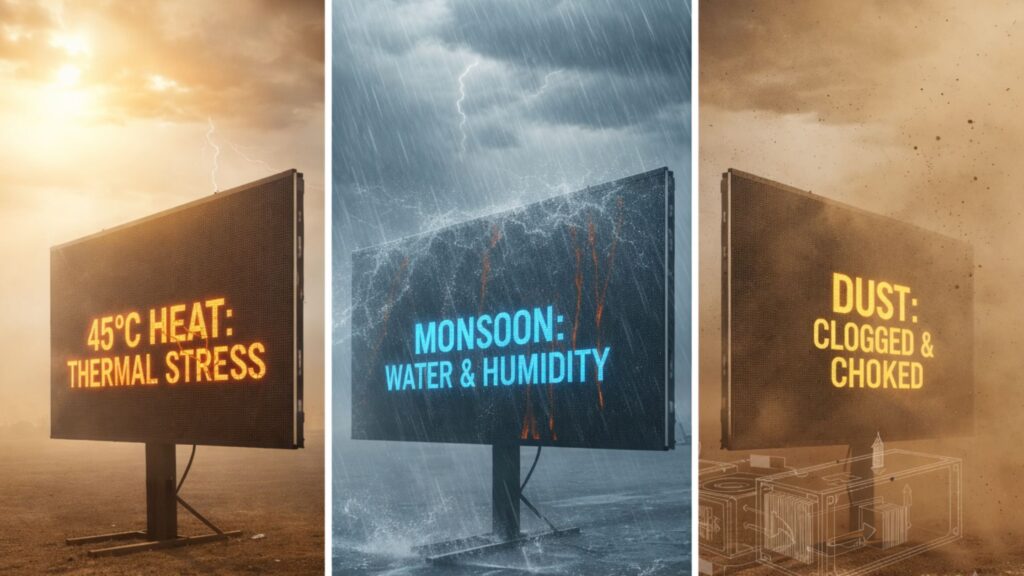
One day it’s 45°C heat.
Next month it’s heavy rain and humidity.
In some regions, there’s dust almost all year.
In coastal cities, there’s salt in the air.
Now imagine a large LED screen running 12–18 hours daily in these conditions. It’s impressive they work at all. But here’s the reality: many large LED screens don’t fail suddenly. They slowly struggle under environmental pressure.
Let’s understand why.
1. Heat Is the Biggest Enemy
Summer in India is intense. When a screen sits under direct sunlight, the internal temperature rises quickly. LED modules, power supplies, and control systems generate their own heat too.
Without proper cooling:
- Brightness starts fluctuating
- Colors look uneven
- Panels may shut down automatically
- Lifespan reduces significantly
Most people blame the brand. But often, it’s poor heat management. Good thermal design makes all the difference.
2. Monsoon Brings More Than Rain
Water is dangerous for any electronic system. Even if rain doesn’t directly hit the screen, moisture in the air can slowly enter weakly sealed cabinets.
Over time, that causes:
- Rusting connectors
- Circuit damage
- Short circuits
And once corrosion starts, performance drops quietly before complete failure. Weather protection is not just about waterproofing. It’s about sealing, coating, and long-term planning.
3. Dust Never Takes a Break
In many Indian cities, dust is part of daily life.
Dust settles inside ventilation areas. It blocks airflow. It traps heat.
Slowly, cooling systems become less effective.
The screen may still run – but under stress.
Dust is one of the most ignored reasons behind LED performance issues.
4. Power Fluctuations During Extreme Weather
Heavy rain, storms, and high electricity demand often cause unstable voltage.
Large LED screens require steady power.
Sudden voltage spikes can damage:
- LED drivers
- Power supplies
- Control boards
Sometimes the screen failure isn’t weather damage – it’s electrical instability. Power planning matters just as much as display quality.
5. Installation That Ignores Local Conditions
Not every installation is done with Indian weather in mind.
Screens placed without shade planning…
No proper airflow gap behind panels…
Weak structural support against wind…
These small decisions show their impact later. The environment should always guide installation design.
6. Cheap Components Struggle Faster
Let’s be honest – cost-cutting happens.
But components built for moderate climates don’t perform well in extreme Indian conditions.
Industrial-grade materials and electronics last longer under pressure.
Long-term reliability starts with what goes inside the cabinet.
Why This Topic Matters
Today, large LED screens are not just advertising tools.
They guide traffic.
Share public announcements.
Update transport schedules.
Support smart city infrastructure.
When they fail, it’s not just inconvenient – it affects communication.
In crowded public spaces, people depend on accurate information.
And accuracy depends on performance.
So How Do We Prevent These Failures?
The answer isn’t complicated. It just requires seriousness.
LED screens in India must be:
- Designed for heat resistance
- Protected against moisture
- Built with dust control in mind
- Connected to stable power systems
- Installed with airflow and structure planning
- Maintained regularly
In short, they must be engineered for real-world Indian conditions – not showroom conditions.
Across malls, highways, metro stations, and public infrastructure, there’s growing awareness that LED displays need more than brightness and resolution. They need durability.
At Vulcan AIC, the focus goes beyond how a screen looks. The focus is on how it performs after months of heat, rain, dust, and heavy usage.
Because in extreme weather, survival isn’t enough.
Consistency is what truly matters.

