
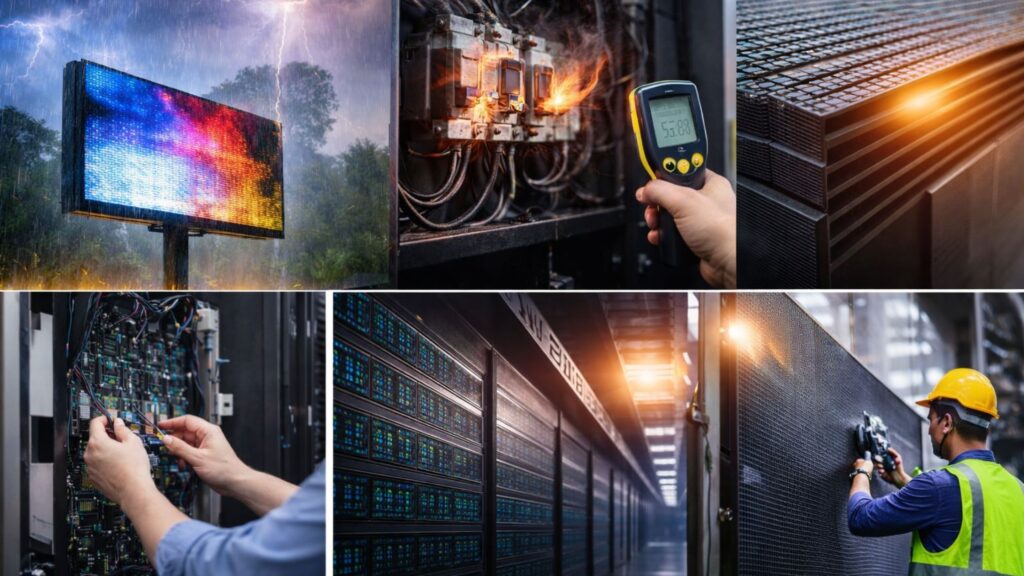
LED displays have become a common part of daily life in India. From metro stations and shopping malls to highways and stadiums, digital screens are everywhere.
They look bright. Smooth. Effortless. But behind every clear and stable LED display, there are several technical factors working silently.
In India especially, environmental conditions, infrastructure challenges, and high public usage make display performance more complex than most people realize.
If you’re planning to install a large LED display – or simply want to understand why some screens perform better than others – these are the top 8 factors that affect LED display performance in India.
1. Extreme Weather Conditions
India’s climate is not easy on electronics.
- High summer temperatures (often above 45°C)
- Monsoon humidity
- Dust storms in some regions
- Coastal salt exposure
Heat directly impacts LED modules and internal circuits. Without proper thermal management, screens can overheat, lose brightness consistency, or shut down automatically.
Weather resistance is not optional in India – it is essential.
2. Power Fluctuations and Voltage Instability
In many cities and semi-urban areas, voltage fluctuations are common.
Large LED video walls require:
- Stable voltage
- Surge protection
- Proper earthing
- Dedicated power lines
Without power stability, control cards and drivers may fail prematurely. Even minor fluctuations over time reduce display lifespan.
Power infrastructure is often the hidden reason behind poor LED performance.
3. Poor Heat Dissipation
LED screens generate heat continuously. In indoor malls, outdoor highways, and stadium installations, continuous operation increases internal temperature.
If:
- Ventilation spacing is poor
- Air circulation is blocked
- Cooling systems are insufficient
Heat builds up. And heat is the silent enemy of LED performance.
4. Low-Quality Components
Not all LED displays are built the same.
Substandard:
- LED drivers
- Power supplies
- Control processors
- Cabinet materials
may reduce upfront cost – but they compromise long-term reliability.
In high-traffic Indian environments, low-grade components show performance issues quickly. Consistency depends on quality engineering.
5. Network and Backend Infrastructure
Modern LED displays are not static.
They run:
- Real-time data
- Advertisement rotations
- Live feeds
- Emergency alerts
If backend servers or network bandwidth are weak, screens may lag, freeze, or show delayed updates. In metro stations or malls, this can create confusion and reduce credibility.
Performance today depends as much on backend systems as on front-end panels.
6. Installation Quality
Even high-quality LED panels can perform poorly if installation is careless.
Common installation issues include:
- Misalignment
- Improper mounting
- Poor cable management
- Inadequate structural support
In India’s high-footfall spaces, vibration and constant usage expose these weaknesses quickly. Engineering precision during installation is critical.
7. Ambient Light and Brightness Calibration
India receives strong natural sunlight for most of the year. Outdoor LED displays must be bright enough to remain visible in daylight – but not so bright that they cause glare at night.
Improper brightness calibration can:
- Reduce visibility
- Cause eye strain
- Increase power consumption
Performance depends on balancing brightness with environment.
8. Lack of Preventive Maintenance
Many LED installations are treated as one-time projects.
Installed once. Forgotten later.
Dust accumulation, firmware updates, loose wiring, and aging components gradually reduce performance.
Regular preventive maintenance ensures:
- Stable brightness
- Proper color calibration
- Early detection of component issues
Maintenance protects investment.
Why LED Display Performance Matters More in India
India is one of the fastest-growing digital infrastructure markets.
Crowded public spaces, smart city projects, and expanding retail hubs mean that LED displays are no longer decorative elements — they are communication infrastructure.
When a display fails:
- Information is delayed
- Advertising impact drops
- Public trust reduces
Performance is directly connected to reputation.
The Real Solution: Engineering for Indian Conditions
Improving LED display performance in India requires more than selecting a high-resolution screen.
It requires:
- Climate-ready design
- Stabilized power systems
- Industrial-grade components
- Advanced heat management
- Scalable backend infrastructure
- Professional installation
- Scheduled maintenance
In other words, it requires system-level thinking.
Across malls, transport hubs, stadiums, and commercial developments in India, there is growing awareness that LED displays must be engineered for long-term reliability – not just short-term visibility.
Behind every stable, high-performing digital screen is a disciplined approach to design, integration, and infrastructure planning.
At Vulcan AIC, we believe LED display systems should be built for real-world conditions – especially in demanding environments like India. Our focus goes beyond brightness and resolution to include backend architecture, structural balance, thermal science, and long-term operational stability.
Because in high-traffic spaces, performance isn’t optional.
It’s expected.

