
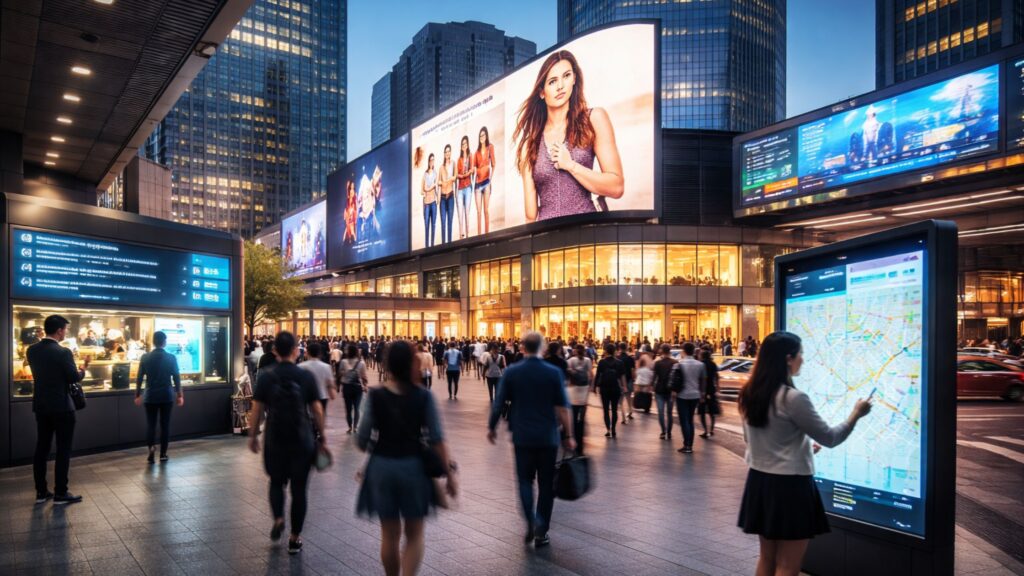
Walk through any metro station, shopping mall, airport, or city highway today. You’ll notice something changing.
Static hoardings – once the king of outdoor advertising – are slowly disappearing. In their place, bright, dynamic, interactive LED screens are taking over.
This is not just a design trend. It’s a shift in how brands communicate in modern cities.
Let’s understand why interactive LED screens are replacing traditional hoardings – and what this means for businesses, infrastructure planners, and urban environments.
The Problem with Traditional Hoardings
For decades, hoardings worked because attention was limited. People noticed whatever stood in front of them.
But today?
Cities are crowded.
Screens are everywhere.
Attention spans are shorter.
A printed hoarding:
- Cannot change in real time
- Cannot adapt to audience behavior
- Cannot measure engagement
- Cannot update instantly
- Cannot interact
It simply displays one message – whether 10 people see it or 10,000. In fast-moving environments, static communication feels outdated.
1. Real-Time Content Updates
Interactive LED screens allow content to change instantly.
Morning rush hour? Show commuter-focused ads.
Evening? Switch to entertainment or retail promotions.
Emergency alert? Broadcast instantly.
Traditional hoardings require reprinting, reinstallation, and manual labor.
LED systems operate through centralized content management systems (CMS), enabling:
- Live updates
- Multiple ads in rotation
- Time-based scheduling
- Geo-targeted messaging
This flexibility gives businesses control that static hoardings simply cannot offer.
2. Higher Attention and Engagement
Bright, high-resolution LED displays naturally attract attention. Movement catches the human eye faster than static visuals.
Interactive screens go even further:
- Touch-enabled panels
- QR code integration
- Motion sensors
- Live social media feeds
Instead of just “seeing” an ad, people interact with it. And interaction increases memory retention. In crowded public spaces like malls and metro stations, engagement matters more than visibility.
3. Data-Driven Advertising
Traditional hoardings operate blindly.
There is no clear data on:
- Who viewed the ad
- How long they looked
- Whether they responded
Interactive LED displays can integrate with:
- Analytics software
- Audience measurement tools
- Engagement tracking systems
This allows advertisers to measure ROI in real time.
In today’s performance-driven world, measurable results win.
4. Smart City Integration
Modern cities are becoming digitally connected ecosystems.
Interactive displays are not just advertising tools anymore. They are:
- Public information boards
- Emergency communication systems
- Wayfinding solutions
- Event announcement platforms
Unlike hoardings, LED screens can switch roles instantly – from brand promotion to public service announcement.
That adaptability makes them valuable infrastructure assets, not just marketing tools.
5. Sustainability and Cost Efficiency Over Time
At first glance, printed hoardings seem cheaper.
However, over time:
- Printing costs add up
- Physical replacements are frequent
- Weather damage reduces lifespan
- Waste generation increases
LED systems eliminate recurring printing costs.
Content updates happen digitally, reducing material waste and operational effort.
As sustainability becomes a priority for urban planners and corporations, digital displays align better with environmental goals.
6. Better Performance in High-Traffic Areas
In places like:
- Metro corridors
- Stadiums
- Airports
- Highways
Crowds fluctuate constantly.
Interactive LED screens are designed for:
- High brightness in daylight
- Wide viewing angles
- Continuous operation
Traditional hoardings fade, tear, and lose impact over time.
Digital systems maintain consistent visual performance.
7. Brand Modernity and Perception
Consumers associate digital technology with innovation.
A brand displayed on a dynamic LED screen appears:
- More premium
- More modern
- More forward-thinking
Static banners feel traditional.
Interactive LED displays signal technological advancement.
In competitive markets, perception matters.
The Bigger Shift: From Advertising to Digital Ecosystems
The real reason interactive LED screens are replacing hoardings is simple:
Communication is no longer one-way.
Cities are evolving into intelligent environments where displays must:
- Inform
- Engage
- Adapt
- Respond
A hoarding speaks. An interactive LED screen communicates.
That difference is redefining urban visual infrastructure.
The Real Solution: Engineering Beyond Brightness
Installing an LED screen is not enough.
For interactive systems to truly replace hoardings, they must be:
- Reliable during peak traffic hours
- Integrated with scalable CMS platforms
- Designed with proper heat management
- Supported by stable power systems
- Built using industrial-grade components
- Installed with precision calibration
Because if a digital screen crashes, flickers, or lags, it loses credibility instantly.
Across India’s growing metro networks, retail hubs, transport terminals, and smart city projects, there is a rising demand for engineered display ecosystems – not just screens.
Behind the seamless visuals people see daily lies serious engineering discipline. At Vulcan AIC, we believe public display systems should move beyond traditional advertising models. They should function as intelligent, resilient communication platforms built for high-traffic environments.
Our approach focuses on system stability, integration architecture, thermal science, structural precision, and long-term operational performance – so that interactive LED displays don’t just replace hoardings, but redefine how cities communicate.
Because in modern infrastructure, visibility is important. But reliability is everything.

